
The Ghent Altarpiece (1432): A Masterpiece by …
Years: 1432 - 1432
The Ghent Altarpiece (1432): A Masterpiece by Hubert and Jan van Eyck
The Ghent Altarpiece, a monumental polyptych consisting of twenty panels, was executed in 1432 for the Church of St. Bavo in Ghent. The altarpiece bears an incomplete Latin inscription, naming Hubert and Jan van Eyck as its artists, though the precise role of Hubert remains debated among scholars.
This groundbreaking work of early Netherlandish painting is one of Jan van Eyck’s first major commissions and remains one of the most famous and controversial altarpieces in art history.
I. The Attribution Controversy: The Role of Hubert and Jan van Eyck
- The Latin inscription on the altarpiece suggests that Hubert van Eyck began the work and that Jan completed it after his brother’s death on September 18, 1426.
- However, scholarly opinions differ:
- One theory holds that Hubert was Jan’s older brother and an accomplished painter who laid out the composition, while Jan finished the painting.
- Another theory suggests that Hubert was not Jan’s brother and was instead a sculptor, possibly responsible for designing an elaborate frame for the altar rather than contributing to the painting.
- The varying scale and style among the panels have fueled debates over whether different artists worked on the piece.
II. The Exterior Panels: Grisaille and Portraits
- The exterior panels depict:
- The donor, Jodocus Vijdt, and his wife, kneeling in prayer.
- Saint John the Baptist and Saint John the Evangelist in grisaille, a technique that uses shades of gray to mimic sculpture.
- Above them, an Annunciation scene, demonstrating Jan van Eyck’s mastery of perspective and light.
III. The Interior: The Adoration of the Holy Lamb
- When opened, the altarpiece reveals a vivid, multi-panel composition, culminating in the central interior panel, The Adoration of the Holy Lamb.
- This panel is dominated by a radiant scene of the Lamb of God, symbolizing Christ’s sacrifice, surrounded by angels, saints, and clergy in a lush, highly detailed landscape.
- The altarpiece’s interior is known for its stunning color, realism, and intricate symbolism, showcasing Jan van Eyck’s groundbreaking use of oil paint.
IV. Legacy and Artistic Significance
- The Ghent Altarpiece is considered one of the greatest masterpieces of Northern Renaissance art.
- It demonstrates Jan van Eyck’s unparalleled skill in realism, light, and texture, solidifying his role as a pioneer of oil painting.
- The altarpiece has survived wars, thefts, and restorations, including a notorious theft in 1934, making it one of the most studied and admired works in Western art history.
The Ghent Altarpiece (1432) remains a defining work of early Netherlandish painting, not only for its technical brilliance and rich symbolism but also for the enduring mystery of its attribution and creation.
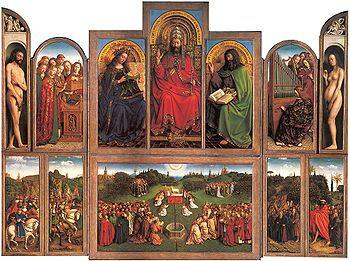
Opened view of the polyptych.
Locations
People
Groups
Topics
Subjects
Regions
Subregions
Years: 1432 - 1432
Opened view of the polyptych.
Locations
People
Groups
Topics
Subjects
Regions
Subregions