
Omri's conquest of Moab is known from …
Years: 861BCE - 850BCE
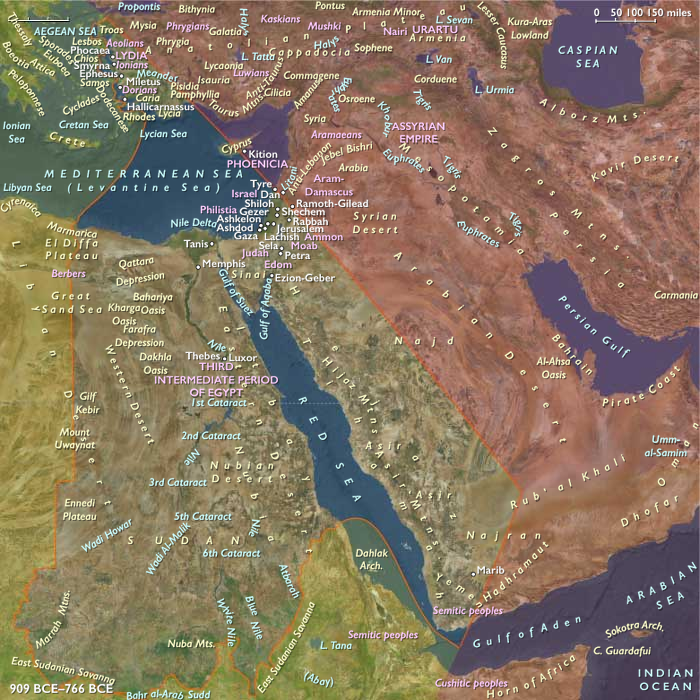
Omri's conquest of Moab is known from the Moabite Stone, a black basalt stone, 1.1 meters (forty-four inches) high, discovered at Dhiban in 1868 and now in the Louvre Museum in Paris.
The Moabite king Mesha erected this stela about forty years after the event in the city of Dibon (modern Dhiban, Jordan).
The stone's text of thirty-four lines, written in a Canaanite alphabet similar to contemporary Hebrew, is the only written document of any length that survives from Moab and the only royal stela known from Israel's neighbors.
In its inscription, Mesha, who flourished around 850, tells of Omri's reconquest of Moab and ascribes the renewed Israelite domination over Moab to the anger of Chemosh.
Mesha then describes his own successful rebellion against Israel, which probably occurs during the reign of Omri's successor, Ahab.
The Moabite Stone, whose story parallels, with some differences, an episode in the bible's Books of Kings (2 Kings 3:4-8), provides invaluable information on the Moabite language and the political relationship between Moab and Israel at one moment in the ninth century BCE.
It is the most extensive inscription ever recovered that refers to the kingdom of Israel (the "House of Omri"), it bears the earliest certain extra-biblical reference to the Israelite god Yahweh, and, if French scholar André Lemaire's reconstruction of a portion of line 31 is correct, the earliest mention of the "House of David" (i.e., the kingdom of Judah).
Thomas L. Thompson (The Bible in History), however, interprets the Mesha stele as suggesting that Omri is an eponym, or legendary founder of the kingdom rather than an historical person.
Most archaeologists reject this interpretation, seeing Omri as historical.
Assyrian kings frequently referred to Omri's successors as belonging to the "House of Omri" (Bit Hu-um-ri-a).
Locations
People
Groups
Topics
Commodoties
Subjects
- Commerce
- Language
- Writing
- Environment
- Labor and Service
- Conflict
- Faith
- Government
- Technology
- Archaeology
Regions
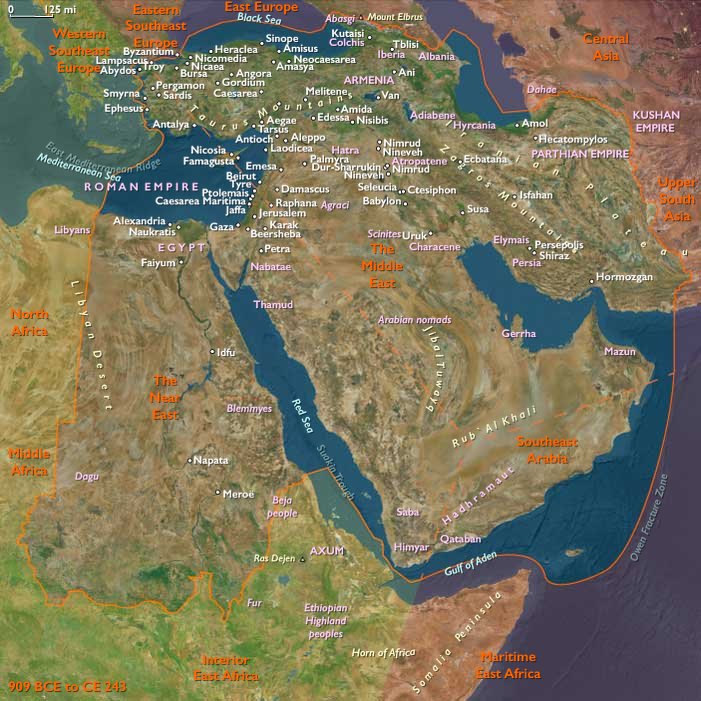
Subregions
Years: 861BCE - 850BCE
Locations
People
Groups
Topics
Commodoties
Subjects
- Commerce
- Language
- Writing
- Environment
- Labor and Service
- Conflict
- Faith
- Government
- Technology
- Archaeology
Regions
Subregions