
Muslim countries of the Middle East have …
Years: 1396 - 1539
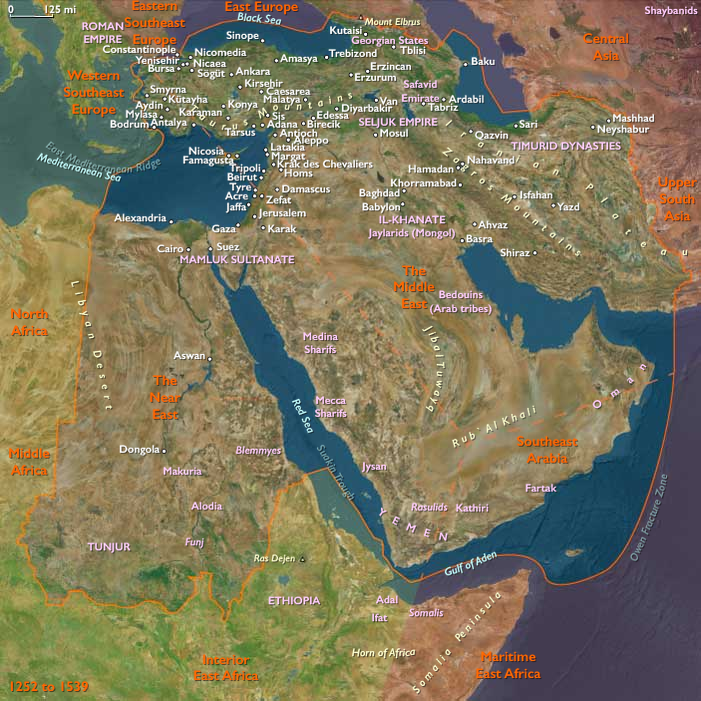
Muslim countries of the Middle East have controlled East-West trade during the Middle Ages.
Control changes in the fifteenth century, however.
The Portuguese, who are building ships with deep hulls that remain stable in high seas, are thereby able to make longer voyages.
They push farther and farther down the west coast of Africa until they find their way around the southern tip of the continent and make contact with Muslim cities on the other side.
In East Africa, the Portuguese enlist Arab navigators there to take them across to India, where they eventually set themselves up in Calicut on the Malabar Coast.
Once in India, the Portuguese use their superior ships to transport goods around Africa instead of using the Red Sea route, thus eliminating the middlemen in Egypt.
The Portuguese then extend heir control to the local trade that crosses the Arabian Sea, capturing coastal cities in Oman and Iran and setting up forts and customs houses on both coasts to collect duty.
The Portuguese allow local rulers to remain in control but collect tribute from them in exchange for that privilege, thus increasing Portuguese revenues.
Groups
- Iranian peoples
- Arab people
- Omanis
- Persian people
- Islam
- Muslims, Sunni
- Muslims, Kharijite
- Muslims, Shi'a
- Muslims, Ibadi
- Ismailism
- Portuguese people
- Qarmatians
- Ormus, Kingdom of
- Portugal, Avizan (Joannine) Kingdom of
- Portuguese Empire
- Persia, Safavid Kingdom of
- Ormus, kingdom of (Portuguese-occupied)
Topics
Subjects
Regions
Subregions
Years: 1396 - 1539
Groups
- Iranian peoples
- Arab people
- Omanis
- Persian people
- Islam
- Muslims, Sunni
- Muslims, Kharijite
- Muslims, Shi'a
- Muslims, Ibadi
- Ismailism
- Portuguese people
- Qarmatians
- Ormus, Kingdom of
- Portugal, Avizan (Joannine) Kingdom of
- Portuguese Empire
- Persia, Safavid Kingdom of
- Ormus, kingdom of (Portuguese-occupied)
Topics
Subjects
Regions
Subregions