Olybrius is elected Roman consul by the …
Years: 464 - 464
Olybrius is elected Roman consul by the Eastern court in Constantinople.
Locations
People
Groups
Topics
Commodoties
Subjects
Regions
Subregions
Related Events
Filter results
Showing 10 events out of 58603 total
The Civil War and Consolidation of the Suebi Kingdom
Throughout the mid-fifth century, the Suebi in Galicia endure a period of civil war and internal fragmentation, as their kingdom operates under a diarchy, with rival factions vying for control. The situation is further complicated by ongoing conflicts with the native Gallo-Roman population, leading to widespread unrest.
The End of Civil War: The Rise of Remismund (464 CE)
In the south, after the death of King Maldras, his faction continues under Frumar, but his rule is short-lived. By 464 CE, Frumar’s death brings an end to this prolonged period of internal strife, paving the way for a unified Suebi ruleunder Remismund, a figure with both diplomatic and military experience.
Remismund’s Diplomatic and Military Acumen
- An Experienced Diplomat – Before becoming king, Remismund had served as an ambassador, traveling between Galicia and Gaul, likely engaging in negotiations with the Visigoths and maintaining ties with various factions.
- Unifying the Suebi – As king, he successfully unites the divided Suebi factions, restoring internal stability and consolidating his authority.
- Relations with the Visigoths – His rule gains recognition—perhaps even approval—from Theodoric II, king of the Visigoths, who sends him gifts and weapons, further legitimizing his reign. Additionally, Theodoric strengthens ties by arranging for Remismund to marry a Gothic princess, reinforcing a Visigothic-Suebi alliance.
The Restoration of Order in Galicia
With his rule secured, Remismund restores peace to the Suebi kingdom, ensuring its continued survival in the post-Roman world. Under his leadership, the Suebi maintain their autonomy in Galicia, though they remain under the shadow of the powerful Visigothic Kingdom, which will later dominate much of the Iberian Peninsula.
The Mysterious Death of Aegidius (464 CE)
Aegidius, the last Roman commander in northern Gaul, continues to rule the Domain of Soissons until his death in 464 CE, though the exact circumstances surrounding it remain uncertain and debated.
Diplomatic Engagements Before His Death
According to the chronicler Hydatius, Aegidius sends an embassy to the Vandals via the Atlantic in May 464, suggesting that he is actively seeking alliances or reinforcements against growing threats in Gaul. Hydatius likely learns of this mission when the ships carrying the embassy pass Gallaecia on their way south.
Conflicting Accounts of His Death
- Poison or Assassination – Hydatius also records Aegidius' death later in 464, attributing it to either poison or an ambush. Some speculate that his murder may have been orchestrated by one of Childeric I’s enemies, possibly a rival seeking to undermine the Gallo-Roman-Frankish alliance.
- Plague – Gregory of Tours, writing centuries later, offers a different explanation, implying that Aegidius died of the plague, which may reflect a contemporary belief rather than verified fact.
- Violent End – Given the instability of the time, it is equally plausible that Aegidius fell in battle or was assassinated by a political adversary, perhaps by agents of the Visigoths or rival Gallo-Roman factions.
Aegidius’ Legacy and the Fate of Soissons
- His death marks a turning point for the Domain of Soissons, which remains the last bastion of Roman rule in Gaul.
- His son, Syagrius, succeeds him, continuing to rule independently until 486 CE, when Clovis I of the Franks conquers the region, marking the final collapse of Roman authority in Gaul.
- His alliance with Childeric I and his campaigns against the Saxons foreshadow the growing Frankish dominance in northern Gaul.
Regardless of the exact cause of his demise, Aegidius’ rule represents the last vestiges of Roman resistance in an empire that is rapidly crumbling, and his death accelerates the transformation of Gaul into a land ruled by barbarian successor states.
Childeric I and the Struggle for Power in Northern Gaul (464–465 CE)
Following the death of Aegidius in 464, the political and military balance in northern Gaul remains precarious. As various factions compete for dominance, Childeric I, king of the Salian Franks, emerges as a key player, assisting the Gallo-Romans in resisting both Visigothic and Saxon incursions.
The Battle Against the Visigoths and the Death of Count Paul
- After Aegidius’ death, Count Paul of Angers, a Gallo-Roman officer, continues the fight against external threats.
- Childeric, leading a mixed force of Franks and Gallo-Romans, joins Paul in raiding and defeating a Visigothic force, likely in central Gaul, taking substantial booty in the process.
- This victory underscores the fragile alliance between the Franks and remaining Roman forces, who are still resisting the spread of Visigothic power in the region.
The Saxon Raid on Angers and Childeric’s Response
- Around this time, Saxon raiders, led by a certain Adovacrius (possibly Odoacer, later king of Italy, but this remains uncertain), attack Angers.
- Childeric arrives the next day, engaging the Saxons in battle.
- Count Paul is killed, but Childeric ultimately captures Angers, demonstrating Frankish military strength in the Loire Valley.
The Rise of Syagrius in Soissons
With Aegidius dead and Roman authority further weakening, his son Syagrius assumes control of the Domain of Soissons, using the title dux (a provincial military commander). Unlike his father, Syagrius rules as an independent authority rather than as an imperial governor, as the Western Roman Empire is collapsing rapidly.
A Critical Moment in Frankish and Gallo-Roman Relations
- Childeric's interventions in Angers and beyond position the Franks as dominant power brokers in northern Gaul, even as they continue to cooperate with Gallo-Roman forces.
- Syagrius’ governance of Soissons represents the last vestige of Roman rule in Gaul, but his authority will be short-lived—by 486 CE, Clovis I will defeat him, marking the final fall of Roman Gaul.
- The battle for control of Gaul is increasingly shifting from a struggle between Romans and barbarians to a contest among successor states, with the Franks emerging as the most powerful force in the region.
Childeric’s victories and alliances pave the way for Frankish expansion under Clovis I, solidifying the transition from Roman rule to the early medieval Frankish Kingdom.
Childeric I’s Pursuit and Massacre of the Saxons
Following his victory at Angers, Childeric I, king of the Salian Franks, does not stop at merely securing the city. Determined to eliminate the Saxon threat, he pursues the fleeing Saxon war band to the islands at the Atlantic mouth of the Loire River. Once he corners them, he massacres the remaining Saxons, effectively eradicating their presence in the region—at least temporarily.
This decisive campaign:
- Secures Frankish dominance over the lower Loire Valley.
- Reinforces Childeric’s reputation as a ruthless and effective military leader.
- Demonstrates his ability to project power beyond traditional Frankish territory.
A Change of Alliances: Childeric and Odoacer Against the Alamanni
Despite his earlier conflicts with Saxon forces, Childeric soon shifts his alliances. According to Gregory of Tours, Childeric joins forces with Odoacer, the future king of Italy, to repel an invasion of the Alamanni, who threaten to push southward into Italy.
This cooperation suggests that:
- Childeric is now engaging in broader European conflicts, extending Frankish influence beyond Gaul.
- Odoacer, a rising power in Italy, sees the Franks as a valuable ally against common threats.
- The Alamanni remain a persistent destabilizing force, as various groups continue to migrate and seek new lands.
Childeric’s Expanding Influence
Through these campaigns, Childeric strengthens Frankish power:
- He defends the western reaches of Gaul against Saxon incursions.
- He plays a role in continental politics, allying with Odoacer against the Alamanni, showing that the Franks are no longer just a regional power.
- He sets the stage for his son, Clovis I, to consolidate Frankish rule and expand Francia even further, ultimately shaping the foundation of medieval Europe.
The northern parts of China after the decline of the Jin Dynasty had come under the control of the Northern Wei, who made the city of Pingcheng, now known as Datong, their capital.
Due to its promotion, Pingcheng saw an increase in construction work.
The Northern Wei had early adopted Buddhism as their state religion.
Buddhism had arrived in this location via travel on the ancient North Silk Road, the northernmost route of about twenty-six hundred kilometers in length, which connects the ancient Chinese capital of Xi'an to the west over the Wushao Ling Pass to Wuwei and emerging in Kashgar before linking to ancient Parthia.
A sectarian movement within the Buddhist religion called Chan (or Ch'an, a Chinese attempt to render the Sanskrit word for meditation, “dhyana”), emphasizing the practice of meditation as the means to enlightenment, becomes distinct in East Asia, flourishing here.
Bodhidharma, a master of this text known as the Lankavatara Sutra, reportedly arrives there from India in about 470 and becomes the first Chan patriarch in China.
He stresses the practice of contemplative sitting (and, according to legend, spends nine years in meditation facing a wall).
Bodhidharma is primarily active in the lands of the Northern Wèi Dynasty (386–534).
Modern scholarship dates him to about the early fifth century.
The Yungang Grottoes, Chinese Buddhist temple grottoes near the city of Datong in the province of Shanxi,are excellent examples of rock-cut architecture and one of the three most famous ancient Buddhist sculptural sites of China.
The others are Longmen and Mogao.
The work on this first period of carving lasts until the year 465, and the caves are now known as caves 16–20.
Chinese monumental stone sculpture becomes a tradition.
In the caves of Yungang (“Cloud Hill”), artisans begin the series of rock-cut shrines that contain a 45-foot sculpture of the Buddha.
The earliest caves reflect Central Asian and Gandharan influences, notably that of Afghanistan’s fourth-century Bamian cave-temples.

The Council of Vannes and the Increasing Exclusion of Jews (465 CE)
In 465 CE, the Council of Vannes, held in Gaul, issues a decree explicitly prohibiting Christian clergy from participating in Jewish feasts. This decision is part of a broader trend in late Roman and early medieval Christendom, aimed at increasing the separation between Jewish and Christian communities.
The Context of Religious Exclusion
By the mid-fifth century:
- The Western Roman Empire is collapsing, but Christian bishops remain powerful figures, filling the void left by weakened imperial administration.
- The Church is growing more institutionalized, and councils such as Vannes seek to define orthodoxy and enforce religious boundaries.
- Previous legislation, such as in the Theodosian Code, had already placed legal and economic restrictions on Jewish communities, reflecting an increasingly hostile stance.
Impact of the Decree
- The prohibition reinforces Jewish exclusion from Christian society, ensuring that Christian clergy do not engage with Jewish religious life.
- It signals a tightening of Church control over its members, emphasizing a growing anti-Jewish sentiment in Church doctrine.
- This kind of clerical restriction will later evolve into broader societal laws, further marginalizing Jewish communities in medieval Europe.
The Council of Vannes is part of a larger movement that will culminate in the full legal and social segregation of Jews in later medieval Christendom. It reflects the transition from the religious pluralism of the Roman world to the more exclusionary policies of post-Roman Christian societies.
Emperor Libius Severus, reigning a little under four years, dies on August 15, 465.
Ricimer, de facto ruler of the Western Empire, establishes political control from his residence in Rome.
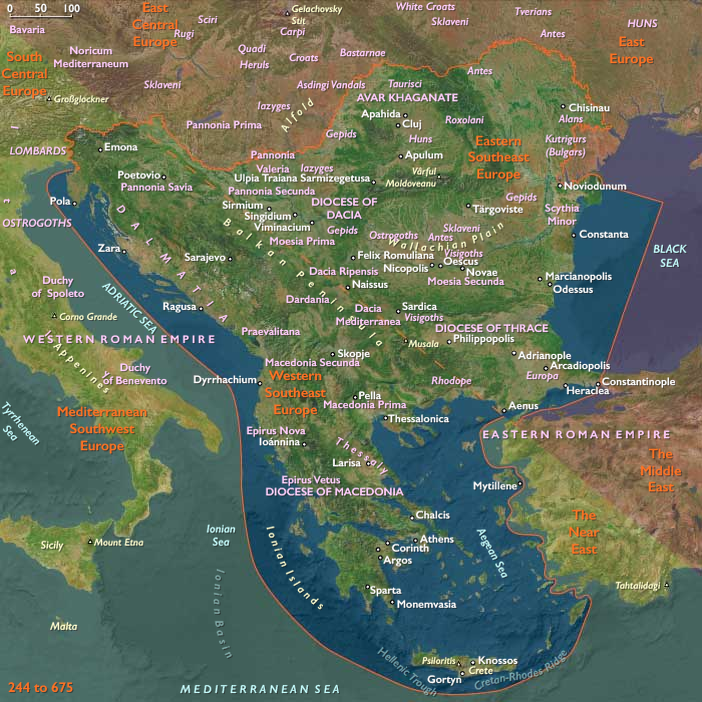
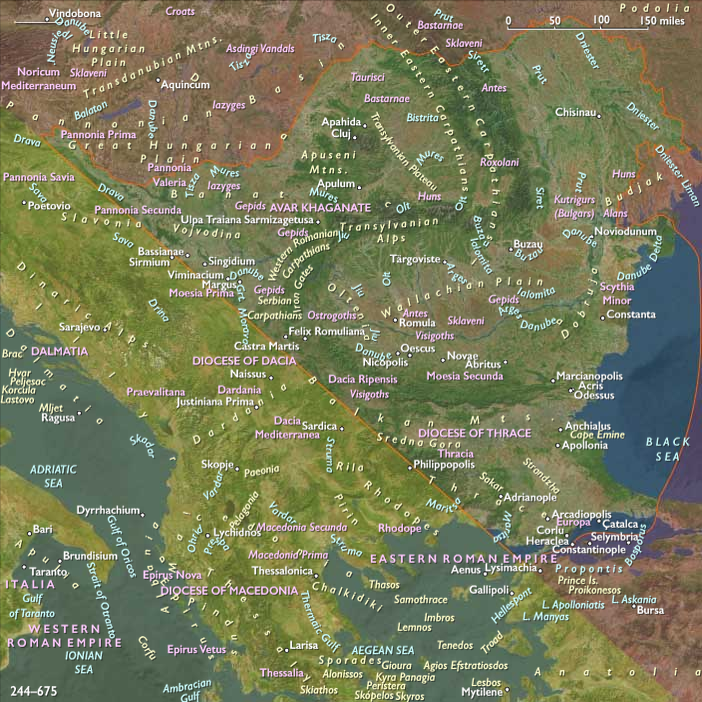
Emperor Leo I repels a Hunnish invasion of Dacia (modern Romania): they ravage the Balkans but are unable to take Constantinople thanks to the city walls, which are rebuilt and reinforced.
Not content to be Aspar's puppet, Leo has begun to rely increasingly on his Isaurian supporters, led by one Tarasis.
According to ancient sources, the earliest reference to Tarasis dates back to 464, when he put his hands on some letters written by Aspar's son, Ardabur, which proved that the son of the magister militum had incited the Sassanid King to invade Roman territory, promising to support the invasion.
Through these letters, which Tarasis gave to Leo, the Emperor could dismiss Ardabur, who at this time is magister militum per Orientem and patricius, thus reducing Aspar's influence and ambition.
As reward for his loyalty, which Leo praises with Daniel the Stylite, Tarasis had been appointed comes domesticorum, an office of great influence and prestige.
This appointment could mean that Tarasis had been a protector domesticus, either at Leo's court in Constantinople, or attached at Ardabur's staff in Antioch.
Leo and Aspar had quarreled in 465, about the appointment of consuls for the following year; it was in this occasion that Tarasis' position had been strengthened, as he had become friend and ally of the Emperor.
Tarasis comes in 466 with evidence that Aspar's son, Ardabur, the magister militum, is forming a conspiracy against Leo I. Ardabur is arrested for treason.
To make himself more acceptable to the Roman hierarchy and the population of Constantinople, Tarasis adopts the Greek name of Zeno; he will use it for the rest of his life.
King Theodoric II is killed by his younger brother Euric, who succeeds him on the throne.
Upon becoming king, Euric defeats several other Visigothic kings and chieftains in a series of civil wars and soon became the first ruler of a truly unified Visigothic nation.
Euric sends an embassy to the Eastern Roman Empire for recognition of the Visigoth sovereignty, and forms an alliance with the Suebi and the Vandals.
With his capital at Toulouse, Euric inherits a large portion of the Visigothic possessions in the Aquitaine region of Gaul, an area that has been under Visigothic control since 415.
Euric conquers Hispania and the harbor city of Marseille in southern Gaul, adding them to the existing Visigothic Kingdom.