
Olmec civilization, centered on the southern Gulf …
Years: 1197BCE - 1054BCE
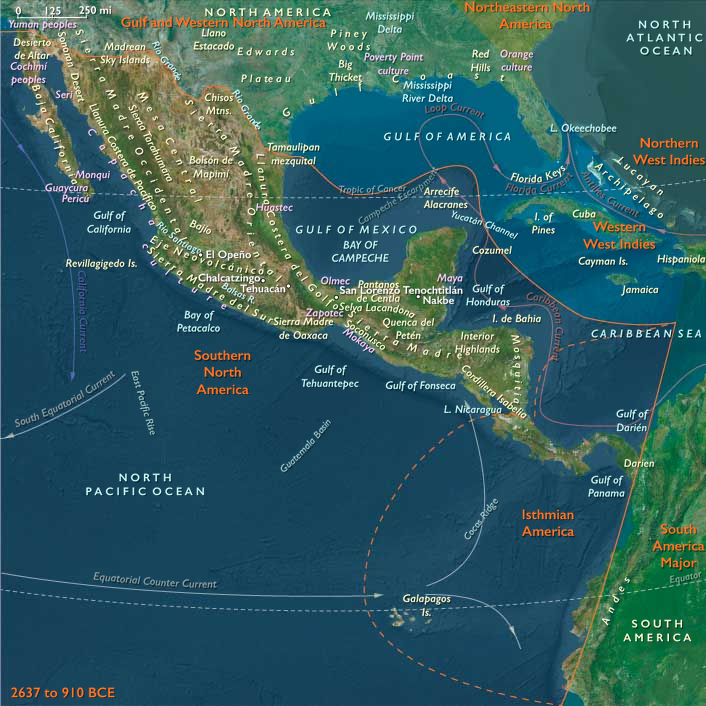
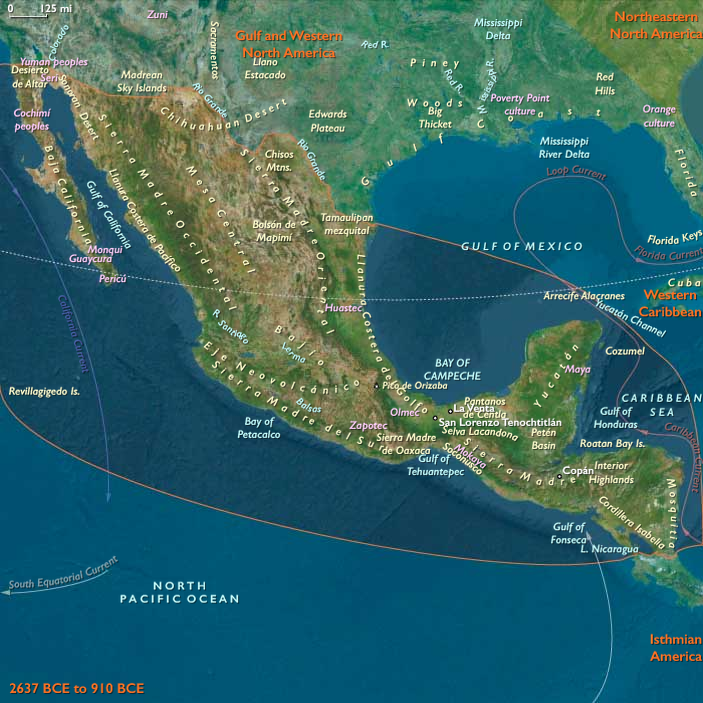
Olmec civilization, centered on the southern Gulf Coast of Mexico, is by 1200 BCE fully developed at San Lorenzo, the first great civic and ceremonial center in North America.
San Lorenzo seems to have been largely a ceremonial site, a town without city walls, centered in the midst of a widespread medium-to-large agricultural population.
The ceremonial center and attendant buildings could have housed fifty-five hundred while the entire area, including hinterlands, could have reached thirteen thousand.
Dominating trade routes that extend from the present Mexican state of Guerrero to present Costa Rica, passing through Maya regions, the Olmecs build massive public works projects, including clay building platforms, stone pavements and drainage systems.
Built on some seven hundred hectares of high ground between then-active tributaries, the core of San Lorenzo covers fifty-five hectares that are further modified through extensive filling and leveling; by one estimate half-a-million to two million cubic meters of earthen fill were needed, moved by the basketload.
San Lorenzo also boasts an elaborate drainage system using buried, covered, and channeled stones as a type of "pipe.” It is thought that while San Lorenzo controlled much of, if not all, the Coatzacoalcos basin, areas to the east (such as the area where La Venta will rise to prominence around 900 BCE) and north-northwest (such as the Tuxtla Mountains) were home to independent polities.
The Olmec culture was first defined as an art style, and this continues to be the hallmark of the culture.
Wrought in a large number of media—jade, clay, basalt, and greenstone among others—much Olmec art, such as the Wrestler, is surprisingly naturalistic.
Other art, however, reveals fantastic anthropomorphic creatures, often highly stylized, using an iconography reflective of a religious meaning.
Common motifs include downturned mouths and a cleft head, both of which are seen in representations of were-jaguars.
Locations
Groups
Topics
Subjects
Regions
Subregions
Years: 1197BCE - 1054BCE
Locations
Groups
Topics
Subjects
Regions
Subregions