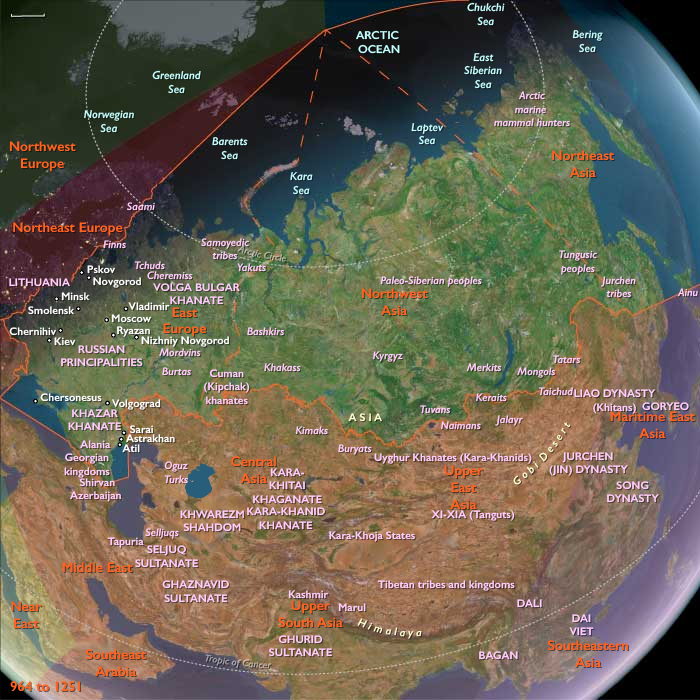
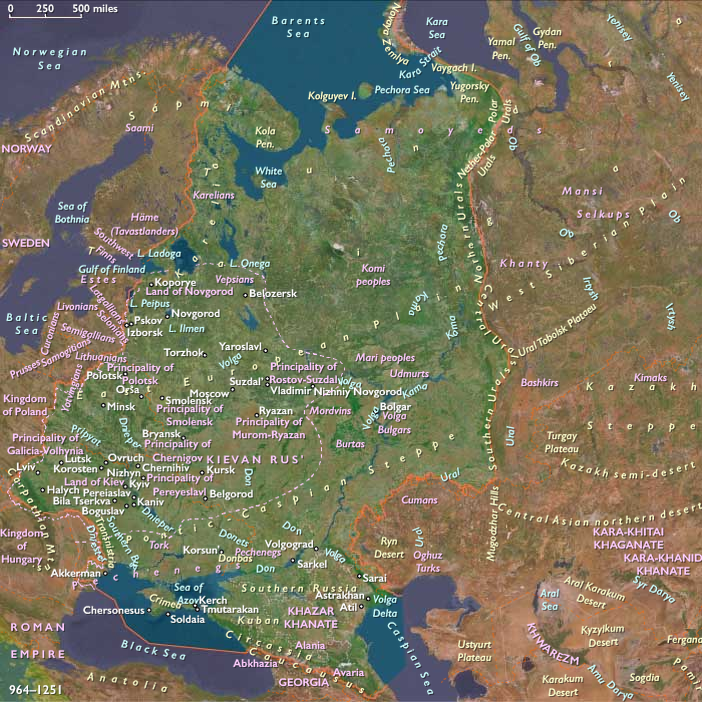
Oleg, one of the sons of Sviatoslav …
Years: 1076 - 1076
Oleg, one of the sons of Sviatoslav II of Kiev, had been named after his grand uncle.
In the 1070s, he rules the towns of Rostov and …
Locations
People
Groups
- Slavs, East
- Rus' people
- Novgorod, Principality of
- Bohemia, Duchy of
- Kievan Rus', or Kiev, Great Principality of
- Cumania (Cuman-Kipchak confederation)
- Cuman people, or Western Kipchaks, also called Polovtsy, Polovtsians)
Commodoties
Subjects
Regions
Subregions
Related Events
Filter results
Showing 10 events out of 50657 total
Dai Viet, formerly Annam (’Pacified South’) to the Chinese, is flourishing under the Ly dynasty.
Vietnamese general Ly Thurong Kiet was born into an Ngo family in Thang Long, the capital of Dai Viet.
His original name was Ngo Tuấn.
His father had been a low-ranking general.
In 1036, he had served the Emperor as a captain in cavalry and later led the imperial guard force.
Because of his bravery, intelligence and loyalty, he had been granted a royal name, Ly Thurong Kiet, and given an important position in the Court.
Wang Anshi, the Song Dynasty prime minister, had told Emperor Shenzong in 1075 that Dai Viet was being destroyed by Champa, with less than ten thousand soldiers surviving, hence it would be a good occasion to annex Dai Viet.
The Song emperor had mobilized troops and passed decrees to forbid all the provinces to trade with Dai Viet.
Upon hearing the news, the Ly ruler had sent Ly Thurong Kiet and Nung Ton Dan with more than one hundred thousand troops to China to carry out a preemptive attack against the Song Dynasty troops.
In the ensuing forty-day battle near modern-day Nanning, the Dai Viet troops had been victorious, capturing the generals of three Song armies.
Ly Thurong Kiet had fought a war with the Cham in 1069, and in 1076 the Song dynasty calls on the Khmer Empire and Champa to go to war again in 1076.
At the same time, the Song commander Guo Kui leads the combined Song force of approximately one hundred thousand men against Ly.
The Song quickly regains Quang Nguyen prefecture and in the process captures the resistance leader Lưu Ky.
Wang Anshi's New Policies Group (Xin Fa), also known as the 'Reformers', are opposed by the ministers in the 'Conservative' faction led by the historian and Chancellor Sima Guang.
As one faction supplants another in the majority position of the court ministers, it demotes rival officials and exiles them to govern remote frontier regions of the empire.
One of the prominent victims of the political rivalry, the famous poet and statesman Su Shi, is jailed and eventually exiled for criticizing Wang's reforms.
The tide has tilted in favor of the conservatives due to renewed foreign conflict.
Like many Chinese officials of the era, Wang's career has experienced many ups and downs, but the beginning of the end had come in 1074.
A famine in northern China had driven many farmers off their lands, their circumstances made worse by the debts they had incurred from the seasonal loans granted under Wang’s reform initiatives.
Local officials insist on collecting on the loans as the farmers were leaving their land.
The empress dowager is also an opponent of Wang, who is blamed for the crisis.
Wang wanted to resign, but the emperor had supported him, giving him high honors and an appointment to Jiangning (present-day Nanjing.)
He had been recalled by the emperor in 1075, but now he is seen as vulnerable and is openly attacked from groups of conservatives.
Wang returns to Nanjing, which he prefers to Kaifeng, to write and engage in scholarship through to his death in 1086.
With Shenzong's death in 1085, the New Policies will be rolled back—some temporarily, some permanently.
Thurong Kiet and Nong Tong Dan defeat the Song militia of Yongzhou in the early spring of 1076, , and during a battle at Kunlun Pass, their forces behead the Governor-General of Guangnan West Circuit, Zhang Shoujie.
After a forty-two day siege, Yongzhou is breached and razed to the ground.
When Song forces attempt to challenge Ly's forces, the latter retreat with their spoils of war and thousands of prisoners.
Much of Wang Anshi's reforms outlined in the New Policies center around state finance, land tax reform, and the Imperial examinations, but there are also military concerns.
This includes policies of raising militias to lessen the expense of upholding a million soldiers, putting government monopolies on saltpeter and sulfur production and distribution in 1076 (to ensure that gunpowder solutions will not fall into the hands of enemies), and aggressive military policy towards China's northern rivals of the Western Xia and Liao dynasties.
Russian scribes compile the so-called Izbornik Sviatoslava in 1076 at the request of Sviatoslav II.
One of the oldest relics of the Old East Slavic language, the book is a compilation of articles on grammar, logic, poetics, church matters, sermons, riddles, and parables.
One of the miniatures represents Sviatoslav himself, standing with his second wife Oda and sons.
…Lutsk, whence he makes a raid into Bohemia in 1076.
The Seljuq sultan Malik Shah I surges into Georgia in 1076 and reduces many settlements to ruins.
Vikramaditya VI has undermined his elder brother, Somesvara II of the Western Chalukyas, by winning the loyalty of the Chalukya feudatories: the Hoysala, the Seuna and the Kadambas of Hangal.
Anticipating a civil war, Somesvara II seeks help from Vikramaditya VI's enemies, Kulothunga Chola I and the Kadambas of Goa.
In the ensuing conflict of 1076, Vikramaditya VI emerges victorious and proclaims himself king of the Chalukya empire.
Vikramaditya, the brother of Somesvara II, the eldest son of Somesvara I, had started planning the new king's overthrow as soon as ascended the throne of the Western Chalukya dynasty.
After entering into negotiations with the Chola king Virarajendra Chola, Vikramaditya consents to rule the Vengi kingdom as the Chola feudatory.
Virarajendra also forces Somesvara to bifurcate his kingdom and let Vikramaditya rule the southern half (Gangavadi) independently.
Vikramaditya marries one of Virarajendra's daughters to strengthen the alliance with the Cholas.
During this time Virarajendra Chola had died in 1070 and his son Athirajendra Chola had succeeded to the throne.
Vikramaditya had soon found his Chola alliance a liability.
Rajendra Chalukya (future Kulothunga Chola I), a Vengi prince with close Chola connection, having been denied his rightful place on the Vengi throne by Vikramaditya, wants to assume the Chola throne instead.
Rajendra Chalukya has his opportunity when civil disturbances arise in the Chola kingdom.
To quell rioting in Kanchipuram, Vikramaditya leads his forces into the city to assist his brother-in-law Athirajendra.
Vikramaditya soon after proceeds to the Chola capital and helps Athirajendra inaugurate his reign and to defeat any attempts by Rajendra Chalukya to overthrow the rightful Chola king.
Satisfied that order had been restored, Vikramaditya had returned to his capital.
But news soon came to him that Athirajendra had been murdered in the civil uprising and Rajendra Chalukya had assumed the Chola throne under the title Kulothunga Chola I. Vikramaditya now found enemies on both sides of his domain: Kulothunga in the south and his brother in the north.
Vikramaditya has spend the past six years in protecting himself from this dangerous situation.
He had continued to undermine the position of his brother Somesvara by inducing Somesvara's feudatories to desert him.
Finally with the help of the Seuna, the Hoysalas and the Kadambas of Hangala, Someshwara II is defeated and Vikramaditya assumes sovereignty in 1076.
He marks his accession to the throne by founding the new era called Chalukya Vikram Era.

Demetrius Zvonimir is crowned on October 8, 1076 at Solin in the Basilica of Saint Peter and Moses (known today as the Hollow Church) by a representative of Pope Gregory VII (1073-1085).
After the Papal legate crowns him, …
Years: 1076 - 1076
Locations
People
Groups
- Slavs, East
- Rus' people
- Novgorod, Principality of
- Bohemia, Duchy of
- Kievan Rus', or Kiev, Great Principality of
- Cumania (Cuman-Kipchak confederation)
- Cuman people, or Western Kipchaks, also called Polovtsy, Polovtsians)