Offa of Mercia founds an abbey at …
Years: 793 - 793
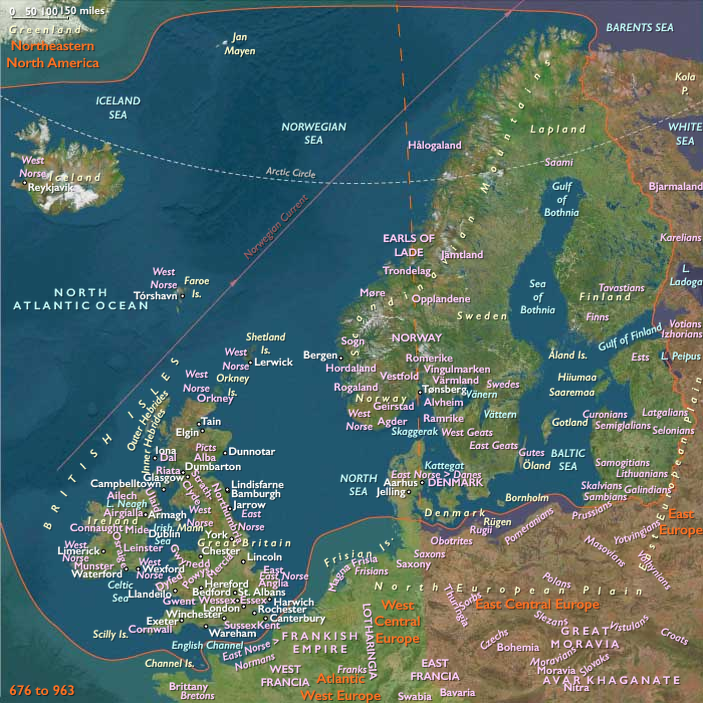
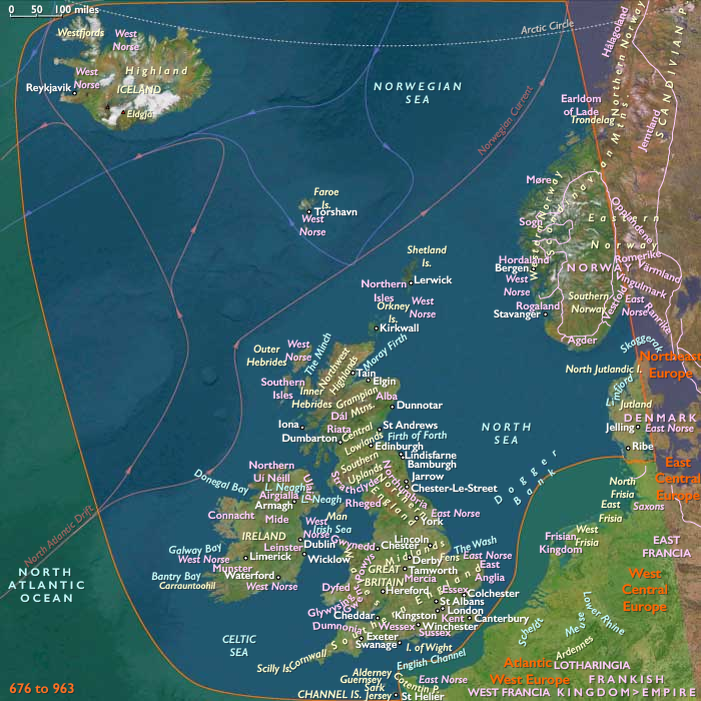
Offa of Mercia founds an abbey at Verulanium, later St. Albans.
Locations
People
Groups
Topics
Commodoties
Subjects
Regions
Subregions
Related Events
Filter results
Showing 10 events out of 54964 total
Irene's iconodule policies alienate many among the themal troops, who are still loyal to the memory of the great warrior emperor, Constantine V. In an effort to maintain her popularity among the monkish defenders of the icons and with the population of Constantinople, she rebates taxes to which these groups are subject; she also reduces the customs duties levied outside the port of Constantinople, at Abydos and Hieros.
The consequent loss to the treasury weighs even more severely since victories won by the Arabs in Asia Minor in 781 and by the Bulgarians in 792 have led both peoples to demand and receive tribute as the price of peace.
A movement develops in favor of his Constantine’s uncle, the Caesar Nikephoros.
Constantine has his uncle's eyes put out and the tongues of his father's four other half-brothers cut off.
His former Armenian supporters revolt after he blinds their general Alexios Mosele.
He crushes this revolt with extreme cruelty in 793.
The Umayyad general Abd-al-Màlik ibn Abd-al-Wàhid ibn Mughith is more fortunate on his approach to Carcassonne, where he defeats Louis the Pious' Carolingian mentor William of Orange.
However, surprisingly, the expedition does not advance deeper into Carolingian territory, but results in hefty loot and numerous slaves, which in turn provide the funds to expand the Great Mosque of Cordoba and build many mosques.
Hisham I, faced in 793 with Carolingian penetration south across the western and eastern Pyrenees, calls a jihad against the Christian Franks, sends troops against Girona and Narbonne, but these strongholds stand firm.
The Last Frisian Rebellion and the End of the Frisian–Frankish Wars (793)
In 793, the Frisians rise in rebellion against Charlemagne for the final time, marking the last major revolt in the long history of Frisian resistance to Frankish rule. The immediate cause of the uprising is the forced recruitment of Frisians and Saxons into Charlemagne’s eastern campaign against the Avars, a conflict far removed from their homeland and interests.
The Uprising of Unno and Eilrad
The rebellion begins east of the Lauwers under the leadership of Dukes Unno and Eilrad, quickly spreading across other Frisian territories. The revolt is not merely a political insurrection—it also leads to a temporary return to paganism, with Christian priests forced to flee once again, as had happened during earlier Saxon uprisings.
Frankish Suppression and the End of Frisian Independence
Despite its initial momentum, the rebellion is swiftly and decisively crushed by Frankish forces. With this defeat, the Frisian–Frankish wars come to an end, and the last remnants of Frisian autonomy are extinguished.
From this point forward:
- The Frisians remain firmly under Frankish rule, fully incorporated into the Carolingian realm.
- Paganism in Frisia is gradually eradicated, as Christianization continues without further large-scale resistance.
- The Frisian elite is increasingly absorbed into the Carolingian system, often serving as military and administrative vassals.
Though the Frisian people will continue to maintain their distinct identity, their political independence is permanently lost, marking 793 as the final chapter in the Frisian resistance against the Franks.
Saxon leader Widukind had surrendered himself to the Franks in 785 and was baptized a Christian the following year.
This capitulation does nothing, however, to alter the savage character of Charles’ Saxon War, now grown so ferocious that Alcuin, the preeminent scholar at the Frankish court, lodges a polite complaint with his ruthless king.
Following a major Saxon rebellion in 792, Charles’ troops begin annual invasions of Saxony.
Sceattas, the primary circulating coinage in Britain at the start of the eighth century, were small silver pennies, which often did not bear the name of either the moneyer or the king for whom they were produced.
To contemporaries these were probably known as pennies, and are the coins referred to in the laws of Ine of Wessex.
This light coinage (in contrast to the heavier coins minted later in Offa's reign) can probably be dated to the late 760s and early 770s.
A second, medium-weight coinage can be identified before the early 790s.
These new medium-weight coins are heavier, broader and thinner than the pennies they replaced and had been prompted by the contemporary Carolingian currency reforms.
The new pennies almost invariably carry both Offa's name and the name of the moneyer from whose mint the coins came.
The reform in the coinage appears to have extended beyond Offa's own mints: the kings of East Anglia, Kent and Wessex all produce coins of the new heavier weight in this period.
Some coins from Offa's reign bear the names of the archbishops of Canterbury, Jaenberht and, after 792, Æthelheard.
Jaenberht's coins all belong to the light coinage, rather than the later medium coinage.
There is also evidence that coins were issued by Eadberht, who was bishop of London in the 780s and possibly before.
Offa's dispute with Jaenberht may have led him to allow Eadberht coining rights, which may then have been revoked when the see of Lichfield was elevated to an archbishopric.
The medium-weight coins often carry designs of high artistic quality, exceeding that of the contemporary Frankish currency.

The second recorded Norse raid in the British Isles occurs at Lindisfarne in 793, when a fleet of Norwegian Viking ships appear without warning to disgorge a few hundred ax- and sword-wielding warriors who overwhelm the monastery, loot and kill, then depart with their plunder.
Similar attacks follow at Wearmouth, Jarrow, and Iona.
Alcuin had returned in 790 from the court of Charles to England, to which he had remained attached.
He dwelled there for some time, but Charles then invited him back to help in the fight against the Adoptionist heresy that is at this time making great progress in Toledo, the old capital of the Visigoths and still a major city for the Christians under Islamic rule in Spain.
He is believed to have had contacts with Beatus of Liébana, from the Kingdom of Asturias, who fought against Adoptionism.
He was back at Charlemagne's court by at least mid-792, writing a series of letters to Æthelred, to Hygbald, Bishop of Lindisfarne, and to Æthelhard, Archbishop of Canterbury in the succeeding months, dealing with the Viking attack on Lindisfarne in July 793.
These letters and Alcuin's poem on the subject, De clade Lindisfarnensis monasterii, provide the only significant contemporary account of these events.
Japanese emperor Kammu, irritated at Buddhist priestly intrusion into state affairs, decides, in 794, to move the capital from Nara to …
…Heian-kyo (in the center of the present-day city of Kyoto).
Reasons cited for this move include frequent flooding of the rivers that had promised better transportation; disease caused by the flooding, affecting the empress and crown prince; and fear of the spirit of the late Prince Sawara.