
Miletus had been alone among the Anatolian …
Years: 499BCE - 499BCE
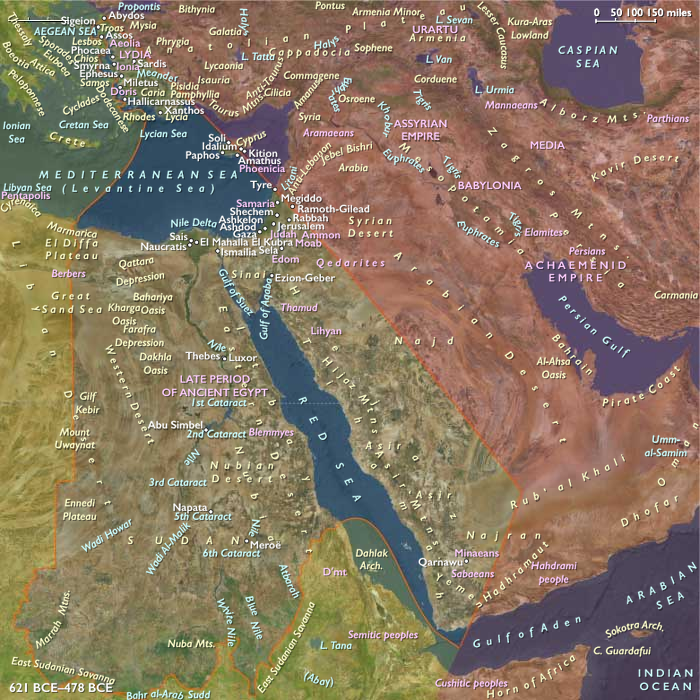
Miletus had been alone among the Anatolian Greek cities in choosing the Persian side in the struggle with Lydia.
A number of the others had been subjected to Persian rule by force.
Many of these Greek towns during the ensuing period have maintained a semiautonomous status while recognizing Achaemenian overlordship.
Outside the cities, occupation forces and military colonies preserve law and order.
In 499, however, Histiaeus, the Greek ruler of Miletus, leads a revolt against Persia.
Greek writer Hecataeus of Miletus, who flourishes around 500, is the first known Greek historian; he attempts in vain to dissuade his fellow citizens from rebellion.
The Milesian deputy governor Aristagoras arrives in Athens and Sparta (and perhaps at other places too, such as Argos) asking for help.
Eretria and Athens (but not Sparta, whose King Cleomenes I rejects the Milesian appeal) grant the rebels token aid: Eretria sends five ships and Athens immediately dispatches a fleet of twenty ships—a major undertaking, considering Athens' resources and commitments—but then swiftly withdraws it.
The Athenian-Aeginetan struggle, having begun well back in the late sixth century with a shadowy precursor in the mythical period, means that the Athenian help sent to Ionia is risky and heroic.
This “Ionian revolt”, in which the Greeks kill or expel many of the Persian-installed tyrants, is the opening phase of the Greco-Persian Wars. (Despite the word Ionian, other Asiatic Greeks join in, from the Dorian cities to the south and from the so-called Aeolian cities to the north, and the Carians, not Greeks in the full sense at all, fight among the bravest).
Locations
People
Groups
- Athens, City-State of
- Carians
- Ionians
- Dorians
- Aeolians
- Miletus (Ionian Greek) city-state of
- Greece, classical
- Persian people
- Aegina, city-state of
- Sparta, Kingdom of
- Eretria, City-State of
- Greeks, Classical
- Achaemenid, or First Persian, Empire
Topics
- Younger Subboreal Period
- Iron Age, Near and Middle East
- Iron Age Cold Epoch
- Classical antiquity
- Ionian Revolt
- Greco-Persian Wars, Early
Commodoties
Subjects
Regions
Subregions
Years: 499BCE - 499BCE
Locations
People
Groups
- Athens, City-State of
- Carians
- Ionians
- Dorians
- Aeolians
- Miletus (Ionian Greek) city-state of
- Greece, classical
- Persian people
- Aegina, city-state of
- Sparta, Kingdom of
- Eretria, City-State of
- Greeks, Classical
- Achaemenid, or First Persian, Empire
Topics
- Younger Subboreal Period
- Iron Age, Near and Middle East
- Iron Age Cold Epoch
- Classical antiquity
- Ionian Revolt
- Greco-Persian Wars, Early
Commodoties
Subjects
Regions
Subregions