Odo, or Eudes, duke of Aquitaine, declares …
Years: 715 - 715
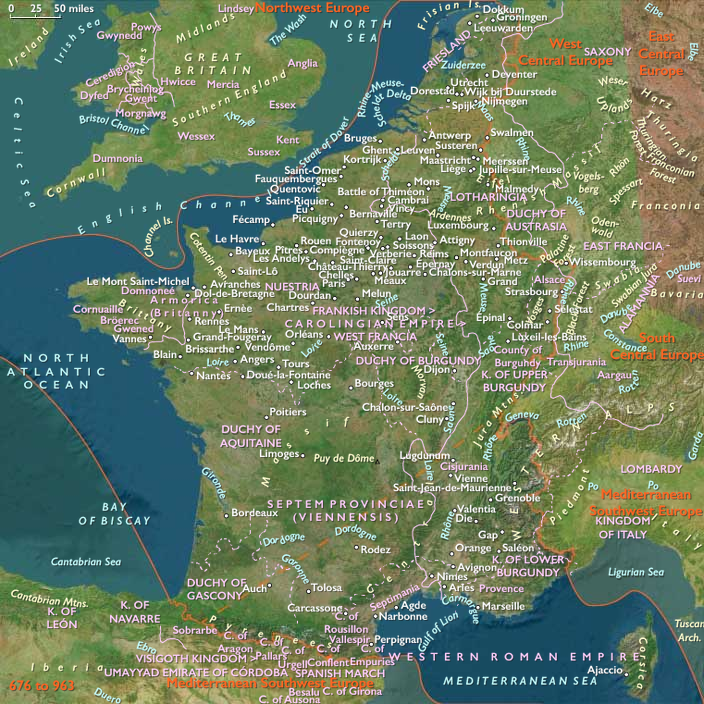
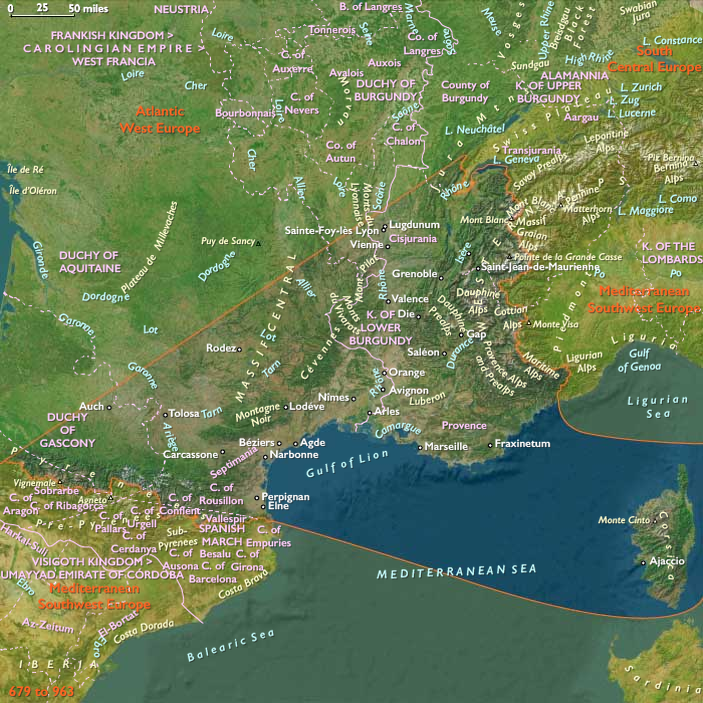
Odo, or Eudes, duke of Aquitaine, declares himself independent of the Frankish kingdoms in 715, using the occasion to increase his holdings and make an alliance with the Neustrians.
Locations
People
Groups
- Franks
- Moors
- Aquitaine, (Frankish) Duchy of
- Burgundy, Frankish Kingdom of
- Francia (mayors of the palaces of Austrasia and Neustria)
- al-Andalus (Andalusia), Muslim-ruled
Topics
Commodoties
Subjects
Regions
Subregions
Related Events
Filter results
Showing 10 events out of 55710 total
Empress Gemmei had in 714 appointed thirteen-year-old Obito as crown prince.
In 715, now in her fifties, the empress abdicates in favor of her daughter Hidaka because of her age and the youth of Obito.
Obito remains as the crown prince of the new monarch, who is known as Empress Gensho.
Caliph Walid quickly reconfirms Qutayba as governor, and even makes his province independent from the governor of Iraq, but Qutayba's position is not secure: the Arab army is tired of constant campaigning and is still riven by factional rivalries, while Qutayba himself has alienated the most powerful Arab tribal groups.
He is generally popular among the native Iranians, but the leader of the native auxiliaries, Hayyan an-Nabati, has secretly turned against him.
Qutayba is completely unaware of the situation however, and began preparations for the campaign of 715, during which he intends to finally capture the Ferghana Valley and complete the subjugation of the Jaxartes valley.
His only concern is that his old rival, Yazid ibn al-Muhallab, might be restored to the Caliph's favor after al-Hajjaj's death, and he takes few precautions except for removing his family and belongings from Merv to Shash and placing a guard on the Oxus.
Qutayba leads an expedition in 715 farther north into Central Asia, establishing nominal Arab rule over Farghana (now part of Uzbekistan and Kyrgyzstan).
He is even traditionally credited with reaching the borders of Chinese Turkestan, and apparently he acquires paper from the Chinese, bringing it to Arab civilization.
Qutayba’s campaign against Ferghana is under way when news reaches the army of Caliph Walid's death and the accession of his brother Sulayman ibn Abd al-Malik to the throne.
The new Caliph is a bitter enemy of Qutayba, for the latter had argued in favor of excluding him from the succession.
Although Sulayman reconfirms him in his position as governor, Qutayba fears that he will soon be removed.
Finally, after negotiations with the new regime in Damascus fail, Qutayba resolves to rebel.
The Khurasani Arabs refuse to support him, and the native auxiliaries, although favorably disposed towards him, are prevented from declaring their support by Hayyan al-Nabati.
Only his family, his fellow Bahili tribesmen and his bodyguard, the Archers, remain faithful.
The opposition, led by the Tamim tribe, coalesces around their leader Waki ibn Abi Sud al-Tamimi.
Qutayba and other members of his family are killed at Ferghana by Arab soldiers in August 715 (according to al-Tabari) or early 716 (according to Ibn Qutaybah).
Waki ibn Abi Sud succeeds him as governor, and orders the army to return to Merv, where it is disbanded.
The invading Arabs threaten the Empire by land and sea (they had penetrated as far as Galatia in 714), and Anastasios has attempted to restore peace by diplomatic means.
His emissaries having failed in Damascus, he undertakes the restoration of Constantinople's walls and the construction of a new fleet.
However, the death of the Caliph al-Walid I in February 715 has given Anastasius an opportunity to turn the tables on the enemy.
He has his fleet concentrate on Rhodes with orders not only to resist the approach of the enemy but to destroy their naval stores, and he dispatches an army under Leo the Isaurian, afterwards emperor, to invade Syria.
The troops of the Opsikian theme, resenting the Emperor's strict measures, mutiny, slay the admiral John, and proclaim as emperor Theodosios, a financial officer and tax collector of lowborn extraction in the southern portion of the theme of Opsikion.
According to one theory, he was the son of the former Emperor Tiberius III.
He did not readily accept this choice and, according to the chronicler Theophanes the Confessor, had even attempted to hide in the forests near Adramyttium.
Eventually he was found and was acclaimed emperor in May 716.
Theodosius and his troops immediately lay siege to Constantinople.
The eunuch churchman Germanus, made bishop of Cyzicus in about 705, had been pressured by Philippikos to sign a decree in 712 rehabilitating Monothelite teachings.
Anastasios upholds the decisions of the Sixth Ecumenical Council and deposes the Monothelete Patriarch John VI of Constantinople, replacing him with Germanus in August 715.
Germanus pronounces the orthodox creed and once again repudiates Monothelitism at a local council this same year.
This also puts an end to the short-lived local schism with the Church in Rome.
The rebels, after besieging the city for six months, gain entry in November.
Theodosius shows himself remarkably moderate in his treatment of his predecessor and his supporters.
Through the intercession of Patriarch Germanus I of Constantinople, Anastasios II is persuaded to abdicate and become a monk in Thessalonica.

Landscape becomes a primary element in Muslim Arabic art, as, for example, in the so-called “Landscape Mosaic,” produced by mosaicists of the Eastern Roman Empire for the new Great Mosque in Damascus, the most impressive in the Islamic world at the time.
The spot where the Great Mosque now stands had been a temple of Hadad in the Aramaean era. (The Aramaean presence is attested by the discovery of a basalt orthostat depicting a sphinx, excavated in the northeast corner of mosque.)
The site was later a temple of Jupiter in the Roman era, then a Christian church dedicated to John the Baptist in the Constantinopolitan era.
Initially, the Muslim conquest of Damascus in 636 did not affect the church, as the building was shared by Muslim and Christian worshipers.
It remained a church although the Muslims built a mud brick structure against the southern wall so that they could pray.
Under the Umayyad caliph Al-Walid I, however, the church has been demolished and between 706 and 715 the current mosque built in its place.
According to legend, Al-Walid himself had initiated the demolition by driving a golden spike into the church.
At this time, Damascus is one of the most important cities in the Middle East and will soon become the capital of the Umayyad caliphate.
The caliph had asked and obtained from the Emperor at Constantinople two hundred skilled workers to decorate the mosque, as evidenced by the partly Byzantine style of the building.
The interior walls are covered with more than an acre of fine mosaics, considered to depict the Qu'ranic paradise, or possibly the Ghouta, which tradition holds so impressed the prophet Muhammad that he declined to enter it, preferring to taste paradise in the afterlife.
The earliest surviving stone mosque, the building, one of the largest of its time, is considered one of the marvels of the world.
The Umayyads, in 715, complete construction on the Great Mosque of Aleppo, which supposedly houses the remains of Zacharias, the father of John the Baptist.
Qasr 'Amrah, a palace in Jordan about fifty miles (eight kilometers) east of Amman, is constructed about 712–715 to serve as both a hunting lodge and a fortress.
One of the best-preserved monuments of Islamic secular art and architecture from the Umayyad period, its main chamber is roofed with three parallel vaults that rest on broad arches.
The vaults are covered with frescoes that depict hunting scenes of mammals long since hunted to extinction in the Middle East, fruit, and nude women; a grouping of rulers and a caliph, thought to be al-Walid I; and a zodiac.
A complete bath forms part of the complex.
Sulayman ibn Abd al-Malik, a younger brother of al-Walid, in 715 succeeds as caliph at his brother’s death, due, in part, to the political opponents of Al-Hajjaj bin Yousef.
However, al-Hajjaj had died in 714, leaving Sulayman free to persecute his political allies.
Among these are the two famous generals Qutayba bin Muslim and his protégé Muhammad bin Qasim; all are imprisoned and then killed.
Serving as the governor of Palestine before his accession, he had allied himself to the Yamani grouping in the tribal politics of the Near East at this time.
As he remains close to the Yamanis, Sulayman does not move to Damascus on becoming Caliph, but rather remains in Ramla in Palestine, having established the city on the coastal plain southeast of Jaffa. (Ramla is fated to be the only city founded by the Arabs in Palestine.)
Al-Walid also has had mosques built at Medina and Jerusalem (the al-Aqsa Mosque, rebuilt on a larger scale); these are to become famous examples of Umayyad architecture.
The mihrab, a prayer niche in the qiblah wall (that facing Mecca) of a mosque; of variable size but usually ornately decorated, originates in the reign of al-Walid.
The structure is an adaptation of the prayer niches common to the oratories of Coptic Christian monks.
When compared to the first Muslim buildings of Iraq and Egypt, the monuments of al-Walid at Damascus, Medina, and Jerusalem are characterized by the growing complexity of their forms, by the appearance of uniquely Muslim symbolic and functional features, and by the quality of their construction.
A first and essential component of al-Walid's mosques is their imperial character; they are to symbolize the permanent establishment of the new faith and of the state that derived from it.
John Damascene, who had succeeded his father to high office as a treasury official under the Muslim caliph, in around 715 enters the monastery of Saint Sabas (Mar Saba) near Jerusalem, where he studies theology, eventually to receive ordination as a priest.
Virtually all of southern Iberia is in Muslim hands by 715.
Abd al-Aziz makes his capital the city of Seville, where he marries Egilona, widow of King Roderic, whom he had taken prisoner and who now encourages him to convert to Christianity and, perhaps, be crowned king of Hispania.
The new Umayyad Caliph Sulayman ibn Abd al-Malik orders the assassination of Abd al-Aziz.
Years: 715 - 715
Locations
People
Groups
- Franks
- Moors
- Aquitaine, (Frankish) Duchy of
- Burgundy, Frankish Kingdom of
- Francia (mayors of the palaces of Austrasia and Neustria)
- al-Andalus (Andalusia), Muslim-ruled