Octavian returns to Italy with the difficult …
Years: 42BCE - 42BCE
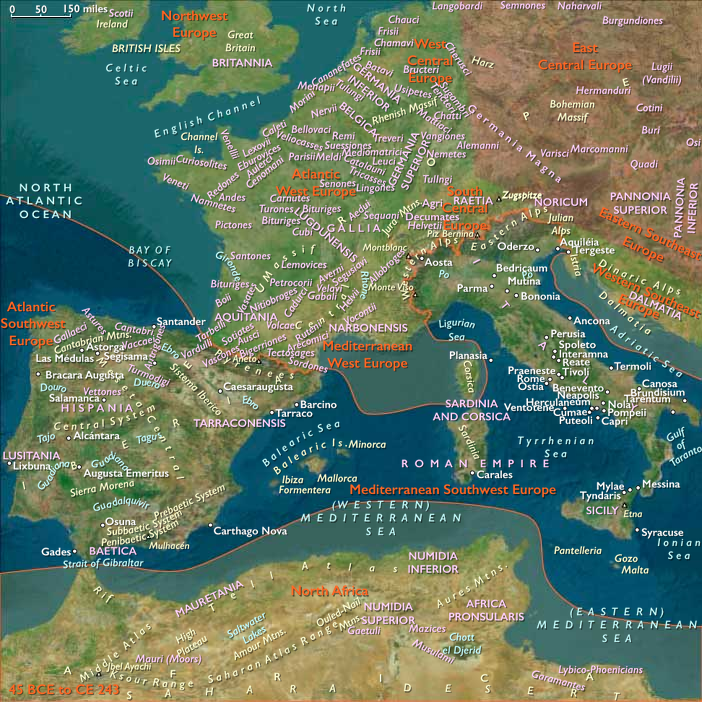
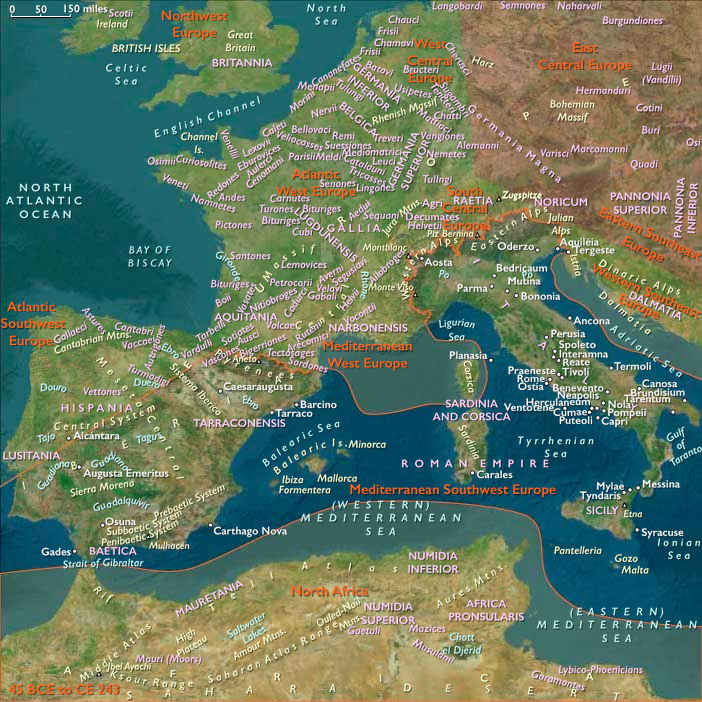
Octavian returns to Italy with the difficult task of finding the land to settle settle tens of thousands of veterans of the Macedonian campaign whom the triumvirs had promised to discharge.
The tens of thousands who had fought on the republican side with Brutus and Cassius, who could easily ally with a political opponent of Octavian if not appeased, also require land.
There is no more government-controlled land to allot as settlements for their soldiers, so Octavian has to choose one of two options: alienating many Roman citizens by confiscating their land, or alienating many Roman soldiers who could mount a considerable opposition against him in the Roman heartland; Octavian chooses the former.
There are as many as eighteen Roman towns affected by the new settlements, with entire populations driven out or at least given partial evictions.
Locations
People
- Augustus
- Gaius Cassius Longinus
- Marcus Aemilius Lepidus (triumvir)
- Marcus Junius Brutus the Younger
- Mark Antony
Groups
Topics
- Classical antiquity
- Roman colonization
- Roman Age Optimum
- Roman Civil War of 44-31 BCE
- Liberators' civil war
Commodoties
Subjects
Regions
Subregions
Related Events
Filter results
Showing 10 events out of 62319 total
Mark Antony summons Cleopatra to meet him in Tarsus to answer questions reports that she had refused to aid the Triumvirate and assisted their enemies.
Cleopatra arrives in great state, and so charms the Triumvir, successfully exonerating herself.
Sri Lanka is the first Asian nation to have a female ruler in Queen Anula, who has ruled from 47 BCE.
Anula had initially risen to power as consort of king Chore Naga (also known as 'Coranaga' and 'Mahanaga'), son of king Valagambahu of Anuradhapura; however in her five-year reign she has poisoned her way through at least four other husbands and consorts.
Anula's motives behind killing her husband are not elaborated on.
Coranaga's successor, king Kuda Tissa, is the son of the man who ruled before him, Mahakuli.
'Kuda' means 'little', and thus it is possible that the new king was only a child, and thus effectively under Anula's control.
For four months in 42 BCE, Anula governs Rajarata on her own until her deposition by Mahakuli Mahatissa's second son Kutakanna Tissa.
In her behavior, Anula has broken every single one of the Rajarata elite's conventions: her partners have all been commoners, lower-caste men, or non-aristocratic Tamils, and the one man of high rank whom she married she ejected in favor of independent rule, something which no woman before her had ever held.
The Mahavamsa, on of the two main Buddhist chronicles of the country's history, states that Kutakanna Tissa had Anula burned on a funeral pyre; other sources indicate that Anula was burned alive in the palace within which she had committed her murders.
(She should not be confused with the other famous Anula in Sri Lankan history, king Devanampiyatissa's consort.)
Herod persuades Mark Antony and Octavian in 42 BCE that his father had been forced to help Caesar's murderers.
In consequence, the Romans name Phasael tetrarch of Jerusalem and Herod tetrarch of Galilee, rendering Hyrcanus powerless.
Many of the Jews are very upset by this, however, since most Jews do not consider Herod to be a true Jew.
The Idumaeans, successors to the Edomites of the Hebrew Bible, had settled in Idumea, formerly known as Edom, in southern Judea.
When in 140–130 BCE the Maccabean John Hyrcanus conquered Idumea, he had required all Idumaeans to obey Jewish law or to leave; most Idumaeans thus converted to Judaism.
Herod publicly identifies himself as a Jew and is considered as such by some, but this religious identification notwithstanding, the Herodians’ Hellenistic cultural affinity has earned them the antipathy of observant Jews.
Cassius and Brutus, having usurped control of most of the Eastern provinces, including Macedonia, Asia Minor, and Syria, combine their armies, cross the Hellespont, march through Thrace, and encamp near Philippi (near present Kavalla) in Macedonia.
The combined armies, with forces roughly equal those of their opponents, lie astride the Via Egnatia to the west of Philippi, their position being partly protected by a marsh.
Their intention is to starve out the enemy, but they are forced into an engagement.
Brutus is successful against Octavian's camp, but Cassius, defeated by Antony's successful attack on the camp, gives up all for lost and orders his freedman Pindarus to slay him.
He is mourned by Brutus as "the Last of the Romans" and buried at Thasos.
Brutus, against his better judgment, fights a second action about three weeks later, on October 23, in which he is routed; despairing of restoring the republican cause, he too commits suicide, leaving the triumvirate in control of the Roman Republic.
Plutarch reports that Antony covered Brutus' body with a purple garment as a sign of respect: they had been friends.
He remembered that Brutus had placed as a condition for his joining the plot to assassinate Caesar that the life of Antony should be spared.
Many other young Roman aristocrats lost their life in the battle or committed suicide after the defeat, including the son of great orator Hortensius, and Marcus Porcius Cato (II) (the son of Cato the younger), and Marcus Livius Drusus Claudianus (the father of Livia, who became Octavian’s wife).
Porcia, Brutus’ wife, reportedly also killed herself by swallowing a red-hot coal when she received news of the defeat. (According to Plutarch [Brutus 53 para 2], there is some dispute as to whether this is the case: Plutarch states that there is a letter in existence that was allegedly written by Brutus mourning the manner of her death.)
Some of the nobles who are able to escape negotiate their surrender to Antony and enter his service (among them Marcus Calpurnius Bibulus and Marcus Valerius Messalla Corvinus).
Apparently, the nobles do not want to deal with the young and merciless Octavian. (Mark Antony will later use the examples of these battles as a means to belittle Octavian, as both battles had been decisively won with the use of Antony's forces.
In addition to claiming responsibility for both victories, Antony will also brand Octavian as a coward for handing over his direct military control to his boyhood friend, Marcus Vipsanius Agrippa, instead.)
Sextus Pompeius in 44 following the assassination of Caesar had come to terms with Mark Antony and been given a naval command, but in August 43 he had been outlawed.
Despite the fact the Sextus is controlling Sicily and Domitius Ahenobarbus still commands the republican fleet, the republican resistance had been definitely crushed at Philippi.
The remains of the Liberators’ army are rounded up and roughly fourteen thousand men are enrolled into the triumvirs’ army.
Old veterans are discharged back to Italy, but some of the veterans remain in the town of Philippi, which becomes a Roman colony (this will later be reinforced by Augustus).
After the battle, a new arrangement is made between the members of the Second Triumvirate, who agree to divide the empire.
Antony proceeds to take up the administration of the eastern provinces.

Octavian is now able to further his cause by emphasizing the fact that he is Divi filius, "Son of God", as the Senate had recognized Caesar as a divinity of the Roman state, Divus Iulius.
Antony and Octavian send twenty-eight legions by sea to face the armies of Brutus and Cassius, who have built their base of power in Greece.
Antony’s wife Fulvia is left behind as the most powerful woman in Rome.
Appian wrote that in December 44 BCE and again in 41 BCE, while Antony was abroad and Cicero campaigned for Antony to be declared an enemy of the state, Fulvia attempted to block such declarations by soliciting support on Antony's behalf.
According to Cassius Dio, Fulvia controlled the politics of Rome.
Dio will write that "the following year Publius Servilius and Lucius Antonius nominally became consuls, but in reality it was Antonius and Fulvia. She, the mother-in‑law of Octavian and wife of Antony, had no respect for Lepidus because of his slothfulness, and managed affairs herself, so that neither the senate nor the people transacted any business contrary to her pleasure.” (Cassius Dio. 48.4.1.)
The triumvirs had distributed the provinces among themseves after the pacification of the east and the defeat of the assassins' faction in the Battle of Philippi.
Antony goes to Egypt, where he meets Cleopatra VII.Lepidus, who had remained in Rome, assumes rule of the western provinces of Hispania and Africa.
Receiving both Hither and Further Spain, along with southern Gaul, as his portion, he celebrates his victories in Spain.
He is consul again in 42, but his two colleagues soon deprive him of most of his power.
Lepidus is left only with the province of Africa, stymied by Antony, who concedes Hispania to Octavian instead.
Antony wants Cleopatra for Egypt's wealth, and, as she wants Antony for his Roman armies, he spends the winter of 41-40 as Cleopatra’s lover at Alexandria. (In spite of the romantic accounts of ancient authors, however, she does not at this stage establish a permanent dominance over him, as for more than three years he will make no move to see her again.)
Arsinoe IV is the fourth daughter of Ptolemy XII Auletes, sister of Ptolemy XIII and Cleopatra VII.
Their late father had left Ptolemy and Cleopatra as joint rulers of Egypt, but Ptolemy had soon dethroned Cleopatra and forced her to flee Alexandria.
When Julius Caesar in 48 BCE arrived in Alexandria and sided with Cleopatra's faction, Arsinoe had escaped from the capital with her mentor Ganymedes and joined the Egyptian army under Achillas, assuming the title of pharaoh.
When Achillas and Ganymedes clashed, Arsinoe had had Achillas executed and placed Ganymedes in command of the army.
Ganymedes had initially enjoyed some success against the Romans, negotiating an exchange of Arsinoe for Ptolemy, but the Romans soon received reinforcements and inflicted a decisive defeat on the Egyptians.
Arsinoe had been transported to Rome and forced to appear in Caesar's triumph.
Despite usual traditions of prisoners in triumphs being strangled when the festivities were at an end, Caesar had spared Arsinoe and granted her sanctuary at Ephesus.
Arsinoe has lived in the temple for many years, always keeping a watchful eye for her sister Cleopatra, who sees her as a threat to her power.
Her fears prove well-founded; in 41 BCE, at Cleopatra's instigation, Mark Antony orders the twenty-six-year-old Arsinoe executed on the steps of the temple, a gross violation of the temple sanctuary and an act that scandalized Rome.
The priest Megabyzus, who had welcomed Arsinoë on her arrival at the temple as Queen, was only pardoned when an embassy from Ephesus made a petition to Cleopatra.
Arsinoe reportedly was given an honorable funeral and a modest tomb, but no conclusive remains of such a burial have been found.
However, an octagonal monument situated in the center of Ephesus will be proposed in the 1990s by Hilke Thür of the Austrian Academy of Sciences to be the tomb of Arsinoë.
A writer from The Times described the identification of the skeleton as "a triumph of conjecture over certainty".
Although no inscription remains on the tomb, it can be dated to between 50 to 20 BCE.
The body of a woman estimated at fifteen to twenty years old will be found in 1926 in the burial chamber.
Thür's identification of the skeleton is based on the shape of the tomb (octagonal, like the Lighthouse of Alexandria), the carbon dating of the bones (between 200 – 20 BCE), the gender of the skeleton, and the age of the young woman at death.
It is also claimed that the tomb contains Egyptian motifs, such as "papyri-bundle" columns.
Arsinoë, if the monument is indeed her tomb, would be the only member of the Ptolemaic dynasty whose remains have been recovered.
Forensic/archaeological analysis of the origins of the skeleton and tomb is ongoing.
Octavian, returning to Rome in 41 BCE to disperse land to Caesar's veterans, divorces Fulvia's daughter and accuses Fulvia of aiming at supreme power.
Fearing that Octavian is gaining the veterans' loyalty at the expense of Antony, Fulvia travels constantly with her children to the new settlements in order to remind the veterans of their debt to Antony.
Fulvia also attempts to delay the land settlements until Antony returns to Rome, so that the two triumvirs can share the credit.
With Octavian in Italy and Antony abroad, Fulvia allies with her brother-in-law Lucius Antonius and publicly endorses Mark Antony in opposition to Octavian.
Lucius Antonius has was always been a strong supporter of his older brother.
In 44 BCE, the year of Antony's consulship and Caesar's assassination, Lucius, as a tribune of the plebs, had brought forward a law authorizing Caesar to nominate the chief magistrates during his absence from Rome.
After the murder of Caesar, he had supported Mark.
Lucius had proposed an agrarian law in favor of the people and Caesar's veterans, and had taken part in the operations at Mutina in 43.
In 41 BCE, he is consul with Publius Servilius Vatia as his senior partner.
Fulvia’ actions cause political and social unrest.
In 41 BCE, tensions between Octavian and Fulvia escalate to war in Italy.
According to Appian, Fulvia was a central cause of the war, due to her jealousy of Antony and Cleopatra's affair in Egypt; she may have escalated the tensions between Octavian and Lucius in order to draw back Antony's attention to Italy.
However, Appian also wrote that the other main causes were the selfish ambition of the commanders and their inability to control their own soldiers.
Lucius assists Fulvia, who is anxious to recall her husband from Cleopatra's court, in the raising of eight legions to fight against Octavian's unpopular policies.
Fulvia feels strongly that her husband should be the sole ruler of Rome instead of sharing power with the Second Triumvirate, especially Octavian.
Later, observing the bitter feelings that had been evoked by the distribution of land among the veterans of Caesar, Antonius and Fulvia change their attitude, and stand forward as the defenders of those who had suffered from its operation.
Antonius marches on Rome, drives out Lepidus, and promises the people that the triumvirate should be abolished.
However, Lucius and Fulvia have taken a political and martial gamble in opposing Octavian, since the Roman army still depends on the triumvirs for their salaries.
On the approach of Octavian, …
…Lucius organizes his troops at Praeneste, and is then forced to retreat with his army to …
Years: 42BCE - 42BCE
Locations
People
- Augustus
- Gaius Cassius Longinus
- Marcus Aemilius Lepidus (triumvir)
- Marcus Junius Brutus the Younger
- Mark Antony
Groups
Topics
- Classical antiquity
- Roman colonization
- Roman Age Optimum
- Roman Civil War of 44-31 BCE
- Liberators' civil war