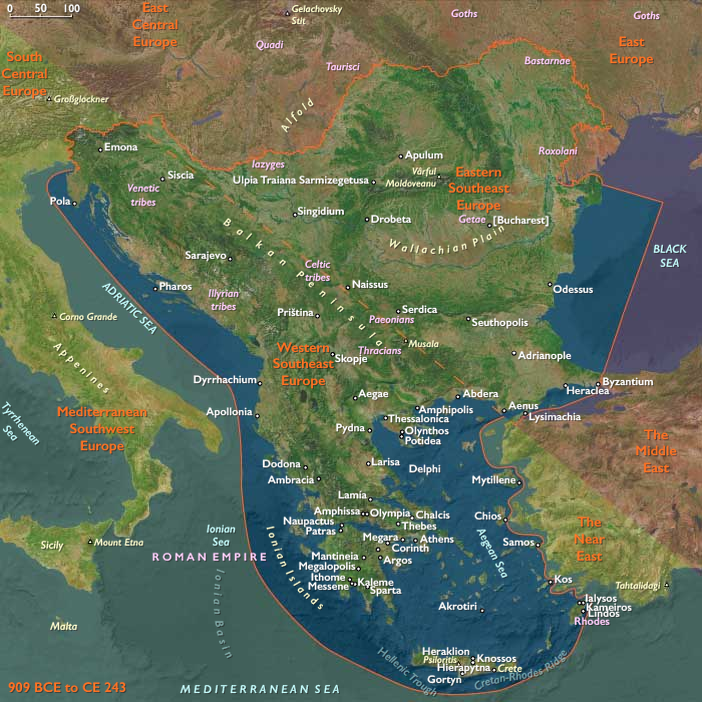
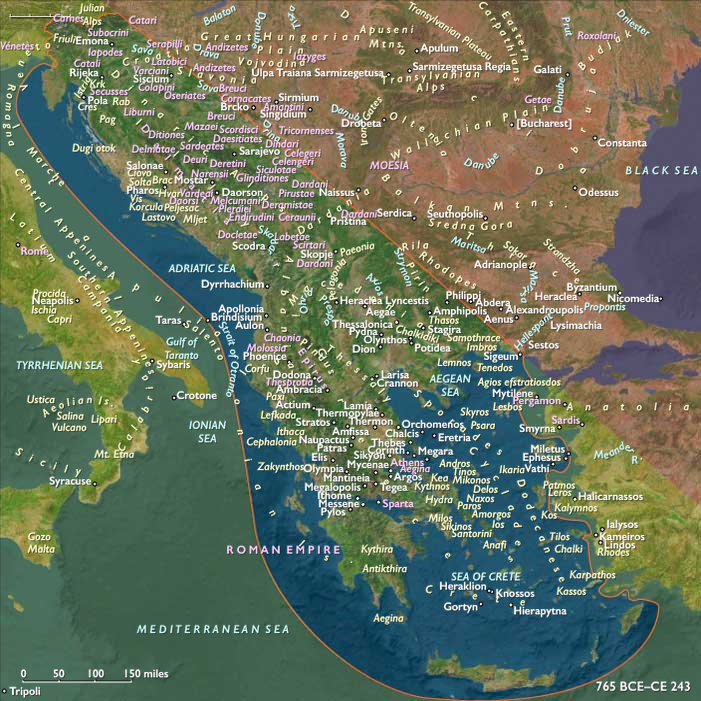
Octavian has fought three campaigns in Illyria …
Years: 27BCE - 27BCE
Octavian has fought three campaigns in Illyria and Dalmatia from 35 BCE to 33 BCE.
The first mention of the province of Illyricum occurs in the context of Augustan settlement of 27 BCE, when it is assigned as a propraetorial province to imperial control.
The Romans divide the lands that make up present-day Albania among the provinces of Macedonia, …
Locations
People
Groups
Topics
Commodoties
Subjects
Regions
Subregions
Related Events
Filter results
Showing 10 events out of 62213 total
Octavian, now Augustus Caesar, gives the ancient city of Samaria to Herod, who expands and renovates the city in 27 BCE and names it "Sebaste", meaning "Augustus", in the Emperor's honor.
An assassination attempt on Herod is foiled in this year.
The former fishing village of Pola, located on the Adriatic Sea at the southern tip of the Istrian peninsula, about sixty miles (one hundred kilometers) south of Tergeste (modern Trieste), between 46 and 45 BCE had been elevated to colonial rank as the tenth region of the Roman Republic, under Julius Caesar.
The town had grown during that time and had at its zenith a population of about thirty thousand, becoming a significant Roman port with a large surrounding area under its jurisdiction.
The town in 42 BCE during the civil war of the triumvirate of Octavian, Mark Antony and Lepidus against Caesar's assassins Brutus and Cassius, had taken the side of Cassius, since the town had been founded by Cassius Longinus, brother of Cassius.
The town had been demolished after Octavian's victory.
Soon rebuilt at the request of Octavian's daughter Iulia, it was then called Colonia Pietas Iulia Pola Pollentia Herculanea'.
Great classical constructions are built of which a few remain.
Construction begins on a great amphitheater, Pula Arena (completed in CE 68), much of it still standing to this day.
The Romans also supply the city with a water supply and sewage systems, and fortify the city with a wall with ten gates, a few of which still remain: the Gate of Hercules (in which the names of the founders of the city are engraved), the Twin Gates, and the triumphal Arch of the Sergii.
The arch commemorates three brothers of the Sergii family, specifically Lucius Sergius Lepidus, a tribune serving in the twenty-ninth legion that participated in the Battle of Actium and in 27 BCE disbanded.
This suggests an approximate date of construction.
The arch stands behind the original naval gate of the early Roman colony.
The Sergii are a powerful family of officials in the colony and for centuries will retain their power.
… Dalmatia, and …
…Epirus.
Nimes, which derives its name from that of a spring in the Roman village, is located on the Via Domitia, a Roman road constructed in 118 BCE that connects Italy to Spain.
The hill named Mt.
Cavalier is the site of the early oppidum, which gave birth to the city.
During the third and second centuries BCE, a surrounding wall was built, closed at the summit by a dry-stone tower, which was later incorporated into the masonry of the Tour Magne.
The Wars of Gaul and the subsequent fall of Marseille in 49 BCE had allowed Nîmes to regain its autonomy under Rome.
Veterans of the Roman legions who had served Julius Caesar in his Nile campaigns, at the end of fifteen years of soldiering, had been given plots of land to cultivate on the plain of Nîmes, which became a Roman colony sometime before 28 BCE, as witnessed by the earliest coins, which bear the abbreviation NEM.
COL, "Colony of Nemausus.
Soon after the residents of Nimes receive Roman citizenship, the city is replanned with an organized street grid.
The constitutional basis of Octavian's power will remain a continuous succession of consulships from 31 until 23 BCE, but he he ostensibly “transfers the State to the free disposal of the Senate and people” in January 27, earning the misleading, though outwardly plausible, tribute that he has restored the republic.
The Senate implores him not to abandon the state—which he has absolutely no intention of doing.
At the same time he makes this purely theatrical gesture, he obtains from the Senate a ten-year tenure of an area of government (provincia) comprising Spain, Gaul, and Syria, the three regions containing the bulk of the army.
The Senate grants Octavian a number of prerogatives that legitimize his position, awarding him the military command (imperium; hence the modern term emperor).
The remaining provinces are to be governed by proconsuls appointed by the Senate in the old republican fashion.
Octavian, however, believes that his supreme prestige—crystallized in the meaningful term auctoritas—safeguards him against any defiance by these personages; and he is indeed able, more or less indirectly, to influence their appointments, just as he will be able (on the rare occasions when he regards it as desirable) to influence the appointments to the consulships and other metropolitan offices that continue to exist in “republican” fashion.
Four days after these measures, his surname of Caesar, acquired through adoption in Julius' will, is supplemented by “Augustus,” an appellation with an antique religious ring, believed to be linked etymologically with auctoritas and with the ancient practice of augury.
The word augustus is often contrasted with humanus; its adoption as the title representing the new order cleverly indicates, in an extraconstitutional fashion, his superiority over the rest of mankind.
With the aid of writers such as Virgil, Livy, and Horace, all of whom in their different ways shared the same ideas, he will show his patriotic veneration of the old Italian faith by reviving many of its ceremonials and repairing numerous temples.
The republic is dead, replaced by Octavian with the principate, "rule by the first citizen:” a monarchy disguised as a republic, with the princeps (the emperor) ostensibly ruling by commission from the Senate and the people.
Rome’s jurisconsults, prominent citizens who find the study and interpretation of the law a satisfying and respected pursuit, have great prestige, and are regularly consulted by officials and laymen alike.
With the establishment of the principate, Octavian grants certain jurisconsults the authority to issue responses to legal queries as though he himself had been asked.
At least since the rise to prominence of the Scipio family around 275 BCE, it has been a habit of many Roman generals to choose from the ranks a private force of Italians (Roman citizens and Latins), consisting of both infantry and cavalry, to act as guards of the tent or the person.
The term Praetorian derives from the tent of the commanding general or praetor of a Roman army in the field—the praetorium.
In time, this cohort had come to be known as the cohors praetoria, and various notable figures possessed one, including Julius Caesar, Mark Antony and Augustus (Octavian).
As Caesar had discovered with the Legio X Equestris, a powerful unit more dangerous than its fellow legions is desirable in the field.
While Augustus understands the need to have a protector in the maelstrom of Rome, he is careful to uphold the Republican veneer of his regime.
Thus, from the ranks of the legions throughout the provinces, he allows only nine cohorts to be formed, originally of five hundred, later increased to one thousand men each, and only three kept on duty at any given time in the capital.
A small number of detached cavalry units (turmae, sing.
turma) of thirty men each are also organized.
While they patrol inconspicuously in the palace and major buildings, the others are stationed in the towns surrounding Rome; no threats are possible from these individual cohorts.

The Incorporation of Normandy into Roman Gaul (27 BCE)
In 27 BCE, the region of northern Gaul, later known as Normandy (French: Normandie), was formally incorporated into the Roman province of Gallia Lugdunensis. This annexation marked the final phase of Roman consolidation in Gaul, following Julius Caesar’s conquest of the region (58–50 BCE).
Geographic and Strategic Importance
- Normandy was located along the English Channel, positioned between Picardy (to the east) and Brittany (to the west).
- Its coastal location made it an important region for trade, defense, and maritime activity in the Roman world.
- The area was home to several Gallic tribes, including the Lexovii, Viducasses, and Unelli, who were gradually integrated into the Roman administrative and economic system.
Normandy Under Roman Rule
- The region became part of Gallia Lugdunensis, one of the four provinces of Roman Gaul, with its capital at Lugdunum (modern Lyon).
- The Romans established roads, trade routes, and infrastructure, linking the region to other parts of Gaul and Britannia.
- Normandy’s harbors and river systems, particularly the Seine, played a key role in commerce and military logistics.
Long-Term Impact of Romanization
- Over time, Latin replaced local Celtic languages, and Roman customs, law, and architecture became widespread.
- The region's Gallo-Roman identity persisted well beyond the fall of the empire, influencing later medieval developments.
- The foundation of Roman towns and villas in Normandy laid the groundwork for urban centers that continued into the Middle Ages.
The Roman annexation of Normandy in 27 BCE was part of Augustus' broader strategy to stabilize and integrate Gaul, ensuring that Roman influence remained strong in northwestern Europe for centuries to come.
Virgil, sometime after the publication of his Eclogues (probably before 37 BCE), had become part of the circle of Maecenas, Octavian's capable agent d'affaires, who sought to counter sympathy for Antony among the leading families by rallying Roman literary figures to Octavian's side.
Virgil seems to have made connections with many of the other leading literary figures of the time, including Horace, in whose poetry he is often mentioned, and Varius Rufus, who will later help finish the Aeneid.
At Maecenas' insistence (according to the tradition), Virgil had spent the ensuing years (perhaps 37–29 BCE) on the longer didactic hexameter poem called the Georgics (from Greek, "On Working the Earth") which he dedicates to Maecenas.
A didactic poem in four books purporting to teach farming, completes them in 26 BCE, Virgil sums up the poem's overall plan in the opening lines: what to plant and when, the cultivation of trees, especially the vine, and of livestock, and the art of beekeeping.
Displaying the influence of Hesiod, Aratus, Callimachus, Varro, and Lucretius, as well as other poets in lesser degree, Virgil interweaves his diverse materials into an astonishingly lyrical composition.
Evoking a tremendous love of the land, he writes of Italy as the beautiful "Saturnian land," fertile and varied in its produce, over which Saturnus ruled during the golden age.
He masterfully balances the horror of disease, embodied in the ravages of a plague, with the picture of the light and joyous bees, whose cultivation he traces to the tragedy of Orpheus and Eurydice.
He closes the poem with Aristaeus appeasing the offended deities and in the process discovering the art of beekeeping.
Virgil now begins work on the story of the legendary Aeneas, commissioned, according to Propertius, by Augustus.
Celtic Settlement and the Cantabrians
Archaeological evidence presented by Luisa Ruiz-Gálvez Priego (1998) suggests that Celtic settlement in the Iberian Peninsula occurred via the Atlantic Ocean, with migrants arriving between French Brittany and the mouth of the River Garona before eventually settling along the Galician and Cantabrian coasts.
The Cantabri, a fiercely independent people, inhabited the highlands of northern Spain’s Atlantic coast, covering what is now modern Cantabria, eastern Asturias, parts of Castile-León, and the northern fringes of Palencia and Burgos provinces.
Comprising around eleven tribes, the Cantabri exhibited a blend of cultural influences, as their tribal names suggest Ligurian, Aquitanian, Indo-Aryan, Celtiberian, and Gallic affiliations.
Cantabrians in Warfare and Roman Encounters
The Cantabri first entered historical records as mercenaries, fighting in various Iberian conflicts. Their reputation as skilled warriors became well known to the Roman military, which had already encountered them prior to the Cantabrian and Asturian Wars.
Notably, Cantabrian warriors served in:
- Hannibal’s army during the Second Punic War (218–201 BCE),
- The siege of Numantia in 151 BCE, where they fought alongside the Vaccaei,
- The Sertorian Wars (80–72 BCE), and
- The Battle of Ilerda in 49 BCE, as recorded by Julius Caesar himself.
The Cantabrians' resistance to Roman rule was so fierce that they even captured a Roman standard, an event considered inexplicable and deeply humiliating for the Roman legions.
Rome’s Response and the Role of Caesar Augustus
The Roman campaigns against the Cantabrians were officially justified as retaliation for their incursions into the Roman-controlled Meseta Central. However, Rome's true motivations likely included securing Asturian gold and Cantabrian iron, both valuable resources.
Finally, in 26 BCE, Emperor Caesar Augustus personally led the campaign against the Cantabrians, establishing his military base in Segisama (modern Burgos). This marked the beginning of Rome’s final push to subjugate the fiercely independent northern tribes.
Galatia, a Roman protectorate from 85 BCE, is ruled by puppet kings.
No military effort is needed in 25 BCE when Galatia is converted to a Roman province shortly after Amyntas of Galatia is killed by an avenging widow of a slain prince from Homonada.
Angora becomes the capital of the new province, which encloses the Galatians between Cappadocia on the east and the province of Asia on the west.