
Nur ad-Din proves to be one of …
Years: 1163 - 1163
Nur ad-Din proves to be one of the most dangerous enemies the Frankish kingdom has ever faced.
Starting out as Emir of Aleppo, he had steadily increased his territory at the expense of his Muslim and Latin neighbors, until he gained the great city of Damascus in 1154.
He had seriously defeated the Crusaders at the Battle of Lake Huleh in 1157, but fell very ill immediately afterward, allowing the Franks to a chance to recover and, with the help of Thierry of Alsace and an army of pilgrims, to capture Harim castle later in the year.
However, an attack on Shaizar failed when Reynald of Châtillon, the Prince of Antioch, quarreled with the other Franks.
Consequently, Shaizar soon became the property of Nur ad-Din.
In 1158, Thierry and King Baldwin III had defeated Nur ad-Din at Butaiha, northeast of Tiberias.
The year 1160 had seen the capture of Reynald, who will spend the next sixteen years in Nur ad-Din's dungeons.
In December 1161, the Emperor Manuel I Comnenus had married Maria of Antioch and this event has given Antioch a strong protector in the emperor.
Amalric, count of Jaffa and Ascalon, succeeds his elder brother Baudouin III to the throne of Jerusalem in 1163.
Both Amalric and Nur ad-Din had soon become aware of the weakness of Fatimid Egypt, whose government has fallen into a state of decay.
After the assassination of Caliph al-Zafir and a series of palace coups, Shawar had seized power in 1162, was soon deposed, and appealed to Nur ad-Din for help.
Neither the Latin king nor the Muslim emir can afford to let the other capture the rich prize of Egypt.
Accordingly, Nur ad-Din had sent his lieutenant Shirkuh with an army to support the Egyptian vizier.
While Shirkuh campaigns in Egypt, Nur ad-Din mounts an offensive in Lebanon.
Following Latin policy, King Amalric takes an army to support his northern vassals, Bohemund III of Antioch and Raymond III of Tripoli.
Fortuitously, a large group of French pilgrims led by Hugh VIII of Lusignan and Geoffrey Martel, the brother of William IV of Angoulême, have joined the king of Jerusalem.
In addition, Constantine Kalamanos, the governor of Cilicia, has brought his Greek warriors to assist the Crusaders.
Nur ad-Din is no match for such a formidable combination of enemies and his army suffers a defeat.
Both Muslims and Franks are impressed by the fighting qualities of the imperial soldiers.
The negative result of al-Buqaia only makes Nur ad-Din more keen for revenge.
Locations
People
- Amalric I of Jerusalem
- Baldwin III of Jerusalem
- Bohemond III of Antioch
- Constantine Kalamanos
- Hugh VIII of Lusignan
- Manuel I Komnenos
- Nur ad-Din Zengi
- Raymond III of Tripoli
- Raynald of Châtillon
- Shawar
- Shirkuh
- Thierry
Groups
- Fatimid Caliphate
- Armenia, Baronry of Little, or Lesser
- Roman Empire, Eastern: Komnenos dynasty, restored
- Antioch, Principality of
- Jerusalem, Latin Kingdom of
- Tripoli, County of
- Zengid dynasty of Syria
Topics
Commodoties
Subjects
Regions
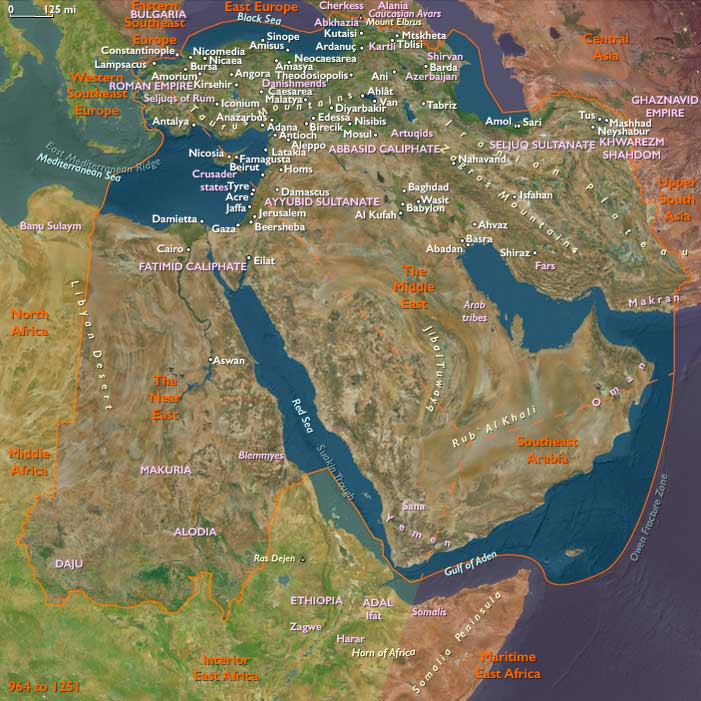
Subregions
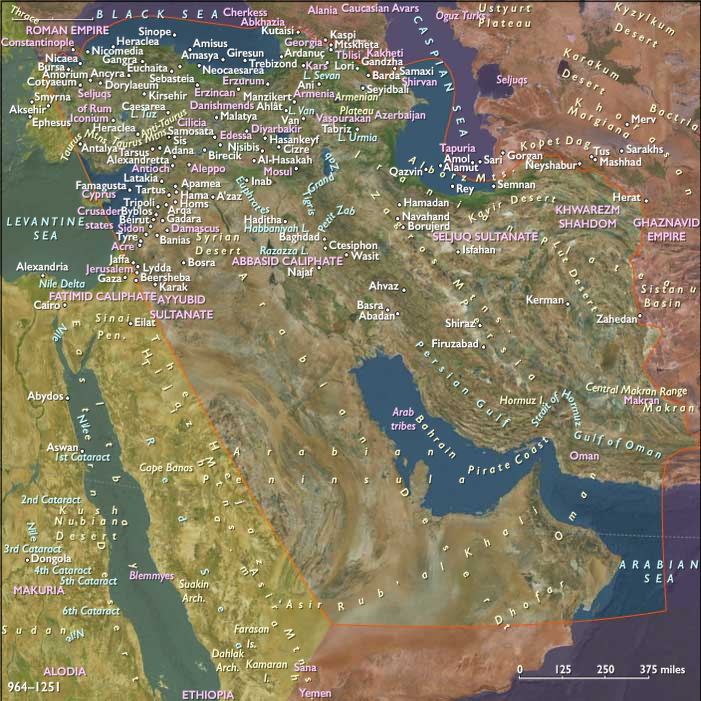
Years: 1163 - 1163
Locations
People
- Amalric I of Jerusalem
- Baldwin III of Jerusalem
- Bohemond III of Antioch
- Constantine Kalamanos
- Hugh VIII of Lusignan
- Manuel I Komnenos
- Nur ad-Din Zengi
- Raymond III of Tripoli
- Raynald of Châtillon
- Shawar
- Shirkuh
- Thierry
Groups
- Fatimid Caliphate
- Armenia, Baronry of Little, or Lesser
- Roman Empire, Eastern: Komnenos dynasty, restored
- Antioch, Principality of
- Jerusalem, Latin Kingdom of
- Tripoli, County of
- Zengid dynasty of Syria
Topics
Commodoties
Subjects
Regions
Subregions