
Atlantic Southwest Europe: Struggles for Succession and …
Years: 1468 - 1479
Atlantic Southwest Europe: Struggles for Succession and Maritime Triumphs (1468–1479)
From 1468 to 1479, Atlantic Southwest Europe witnessed significant political upheaval driven by dynastic conflicts in Castile, consolidation of royal power in Portugal, and persistent internal disputes within Navarre. Simultaneously, maritime achievements further solidified Portugal’s status as an emerging global naval and commercial power.
Political and Military Developments
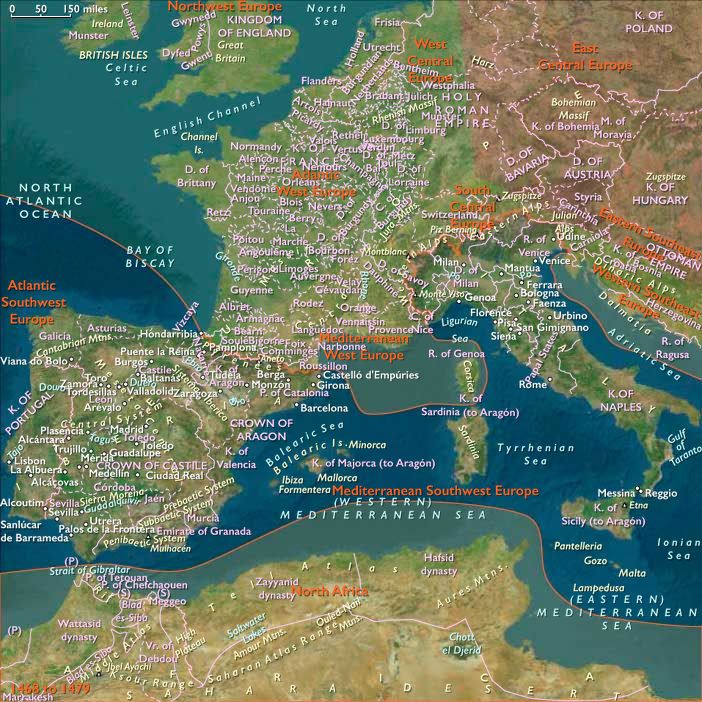
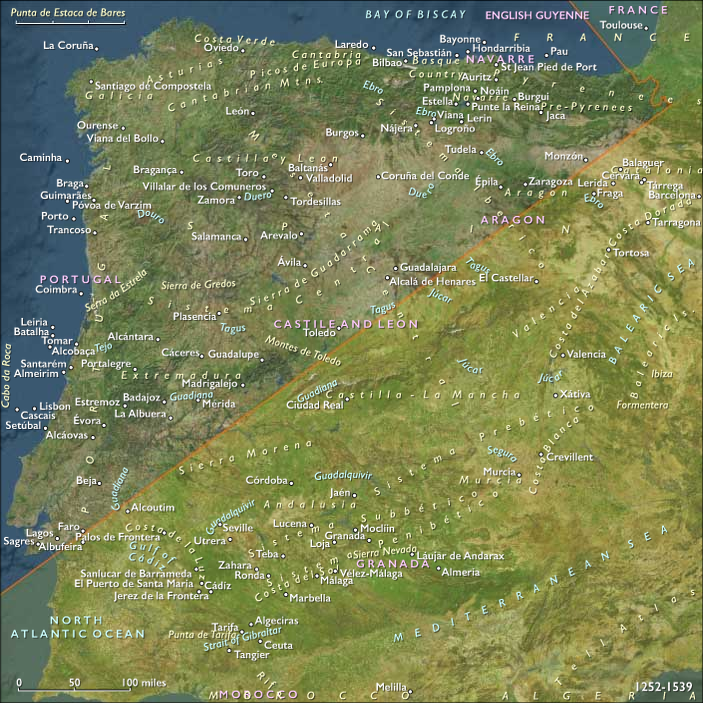
- Portugal: King Afonso V (r. 1438–1481) intensified military efforts in Morocco, culminating in the capture of Arzila and Tangier in 1471, solidifying Portugal’s foothold in North Africa and positioning it as a prominent Atlantic maritime power. Domestically, the Portuguese monarchy enjoyed relative stability, reinforcing royal authority and centralization that laid groundwork for future maritime exploration under his son João, who became increasingly influential in policy.
- Northern Castile and León: The contentious succession struggle escalated dramatically following the death of Enrique IV (1474). His daughter, Joanna la Beltraneja, supported by Portugal’s Afonso V, contested the throne against Enrique’s half-sister, Isabella of Castile, sparking the destructive War of the Castilian Succession (1475–1479). The Basque territories, Galicia, and northern Rioja were severely impacted by the conflict, with local nobles divided in allegiance, leading to intermittent warfare and economic disruption.
- Navarre: Navarre endured ongoing instability under Leonor I (1479), whose brief reign reflected continuing succession crises and foreign interference, particularly from neighboring Castile and Aragon, exacerbating internal divisions and undermining effective governance. Persistent political uncertainty deepened Navarre's vulnerability, making it increasingly susceptible to external manipulation.
Economic and Maritime Expansion
- Portuguese Maritime Success: Portugal’s capture of key Moroccan port cities in 1471 significantly boosted trade in gold, ivory, spices, and slaves, enriching Lisbon as a critical European economic hub and stimulating merchant wealth and international commerce. Advances in navigation continued, with improved cartographic knowledge and ship design further enabling Portugal’s pioneering role in European exploration of the Atlantic and African coasts.
- Economic Disruptions in Northern Iberia: In Castile, particularly northern regions including Basque ports and Galicia, commerce and agriculture suffered from the prolonged civil war, although the robust maritime trade in wool and iron persisted despite disruptions, due to well-established northern trading networks. Navarre’s internal turmoil negatively impacted local trade, weakening the region’s commercial stability, though its strategic location kept it involved in broader European trade routes.
Cultural and Social Developments
- Portuguese Courtly Culture: Lisbon's royal court continued patronizing intellectual pursuits, fostering Renaissance humanism and attracting prominent scholars and artists, elevating Portugal’s cultural prestige within Europe. Chroniclers like Gomes Eanes de Zurara actively documented Portuguese maritime conquests, contributing significantly to Europe’s collective knowledge of Africa and the wider Atlantic world.
- Cultural Identity Amidst Conflict: Despite political instability, the Basque Country and Galicia strengthened their local identities, preserving distinct legal traditions (fueros) and language amid centralizing pressures from Castile’s emerging monarchy. Pilgrimage routes, particularly to Santiago de Compostela, remained vibrant conduits for cultural and scholarly exchanges despite disruptions from military conflicts.
Significance and Legacy
The era 1468–1479 decisively shaped the future of Atlantic Southwest Europe. Portugal's military successes cemented its reputation as a preeminent maritime empire, while Castile's dynastic conflicts resolved in favor of Isabella, whose victory set the foundation for unified Spanish monarchy. Navarre’s political fragility highlighted broader Iberian power dynamics, foreshadowing its later absorption by neighboring powers. Economically, culturally, and politically, these developments profoundly influenced subsequent regional histories, driving Portugal toward global expansion and setting the stage for Spain's consolidation as a unified kingdom.
People
- Afonso V of Portugal
- Eleanor of Navarre
- Gomes Eanes de Zurara
- Henry IV of Castile
- Isabella I of Castile
- Joanna la Beltraneja
Groups
- Galicia, Kingdom of
- Navarre, Kingdom of
- Basque people
- Christians, Roman Catholic
- Castile, Crown of
- Portugal, Avizan (Joannine) Kingdom of
- Portuguese Empire
Topics
Commodoties
Subjects
Regions
Subregions
Years: 1468 - 1479
People
- Afonso V of Portugal
- Eleanor of Navarre
- Gomes Eanes de Zurara
- Henry IV of Castile
- Isabella I of Castile
- Joanna la Beltraneja
Groups
- Galicia, Kingdom of
- Navarre, Kingdom of
- Basque people
- Christians, Roman Catholic
- Castile, Crown of
- Portugal, Avizan (Joannine) Kingdom of
- Portuguese Empire
Topics
Commodoties
Subjects
Regions
Subregions