
Northern North America (6,093 – 4,366 BCE): …
Years: 6093BCE - 4366BCE
Northern North America (6,093 – 4,366 BCE): Middle Holocene — Waterways, Woodcraft, and the Rise of Storage Societies
Geographic & Environmental Context
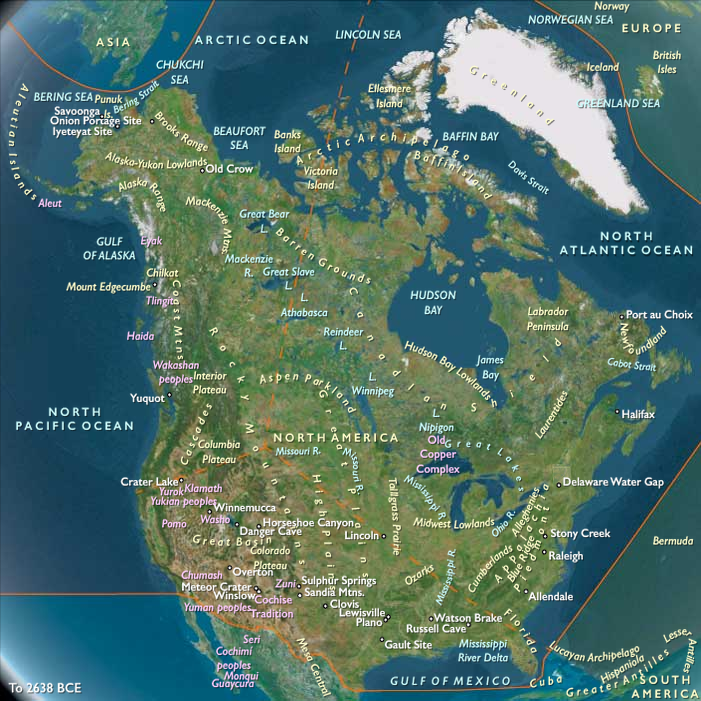
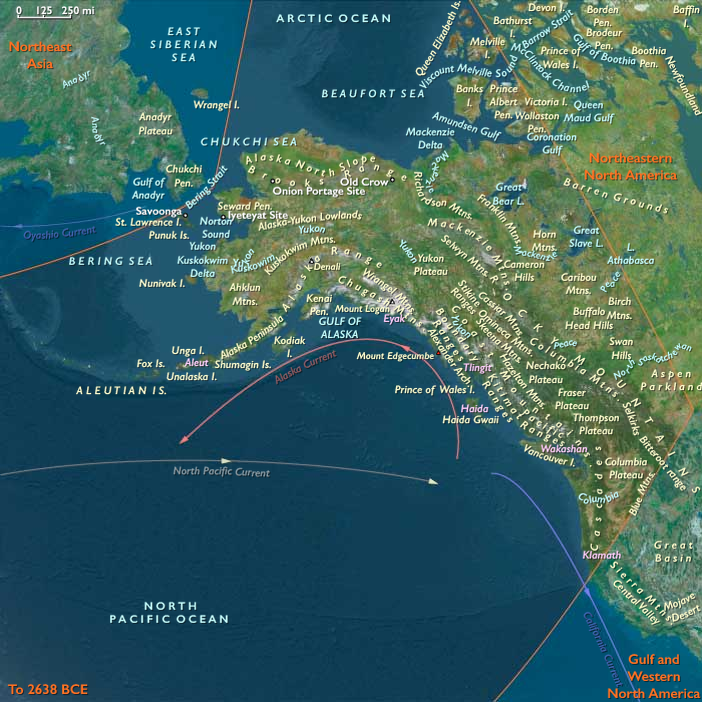
Northern North America formed a continuous, water-linked world from the Gulf of Alaska and the Fraser–Columbia canyons across the Great Lakes–St. Lawrence interior to the Lower Mississippi and Gulf estuaries, the Great Basin, and nearly all of California.
Mid-Holocene highstands stabilized estuaries, kelp forests, and lagoon systems on both coasts; inland, lake and river complexes matured (Great Lakes, St. Lawrence, Upper Mississippi), while playas and spring-fed wetlands punctuated the Great Basin and desert Southwest. Across this breadth, people organized life around fish rivers, shell shores, and seedlands—a hydrologic continent knitted by canoe, portage, and trail.
Climate & Environmental Shifts
The Hypsithermal warm phase brought long ice-free seasons on the North Pacific, strong but reliable monsoon/westerly regimes in the interior West, and moist, productive summers across the Great Lakes and Northeast.
Periodic interior dry spells reshaped foraging calendars on plateaus and basins, counterbalanced by refugia along major rivers and coasts. Sea levels approached near-modern outlines, locking in tidal flats, eelgrass meadows, and delta silts that sustained fisheries and shellfisheries at scale.
Subsistence & Settlement
A continental portfolio economy matured, with storage at its core:
-
Northwest Pacific & Subarctic coast/plateau: canyon and estuary salmon fisheries supported large pit-house villages inland and substantial coastal house platforms; shellfish management (including clam gardens) and berry-patch tenure increased carrying capacity.
-
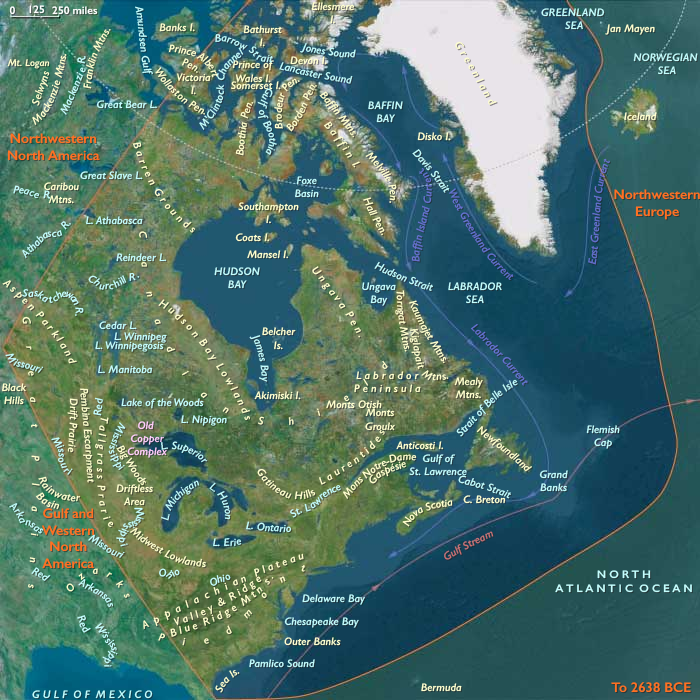
Great Lakes–Northeast & Atlantic seaboard: intensified Archaic lifeways combined lake/river fisheries with broad plant use; along Superior, the Old Copper tradition added durable tools to fishing and woodworking; shell-ring and shell-heap communities expanded on the southern Atlantic margins.
-
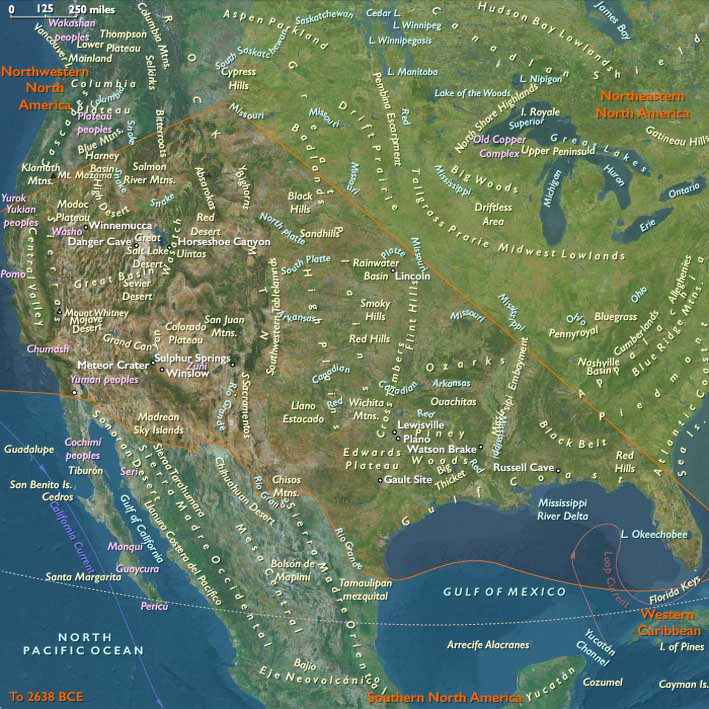
Gulf & Western North America: along the Lower Mississippi and Gulf estuaries, shell rings and river aggregation cycles grew; in California, island–mainland canoe commutes, fish weirs, and large shell-middens scaled up; in the Southwest and Great Basin, seed-processing economies, agave roasts, rabbit drives, and wetland micro-patch exploitation anchored seasonal rounds.
Everywhere, semi-sedentism deepened: villages clustered at fisheries and wetlands, fanning out to upland hunts and seedlands, then reconverging for curing, smoking, and exchange.
Technology & Material Culture
Toolkit fluency underwrote surplus:
-
Heavy carpentry with standardized ground-stone adzes and chisels; hafted slate knives on outer coasts; composite toggling harpoons for sea mammals.
-
Mass-capture gear—engineered net-weir complexes, fish fences, intertidal traps—paired with dugout canoes and, in some areas, sewn-plank precursors; interior basketry, nets, and cordage flourished.
-
In the Great Lakes, native copper (adzes, awls, points) augmented woodcraft and butchery; across the West, millingstones, lined earth ovens, and roasting pits powered “low-level food production.”
-
Shell and stone beadwork, labrets, bannerstones, and fine lithics circulated as display and exchange valuables.
Movement & Interaction Corridors
Water was the road system:
-
Inside Passage canoe lanes stitched Gulf of Alaska islands to Haida Gwaii and the Fraser–Columbia trunk; inland, obsidian (e.g., Mount Edziza), ochre, and fine lithics moved along plateau rivers.
-
The Great Lakes–St. Lawrence spine moved copper, fish, and crafted goods east–west; Niagara and Fox–Wisconsin–Mississippi routes linked interior basins.
-
The Lower Mississippi and Gulf littoral tied shell-ring peoples to river valleys; westward, Rio Grande–Gila–Salt corridors connected deserts, plateaus, and coasts; California’s Channel and outer coasts ran island–mainland circuits.
These braided routes created redundancy—if a run failed or a drought tightened, another corridor supplied protein, salt, or tools.
Cultural & Symbolic Expressions
Material surplus fed prestige and ceremony:
-
On the North Pacific, feasting middens, shell bead caches, rare lithics, and labrets signal rising lineage prestige tied to weir estates and canoe rights.
-
In the interior and Northeast, mortuary elaboration, copper as status metal, and nascent earthworks mark growing ceremonial integrators.
-
Along the Gulf and Atlantic, shell-ring ritual landscapes codified ancestry at water’s edge.
-
Across the West and Southwest, rock art fluorescence (canyonlands to desert basins) mapped mythic hunts, trance, and water guardians; in wetlands, bog deposits and curated places expressed ancestor presence.
Environmental Adaptation & Resilience
Communities engineered stability through storage, scheduling, and tenure:
-
High-capacity drying/smoking of salmon and marine fats; seed banks from nut mast and grass harvests; oils and dried meats as transportable capital.
-
Territorial tenure over weirs, shell beds, berry grounds, and seed patches enforced sustainable yields and reciprocal access.
-
Diversified procurement—coast + river + upland + desert micro-patch—buffered climate swings; exchange networks redistributed risk.
-
Built features—clam gardens, weirs, trackways, ovens—were niche-engineering that increased productivity without agriculture.
Long-Term Significance
By 4,366 BCE, Northern North America had become a continent of storage-rich, semi-sedentary societies—masters of wood, water, and weirs.
From the salmon strongholds of the Northwest to the copper shores of Superior and the shell-ring estuaries of the Gulf and Atlantic, peoples forged rank-leaning economies, prestigious gift circuits, and durable settlement fabrics without farms or cities.
These Middle Holocene habits—surplus management, engineered ecotones, canoe logistics, and ceremonial redistribution—formed the deep grammar from which later Northwest Coast polities, Woodland earthwork traditions, and Pacific littoral chiefdoms would rise.
Groups
- Paleo-Indians, or Paleoamericans
- Paleo-Arctic Tradition
- Athabaskans, or Dene, peoples
- Klamath (Amerind tribe)
Topics
- Neolithic Revolution
- Archaic Stage (Americas)
- Neolithic Subpluvial, or Holocene climatic optimum, or Holocene Wet Phase
- Atlantic Period during the Neolithic Subpluvial
- 8.2 kiloyear event during the Neolithic Subpluvial
- Chalcolithic Epoch, or Copper Ages
- Older Peron Transgression during the Neolithic Subpluvial
Commodoties
Subjects
Regions
Subregions
Related Events
Showing 10 events out of 69156 total
Years: 6093BCE - 4366BCE
Groups
- Paleo-Indians, or Paleoamericans
- Paleo-Arctic Tradition
- Athabaskans, or Dene, peoples
- Klamath (Amerind tribe)
Topics
- Neolithic Revolution
- Archaic Stage (Americas)
- Neolithic Subpluvial, or Holocene climatic optimum, or Holocene Wet Phase
- Atlantic Period during the Neolithic Subpluvial
- 8.2 kiloyear event during the Neolithic Subpluvial
- Chalcolithic Epoch, or Copper Ages
- Older Peron Transgression during the Neolithic Subpluvial
Commodoties
Subjects
Regions
Subregions