
Northern North America (2637 – 910 BCE): …
Years: 2637BCE - 910BCE
Northern North America (2637 – 910 BCE): Copper and Slate, Salmon and Earthworks — Coast, River, and Desert Worlds
Regional Overview
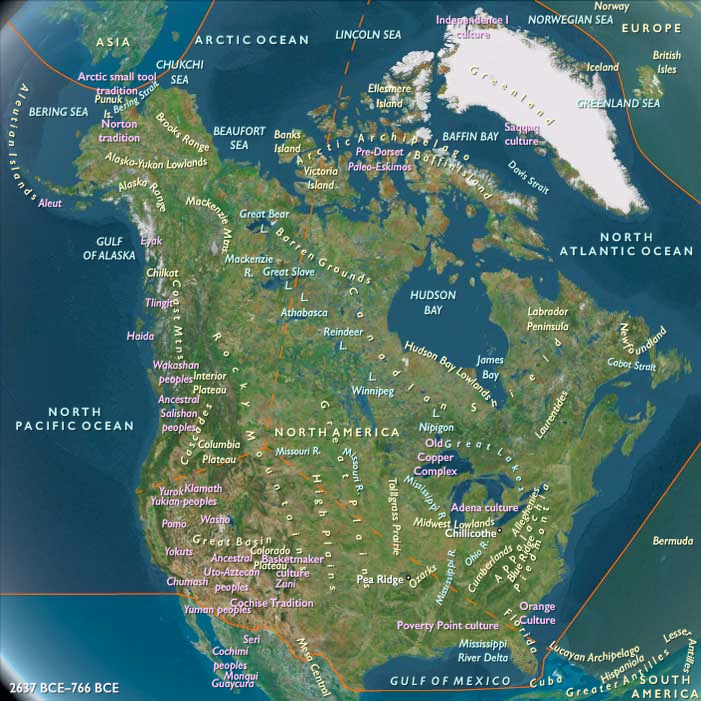
From the Arctic sea-ice and salmon-flooded fjords of the North Pacific to the Great Lakes–Ohio valleys and the estuaries and deserts of the Gulf and West, Early Antiquity in Northern North America was defined by mobility, storage, and exchange.
Three great cultural theaters cohered without empire:
-
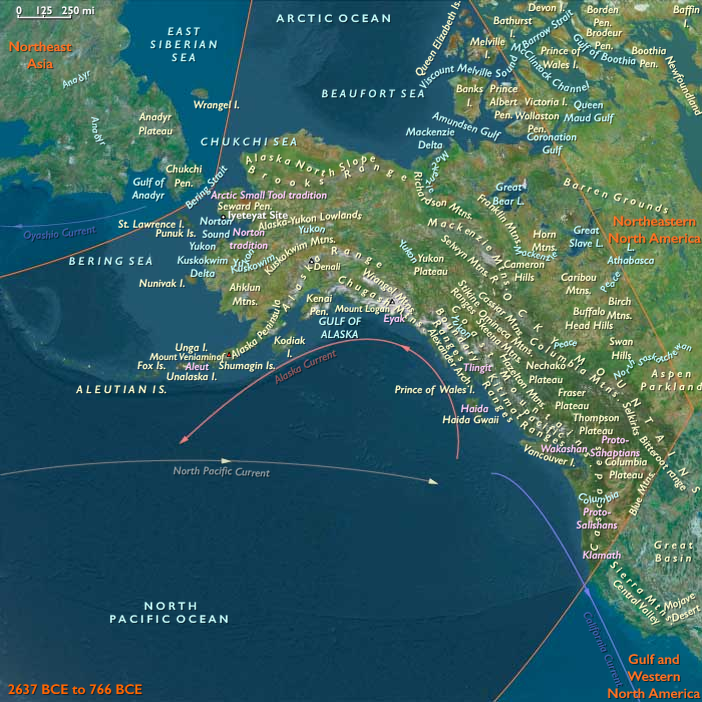
the Northwest, where ASTt bands in the Arctic coexisted with ranked plank-house polities on the Pacific coast;
-
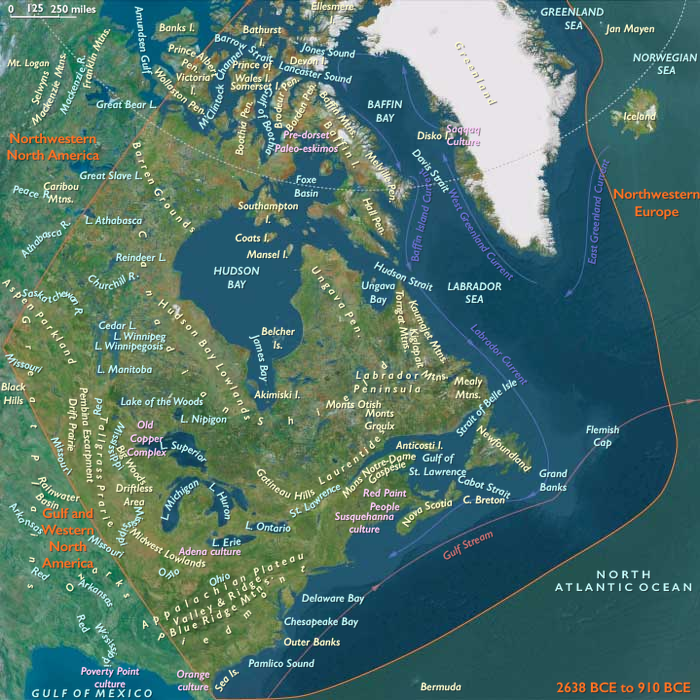
the Northeast, where Woodland earthwork traditions and diversified river–coastal economies matured;
-
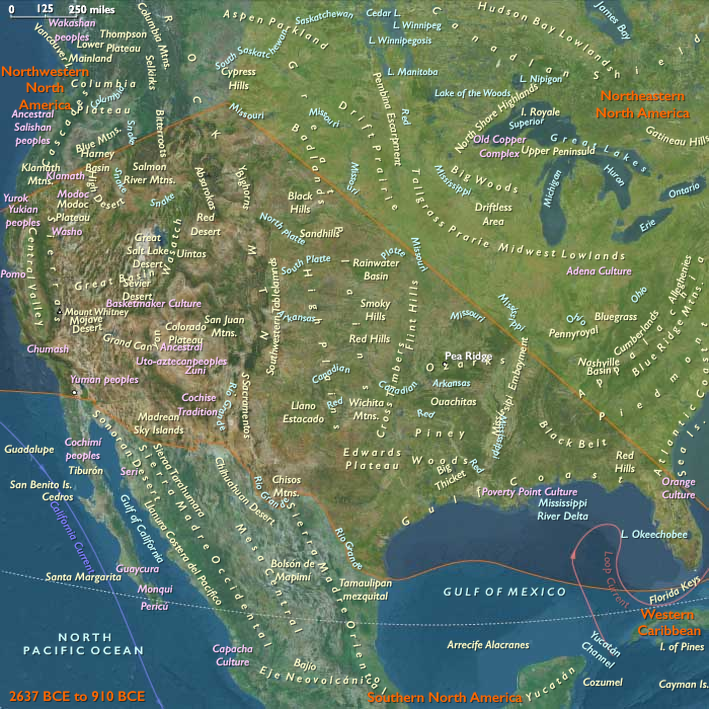
the Gulf & West, where estuaries, deserts, and Pacific littorals linked seasonal camps into wide resource webs.
Together they formed a continent-spanning mosaic of specialized ecologies joined by grease trails, canoe corridors, and reciprocity.
Geography & Environment
-
Northwest: Arctic Alaska’s Kotzebue–Norton coasts, Brooks Range interior, Cook Inlet–Prince William Sound, Haida Gwaii–Central Coast, and the Fraser–Columbia plateaus.
-
Northeast: Atlantic façade from Florida to Newfoundland, St. Lawrence–Great Lakes–Ohio–Mississippivalleys, Appalachian uplands, Hudson Bay rim, and the Eastern Arctic/Greenland margins.
-
Gulf & West: Gulf wetlands and estuaries, Colorado and Central California valleys, Sonoran–Mojave deserts, and southern Rockies/Sierra piedmonts.
Environmental contrasts—ice-edge seas, temperate rainforests, prairie-woodland ecotones, and dune–playa basins—drove seasonal movement and regional specialization.
Climate & Environmental Shifts
Gradual late-Holocene cooling touched all three spheres.
-
Arctic sea-ice regimes structured hunting windows but salmon runs stayed reliable.
-
Northeastern woodlands stabilized around lake–river systems; coastal storms and estuarine productivity persisted.
-
Gulf & West oscillated between wetland surges and desert drought pulses; Pacific upwelling anchored fisheries.
Across the region, storage, multi-ecozone mobility, and trade redundancy were the principal buffers against climate variability.
Societies & Settlement
Northwest
-
Arctic Small Tool tradition (c. 2500–800 BCE): microblade toolkits, small semi-subterranean houses, high mobility—precursors to later Paleo-Inuit/Thule systems.
-
North Pacific Coast: ranked household polities in massive cedar plank dwellings controlled salmon weirs, canoe landings, and cedar stands; interior pit-house towns flourished along salmon canyons (Fraser/Columbia).
Northeast
-
Early–Middle Woodland trajectories seeded by Late Archaic: Adena → Hopewell earthwork ceremonialism in the Ohio and allied river valleys; dense fisheries around the Great Lakes; shell-heap villages along the Atlantic.
-
Horticulture expanded; maize diffusion began in the Midwest late in the span, complementing riverine stored foods.
Gulf & West
-
Gulf Coast: shellfish- and fish-rich estuaries supported large middens and seasonal mound sites.
-
Arid Southwest/Great Basin: early cultivation (squash, sunflower) complemented foraging; water storage and mobility were key.
-
California: acorn economies, salmon fisheries, and Channel Islands–coast exchange linked beadwork, fish products, and obsidian.
Economy & Technology
-
Metals: No bronze/iron industries; native copper cold-hammered in the Northwest and Northeast (Great Lakes copper sheets, NW Alaska awls/points).
-
Lithics: Ground slate knives and points proliferated on the North Pacific; obsidian (Edziza) traveled inland; widespread projectile point traditions persisted.
-
Boats: Skin boats and lamps in the Arctic; sewn-plank and dugout canoes on coasts and inland rivers; estuarine canoes in the Gulf and California.
-
Food systems: smoking/drying racks, plank or pit granaries, and earth ovens generalized food storage across regions—the continent’s key resilience technology.
Movement & Interaction Corridors
-
Grease trails carried eulachon oil from coastal inlets to interior plateau towns; copper, slate, and labret styles circulated along the Gulf of Alaska.
-
Hopewell Interaction Sphere moved mica, obsidian, copper, marine shell among the Great Lakes–Ohio–Appalachian networks; coastal canoe routes linked Chesapeake–Delaware–Hudson–Gulf of Maine.
-
Gulf & Pacific corridors joined estuaries to deserts and islands: shell beads, fish products, pigments, and lithics moved between California, the Channel Islands, and interior valleys; along the Gulf, canoe coasting tied river mouths into a common littoral.
Belief & Symbolism
-
Northwest: first-salmon rites, sea-mammal ceremonies, and emergent crest/lineage identifiers in house art and grave goods.
-
Northeast: earthwork cosmology—Adena/Hopewell mounds with astronomical alignments; carved pipes, copper sheets, and mica mirrors in mortuary assemblages.
-
Gulf & West: shell ornaments, petroglyphs, and painted shelters; coastal and desert ritual emphasized water, game, and ancestral places.
Across regions, feasting, exchange, and mortuary offerings cemented alliances and stabilized resource sharing.
Environmental Adaptation & Resilience
-
Arctic & Subarctic: ice-edge scheduling + salmon storage; driftwood logistics; multi-habitat seasonal rounds.
-
North Pacific Coast: ranked redistribution and stored salmon/eulachon oil smoothed shocks.
-
Northeast: diversified woodland subsistence and inter-regional alliances buffered failure.
-
Gulf & West: mobility between estuary, valley, and upland; water caching and drought-tolerant foraging; smoked/dried surplus against hurricanes and dry years.
Storage + mobility + exchange formed a continent-wide triad of resilience.
Regional Synthesis & Long-Term Significance
By 910 BCE, Northern North America had matured into a tripartite cultural mosaic:
-
Arctic ASTt traditions set the stage for Paleo-Inuit and Thule expansions;
-
North Pacific ranked house societies and interior salmon towns approached their classic florescence;
-
Woodland earthwork networks in the Northeast deepened, while Gulf & Western ecologies sustained diverse, specialized lifeways.
Copper and slate innovation, canoe corridors, and ritualized exchange bound these worlds together—a continental infrastructure of knowledge and movement that would support the medieval transformations described in later-epoch chapters.
Groups
- Kwakwakaʼwakw
- Haida people
- Tlingit people
- Athabaskans, or Dene, peoples
- Klamath (Amerind tribe)
- Tsimshian
- Aleutian Tradition
Topics
- Archaic Stage (Americas)
- Subboreal Period
- Abrolhos Transgression
- 4.2 kiloyear BP aridification event
- Formative Stage (Americas)
- Rottnest Transgression
- Younger Subboreal Period
Commodoties
Subjects
Regions
Subregions
Years: 2637BCE - 910BCE
Groups
- Kwakwakaʼwakw
- Haida people
- Tlingit people
- Athabaskans, or Dene, peoples
- Klamath (Amerind tribe)
- Tsimshian
- Aleutian Tradition
Topics
- Archaic Stage (Americas)
- Subboreal Period
- Abrolhos Transgression
- 4.2 kiloyear BP aridification event
- Formative Stage (Americas)
- Rottnest Transgression
- Younger Subboreal Period
Commodoties
Subjects
Regions
Subregions