
Northwest Europe (988–999 CE): Renewal of Viking …
Years: 988 - 999
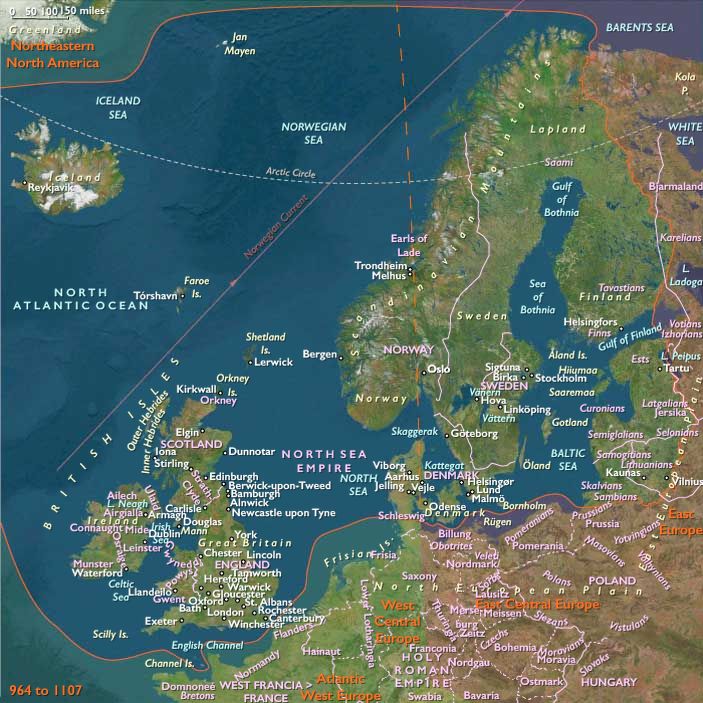
Northwest Europe (988–999 CE): Renewal of Viking Threats and Shifting Powers
Æthelred the Unready and the Resurgence of Viking Raids
During the period of 988–999 CE, Æthelred II, known as Æthelred the Unready (r. 978–1016 CE), faced escalating Viking incursions. Danish and Norse fleets, drawn by England’s political weakness, increasingly raided coastal towns and monastic centers, culminating in significant attacks beginning around 991 CE. The English suffered a devastating defeat at the Battle of Maldon in 991, resulting in the payment of the first substantial Danegeld, an expensive tribute meant to prevent further attacks. These payments marked a turning point, establishing a precedent for repeated extortions that would burden England economically and politically.
Norse-Gaelic Dublin and Brian Boru’s Rise in Ireland
In Ireland, after the abdication of Olaf Cuaran in 980 CE, the Kingdom of Dublin experienced considerable instability. However, the city retained its commercial significance. Irish political dynamics dramatically shifted with the rise of Brian Boru, King of Munster, who extended his influence during this decade, aiming to unify Ireland and challenge Norse-Gaelic dominance. By 999 CE, Brian had firmly positioned himself as a formidable power against Dublin and other Viking-controlled territories.
Leinstermen Revolt with Norse Allies
In late 999 CE, resistance against Brian’s expanding authority culminated when the historically independent-minded Leinstermen, opposed to dominance by either the Uí Néill overkings or Munster, forged a strategic alliance with the Norse rulers of Dublin. This coalition mounted a notable but ultimately unsuccessful rebellion against Brian Boru. Although suppressed, this uprising underscored continuing tensions and rivalries within Ireland and foreshadowed larger conflicts to come.
Scotland: Consolidation Under Kenneth II and Constantine III
In Scotland, Kenneth II (r. 971–995 CE) continued strengthening central authority, expanding royal control into contested regions. His reign, however, was troubled by persistent dynastic rivalries and internal conflict. After Kenneth II’s death—likely by assassination—in 995 CE, Constantine III briefly succeeded him (995–997 CE), only to be quickly replaced by Kenneth III (r. 997–1005 CE). These quick successions highlighted ongoing political volatility within the Kingdom of Alba, even as central authority gradually solidified.
Scandinavia: Christianization and Political Transformation
In Scandinavia, significant political and religious transformations took place. Around 995 CE, the Norwegian king Olaf Tryggvason (r. 995–1000 CE) rose to power, energetically promoting Christianity throughout his realm. Olaf’s forceful approach, often employing violence, accelerated the region’s Christianization, deeply influencing Norwegian society and prompting further migrations of traditionalist Norse settlers to Iceland, Orkney, and Shetland.
Icelandic Commonwealth: Stability Amid External Changes
Iceland, under its decentralized Commonwealth governance and the oversight of the Althing, remained politically stable and culturally robust. Despite increasing Christian influence from mainland Europe and Scandinavia, Icelandic society retained its strong Norse cultural identity and traditions. During this era, Iceland’s trade and maritime connections with Norway, Britain, and Ireland flourished, further integrating it into broader regional economic networks.
Economic and Cultural Resilience of Norse Settlements
Throughout this period, Norse settlements in the Faroe Islands, Orkney, Shetland, and the Hebrides maintained vibrant maritime economies based on trade, fishing, and farming. These communities served as important cultural bridges, preserving Norse traditions while interacting closely with Gaelic and Anglo-Saxon neighbors. They thrived economically despite political volatility elsewhere in Northwest Europe.
Religious Institutions and Cultural Scholarship
Monastic centers in England, Ireland, and Scotland continued their roles as critical sites for intellectual life and cultural preservation, despite the threats posed by Viking incursions. Monks maintained the traditions of manuscript illumination, religious poetry, and historical writing, reinforcing cultural continuity. Latin and Old English scholarship remained robust, notably producing ecclesiastical texts, legal codes, and literary works that shaped subsequent generations.
Legacy of the Era
By 999 CE, Northwest Europe was undergoing significant transitions. England faced increasing vulnerability and fiscal burdens from renewed Viking threats under Æthelred the Unready. In Ireland, Brian Boru emerged as a potent unifying force against Viking dominance, though his supremacy faced notable resistance, illustrated by the unsuccessful rebellion of the Leinstermen allied with Dublin’s Norse. Scotland grappled with ongoing dynastic rivalry even as it slowly consolidated royal authority. In Scandinavia, Olaf Tryggvason’s reign marked a pivotal religious shift toward Christianity, influencing the broader region culturally and politically. Meanwhile, Iceland and other Norse territories continued to thrive culturally and economically, demonstrating resilience amid external pressures. These intertwined developments set the stage for the profound transformations awaiting Northwest Europe in the eleventh century.
People
- Amlaíb Cuarán
- Brian Boru
- Constantine III of Scotland
- Kenneth II of Scotland
- Kenneth III of Scotland
- Olaf Tryggvason
- Æthelred the Unready
Groups
- Gaels
- Anglo-Saxons
- Christianity, Chalcedonian
- Denmark, Kingdom of
- Vikings
- Ireland, medieval
- Dublin, Kingdom of
- Norway, independent Kingdom of
- Alba (Scotland), Scots Kingdom of
- England, (Anglo-Saxon) Kingdom of
- Icelandic Commonwealth, or Icelandic Free State
Topics
- Viking Raids in Ireland
- Viking Raids
- Viking Raids in the North Sea
- Viking Raids in England, Later
- Medieval Warm Period (MWP) or Medieval Climate Optimum
- Leinster revolt against Brian Boru, First
Subjects
- Writing
- Painting and Drawing
- Conflict
- Mayhem
- Exploration
- Faith
- Government
- Custom and Law
- Human Migration
Regions
Subregions

Years: 988 - 999
People
- Amlaíb Cuarán
- Brian Boru
- Constantine III of Scotland
- Kenneth II of Scotland
- Kenneth III of Scotland
- Olaf Tryggvason
- Æthelred the Unready
Groups
- Gaels
- Anglo-Saxons
- Christianity, Chalcedonian
- Denmark, Kingdom of
- Vikings
- Ireland, medieval
- Dublin, Kingdom of
- Norway, independent Kingdom of
- Alba (Scotland), Scots Kingdom of
- England, (Anglo-Saxon) Kingdom of
- Icelandic Commonwealth, or Icelandic Free State
Topics
- Viking Raids in Ireland
- Viking Raids
- Viking Raids in the North Sea
- Viking Raids in England, Later
- Medieval Warm Period (MWP) or Medieval Climate Optimum
- Leinster revolt against Brian Boru, First
Subjects
- Writing
- Painting and Drawing
- Conflict
- Mayhem
- Exploration
- Faith
- Government
- Custom and Law
- Human Migration
Regions
Subregions