
Northwest Europe (976–987 CE): Succession, Strife, and …
Years: 976 - 987
Northwest Europe (976–987 CE): Succession, Strife, and Cultural Resilience
England After Edgar: Succession Crisis and Instability
Following the death of Edgar the Peaceful in 975 CE, England entered a period of considerable turbulence. Edgar's elder son, Edward the Martyr (r. 975–978 CE), ascended to the throne amid controversy and factional rivalry. His brief reign was plagued by political infighting between secular nobles and reform-minded clergy led by Dunstan, Archbishop of Canterbury. This internal conflict culminated in Edward’s assassination at Corfe Castle in 978 CE.
Æthelred the Unready and Early Signs of Weakness
Edward’s death brought his younger half-brother, Æthelred II (r. 978–1016 CE), known as Æthelred the Unready, to power at around age ten. Initially overshadowed by his mother, Ælfthryth, and prominent nobles, Æthelred’s reign quickly revealed vulnerabilities, especially in governance and military preparedness. His rule became increasingly marked by indecisiveness and internal dissent, weakening royal authority.
Renewed Viking Raids and Danish Threat
Exploiting English instability, renewed Viking raids began around 980 CE, intensifying by the decade’s close. Norse raiders, notably under Danish and Norwegian leaders, targeted coastal settlements and monasteries, renewing fears reminiscent of earlier Viking incursions. By 987 CE, Viking attacks had severely tested Æthelred’s government, foreshadowing greater turmoil in subsequent decades.
Dublin Under Olaf Cuaran: Norse-Gaelic Prosperity
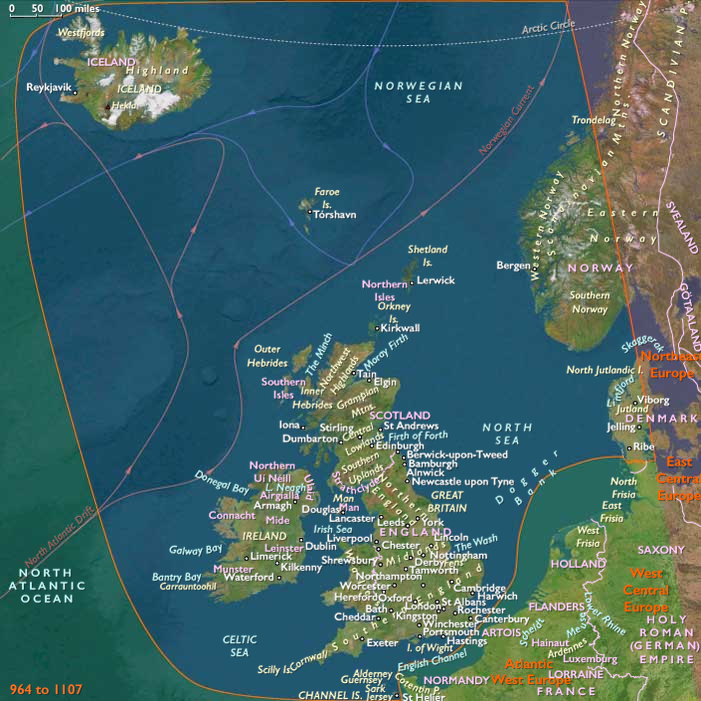
In Ireland, Olaf Cuaran, King of Dublin (r. 952–980 CE), maintained prosperous trade networks and maritime power until his abdication following a decisive defeat at the Battle of Tara in 980 CE. After Olaf's departure, Dublin entered a period of political uncertainty but retained significant economic importance as a thriving center of Norse-Gaelic culture and commerce, maintaining vital connections across the Irish Sea and Scandinavia.
Scottish Succession and Rivalries: Kenneth II
After Scottish king Cuilén died in 971 CE, Kenneth II (r. 971–995 CE) emerged as the prominent figure of Alba. His reign was marked by consolidation efforts, territorial expansion, and ongoing internal rivalries. Kenneth sought to strengthen royal authority, solidifying central governance amidst persistent tensions among Scotland’s regional elites, particularly in northern and eastern regions.
Icelandic Commonwealth: Continued Stability and Development
Throughout this period, Iceland’s political and social stability under the decentralized but effective governance of the Althing allowed cultural and economic development. The Icelandic Commonwealth continued to refine its sophisticated legal framework, settling disputes peacefully and fostering a distinctive Norse cultural identity. By 987 CE, Iceland had solidified its unique position as a stable, prosperous community with well-established institutions.
Scandinavian Political Fragmentation and Migration Patterns
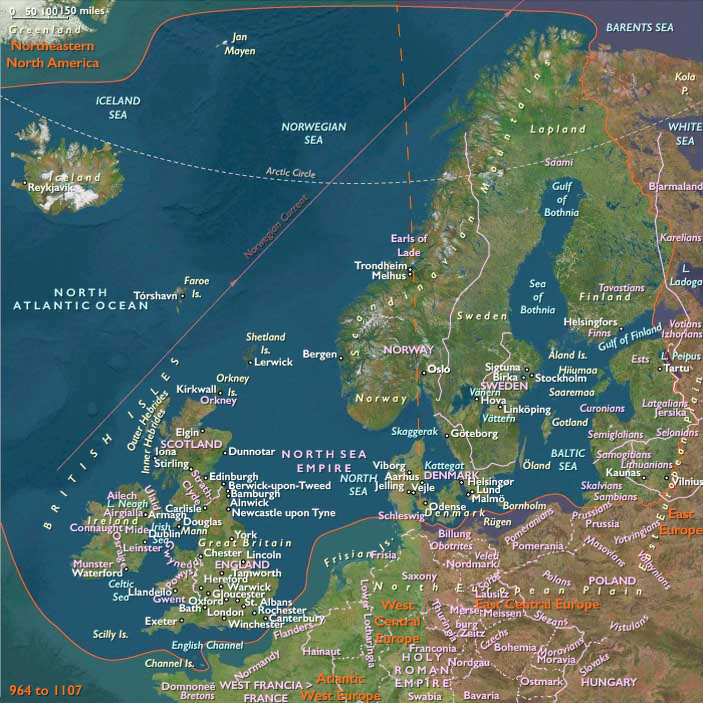
In Scandinavia, ongoing dynastic struggles continued, particularly in Norway, prompting further westward migration. Notable numbers of Norse settlers continued to arrive in Iceland, the Faroes, Orkney, Shetland, and northern Britain, reinforcing strong cultural ties between Scandinavia and the Atlantic islands.
Religious and Cultural Scholarship
Monastic and ecclesiastical centers across England, Scotland, and Ireland persisted as essential hubs of religious learning and literary production. The legacy of the earlier Benedictine Reform continued, ensuring vibrant cultural life despite political upheavals. Manuscript preservation and intellectual scholarship remained critical, reflecting continued cultural resilience.
Legacy of the Era
By 987 CE, Northwest Europe had experienced critical transitions marked by significant political challenges and ongoing cultural vibrancy. England’s internal strife under Æthelred foreshadowed prolonged instability, exacerbated by renewed Viking threats. Conversely, Norse-Gaelic Dublin maintained its prominence despite political uncertainty, while Scotland saw strengthened royal authority under Kenneth II. Meanwhile, Iceland's Commonwealth matured into a stable polity. Collectively, these developments emphasized both vulnerability and resilience, laying essential foundations for subsequent historical changes in Northwest Europe.
People
- Amlaíb Cuarán
- Cuilén
- Dunstan
- Edward the Martyr
- Indulf
- Kenneth II of Scotland
- Ælfthryth
- Æthelred the Unready
Groups
- Gaels
- Anglo-Saxons
- Christianity, Chalcedonian
- Benedictines, or Order of St. Benedict
- Denmark, Kingdom of
- Vikings
- Ireland, medieval
- Dublin, Kingdom of
- Norway, independent Kingdom of
- Alba (Scotland), Scots Kingdom of
- England, (Anglo-Saxon) Kingdom of
- Icelandic Commonwealth, or Icelandic Free State
Topics
- Middle Subatlantic Period
- Subatlantic Period
- Viking Raids in Ireland
- Viking Raids
- Viking Raids in the North Sea
- Viking Raids in England, Later
- Tara, Battle of
Subjects
- Writing
- Painting and Drawing
- Conflict
- Mayhem
- Exploration
- Faith
- Government
- Custom and Law
- Human Migration
Regions
Subregions
Years: 976 - 987
People
- Amlaíb Cuarán
- Cuilén
- Dunstan
- Edward the Martyr
- Indulf
- Kenneth II of Scotland
- Ælfthryth
- Æthelred the Unready
Groups
- Gaels
- Anglo-Saxons
- Christianity, Chalcedonian
- Benedictines, or Order of St. Benedict
- Denmark, Kingdom of
- Vikings
- Ireland, medieval
- Dublin, Kingdom of
- Norway, independent Kingdom of
- Alba (Scotland), Scots Kingdom of
- England, (Anglo-Saxon) Kingdom of
- Icelandic Commonwealth, or Icelandic Free State
Topics
- Middle Subatlantic Period
- Subatlantic Period
- Viking Raids in Ireland
- Viking Raids
- Viking Raids in the North Sea
- Viking Raids in England, Later
- Tara, Battle of
Subjects
- Writing
- Painting and Drawing
- Conflict
- Mayhem
- Exploration
- Faith
- Government
- Custom and Law
- Human Migration
Regions
Subregions