
Northwest Europe (952–963 CE): Political Consolidation and …
Years: 952 - 963
Northwest Europe (952–963 CE): Political Consolidation and Cultural Vitality
Eadred’s Reign and the End of Norse Rule in York
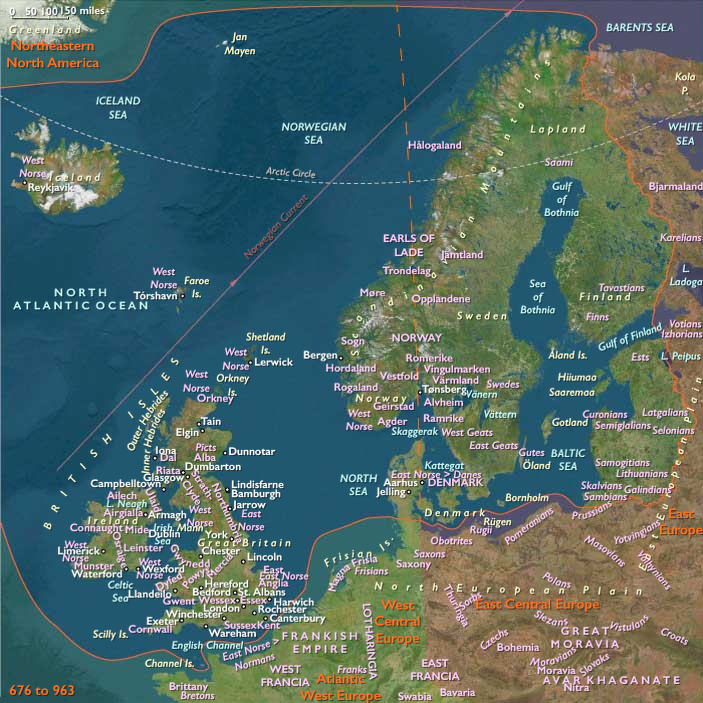
Between 952 and 954 CE, King Eadred of England continued to consolidate royal power, decisively ending the rule of the Norse king Eric Bloodaxe in Northumbria. After intermittent periods of instability, Eadred’s capture of York in 954 CE permanently dissolved the independent Norse kingdom there, firmly uniting Northumbria under English control and marking a pivotal shift in England's political landscape.
Ascension and Stability Under Edgar the Peaceful
Following Eadred’s death in 955 CE, his young nephew Eadwig ascended to the throne briefly (955–959 CE), marked by internal court disputes. However, his reign swiftly transitioned in 959 CE to that of his younger brother, Edgar the Peaceful (r. 959–975 CE), whose rule quickly restored internal stability. Edgar’s reign is characterized by peace, consolidation of centralized governance, and enhanced administrative efficiency, laying lasting foundations for the late Anglo-Saxon kingdom.
Ireland’s Norse-Gaelic Kingdoms
During this period, Norse-Gaelic kingdoms in Ireland, particularly Dublin and Limerick, flourished economically and culturally despite frequent political instability. Rulers such as Olaf Cuaran of Dublin (first reign 945–947, second reign 952–980 CE) solidified control over their territories, strengthening maritime trade connections with Britain, Scandinavia, and mainland Europe. Dublin’s prominence as a cultural and trading hub grew significantly.
Political Continuity in Alba Under Indulf
In Scotland, following the death of Malcolm I in 954 CE, his successor Indulf (r. 954–962 CE) continued efforts to consolidate Alba. His reign is notable for successfully capturing Edinburgh (Dunedin), further strengthening Scottish authority in the region. Despite occasional Viking incursions, Indulf maintained stability, facilitating gradual unification and centralization of royal power in Scotland.
Stability and Expansion in the Icelandic Commonwealth
In Iceland, the Commonwealth flourished culturally and politically through the stability provided by the newly established Althing, which mediated disputes and codified laws. Icelandic society continued to mature, developing its distinctive cultural traditions, social institutions, and an increasingly sophisticated legal framework. The settlement era's conclusion fostered a stable, economically robust community, laying groundwork for a vibrant literary and historical culture.
Compilation and Cultural Significance of the Cædmon Manuscript
In Anglo-Saxon England, the period remained culturally significant with continued literary production and manuscript compilation. The so-called Cædmon manuscript, compiled between approximately 930–960 CE, represented a significant scholarly achievement. This collection of Old English religious poetry, featuring works such as Genesis A, Genesis B, Exodus, Daniel, Christ and Satan, and Judith, was illustrative of the cultural vibrancy and intellectual rigor characterizing late Anglo-Saxon monastic scholarship.
Religious Institutions and Cultural Preservation
Monastic centers in England, Scotland, and Ireland remained vibrant hubs of learning, manuscript preservation, and religious life throughout this period. Such institutions safeguarded classical and ecclesiastical texts, maintained educational traditions, and promoted cultural continuity despite regional political turbulence.
Scandinavian Political Dynamics and Continued Migration
In Scandinavia, the death of prominent rulers like Eric Bloodaxe intensified internal power struggles and succession disputes. Instability and political fragmentation in Norway prompted ongoing Norse migrations toward Iceland, the British Isles, and the North Atlantic islands, sustaining the cultural links across the North Atlantic world.
Legacy of the Era
By 963 CE, Northwest Europe had undergone crucial political consolidation, notably with the integration of York under firm English control, the growing stability of Edgar the Peaceful’s reign, and the territorial expansion of Alba under Indulf. At the same time, Ireland's Norse-Gaelic kingdoms retained vibrant economic and cultural roles, while Iceland solidified its unique Commonwealth governance. Scholarly and cultural life, epitomized by the Cædmon manuscript, reflected the rich intellectual atmosphere of the period, marking a significant transitional era towards a more politically centralized and culturally coherent medieval Europe.
People
- Amlaíb Cuarán
- Eadred
- Eadwig
- Edgar the Peaceful
- Eric Bloodaxe
- Harald Fairhair
- Indulf
- Malcolm I of Scotland
Groups
- Gaels
- Christianity, Chalcedonian
- Denmark, Kingdom of
- Vikings
- Dublin, Kingdom of
- Norway, independent Kingdom of
- York, Scandinavian (Danish)
- Alba (Scotland), Scots Kingdom of
- England, (Anglo-Saxon) Kingdom of
- Icelandic Commonwealth, or Icelandic Free State
Topics
- Middle Subatlantic Period
- Subatlantic Period
- Viking Raids in Ireland
- Viking Raids
- Viking Raids in the North Sea
- Viking Raids in England, Later
Subjects
Regions
Subregions

Years: 952 - 963
People
- Amlaíb Cuarán
- Eadred
- Eadwig
- Edgar the Peaceful
- Eric Bloodaxe
- Harald Fairhair
- Indulf
- Malcolm I of Scotland
Groups
- Gaels
- Christianity, Chalcedonian
- Denmark, Kingdom of
- Vikings
- Dublin, Kingdom of
- Norway, independent Kingdom of
- York, Scandinavian (Danish)
- Alba (Scotland), Scots Kingdom of
- England, (Anglo-Saxon) Kingdom of
- Icelandic Commonwealth, or Icelandic Free State
Topics
- Middle Subatlantic Period
- Subatlantic Period
- Viking Raids in Ireland
- Viking Raids
- Viking Raids in the North Sea
- Viking Raids in England, Later
Subjects
Regions
Subregions