
Northwest Europe (940–951 CE): A Shifting Balance …
Years: 940 - 951
Northwest Europe (940–951 CE): A Shifting Balance of Power
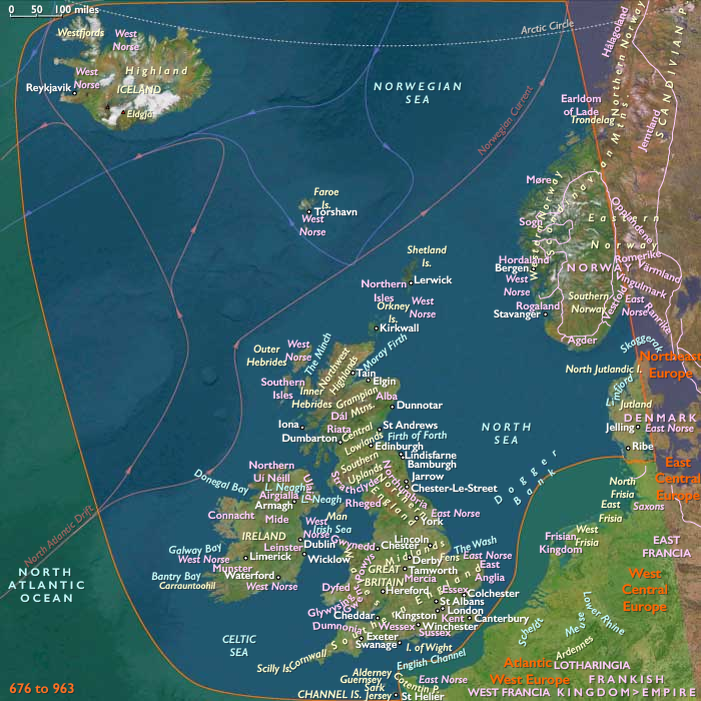
Aftermath of Athelstan’s Reign in England
Following the death of King Athelstan in 939 CE, his half-brother, Edmund I (r. 939–946), inherited a kingdom under immediate threat. The Norse leader Olaf Guthfrithson, King of Dublin, swiftly exploited the political transition, reclaiming Northumbria and briefly reasserting Viking dominance. Edmund responded decisively, regaining the Five Boroughs (Derby, Lincoln, Nottingham, Stamford, and Leicester) by 942 CE, further consolidating the unity established under Athelstan.
Norse-Gaelic Influence in York and Dublin
Olaf Guthfrithson’s short-lived rule (939–941 CE) in York exemplified the continued resilience of Norse-Gaelic power in northern England. After Olaf's death in 941 CE, instability marked Viking rule in Northumbria, with intermittent power shifts between Anglo-Saxon and Norse leaders. In Dublin, Olaf's successors maintained the economic vitality and maritime trade links of the kingdom, reinforcing its role as a key Norse-Gaelic trading center.
Eadred’s Consolidation and English Unification
Following Edmund I’s assassination in 946 CE, his brother Eadred (r. 946–955) succeeded him. Eadred energetically suppressed rebellions in Northumbria, notably quelling renewed Norse uprisings by 948 CE. Through persistent military and diplomatic efforts, Eadred firmly reestablished English control over the north, significantly reducing independent Norse rule in York by the period's end.
Kingdom of Alba and Malcolm I’s Reign
In Scotland, Constantine II abdicated in 943 CE, retiring to monastic life. His successor, Malcolm I (r. 943–954 CE), assumed leadership of the Kingdom of Alba and continued consolidating royal authority. Malcolm secured his realm against internal and external threats, particularly from resurgent Viking powers, maintaining Alba’s integrity and strengthening administrative structures.
Norway Under Eric Bloodaxe
In Norway, succession struggles following Harald Fairhair’s death resulted in the brief but notable reign of his son Eric Bloodaxe. Known for aggressive tactics, Eric’s contentious rule (briefly in Norway around 930–934 CE, later in York circa 947–948 and again 952–954 CE) generated significant internal conflict, prompting further Norse migration toward Iceland, Orkney, Shetland, and northern Britain.
Icelandic Commonwealth Establishment
The Icelandic Commonwealth, formally established in 930 CE with the founding of the Althing, matured into a stable, decentralized governance system during these years. The Althing became a cornerstone of Icelandic political and social identity, mediating disputes among chieftains and ensuring communal cooperation. The period of settlement drew to a close, leading to a distinct, thriving Norse society.
Compilation of the Cædmon Manuscript
Around 950 CE, Anglo-Saxon England experienced a flourishing of literary culture exemplified by the compilation of the so-called Cædmon manuscript, a significant collection of Old English religious poetry. Although historically associated with the poet Cædmon, scholars now attribute its contents—including the works known today as Genesis A, Genesis B, Exodus, Daniel, Christ and Satan, and Judith—to various anonymous poets. Recent scholarship, focusing on illustration styles, places the manuscript's compilation date narrowly between 930–960 CE. The manuscript serves as a vital record of the religious and cultural milieu of late Anglo-Saxon England.
Religious and Cultural Continuity
Monastic institutions across England, Scotland, and Ireland continued to serve as essential centers for preserving learning, cultural traditions, and religious practices. Manuscripts, historical records, and legendary narratives were diligently preserved, reinforcing cultural identity amid political turbulence.
Legacy of the Era
By 951 CE, Northwest Europe had undergone pivotal transformations. The renewed consolidation of English royal authority under Edmund I and Eadred significantly curtailed Viking political independence in Northumbria. Concurrently, Norse-Gaelic kingdoms in Ireland and Scotland retained their cultural and economic vibrancy, and the Icelandic Commonwealth established enduring political innovations. The era also witnessed rich literary activity exemplified by the Cædmon manuscript, reflecting the intellectual depth of Anglo-Saxon England. These developments collectively shaped the regional trajectory of governance, cultural identity, and historical memory.
People
- Constantine of Scotland
- Eadred
- Edmund I of England
- Eric Bloodaxe
- Harald Fairhair
- Olaf Guthfrithsson
- Æthelstan
Groups
- Gaels
- Britons (historical)
- Anglo-Saxons
- Christianity, Chalcedonian
- East Angles, Kingdom of the
- Fortriu, (Pictish) Kingdom of
- Wessex, English Kingdom of
- Mercia, Kingdom of
- Northumbria, Kingdom of
- Denmark, Kingdom of
- Vikings
- Norse
- Danes (Scandinavians)
- Scottish people
- Norway, independent Kingdom of
- York, Scandinavian (Danish)
- Alba (Scotland), Scots Kingdom of
- Icelandic Commonwealth, or Icelandic Free State
Topics
- Middle Subatlantic Period
- Subatlantic Period
- Viking Raids in Ireland
- Viking Raids
- Viking Raids in the North Sea
- Viking Raids in England, Later
Subjects
Regions

Subregions
Years: 940 - 951
People
- Constantine of Scotland
- Eadred
- Edmund I of England
- Eric Bloodaxe
- Harald Fairhair
- Olaf Guthfrithsson
- Æthelstan
Groups
- Gaels
- Britons (historical)
- Anglo-Saxons
- Christianity, Chalcedonian
- East Angles, Kingdom of the
- Fortriu, (Pictish) Kingdom of
- Wessex, English Kingdom of
- Mercia, Kingdom of
- Northumbria, Kingdom of
- Denmark, Kingdom of
- Vikings
- Norse
- Danes (Scandinavians)
- Scottish people
- Norway, independent Kingdom of
- York, Scandinavian (Danish)
- Alba (Scotland), Scots Kingdom of
- Icelandic Commonwealth, or Icelandic Free State
Topics
- Middle Subatlantic Period
- Subatlantic Period
- Viking Raids in Ireland
- Viking Raids
- Viking Raids in the North Sea
- Viking Raids in England, Later
Subjects
Regions
Subregions