
Northwest Europe (100–243 CE): Roman Consolidation, Economic …
Years: 100 - 243
Northwest Europe (100–243 CE): Roman Consolidation, Economic Expansion, and Cultural Synthesis
Stabilization and Expansion of Roman Britain
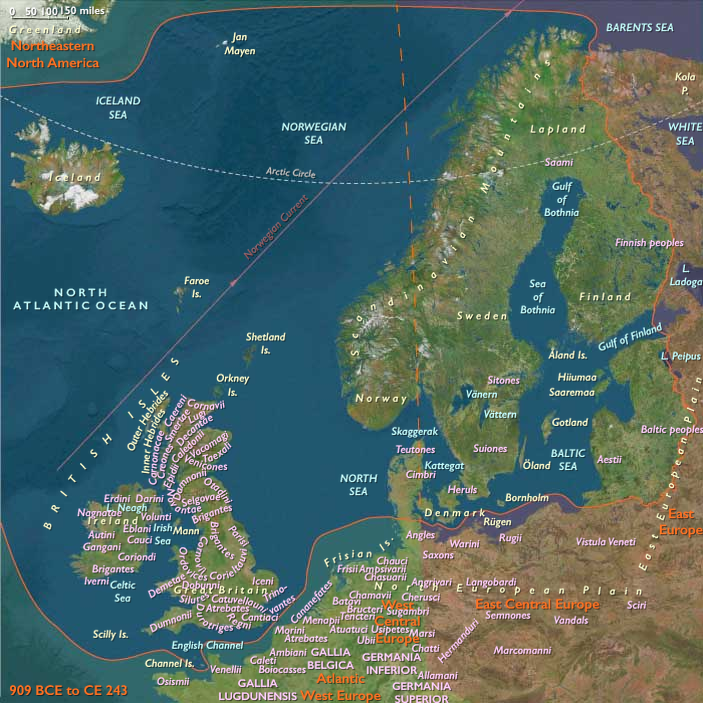
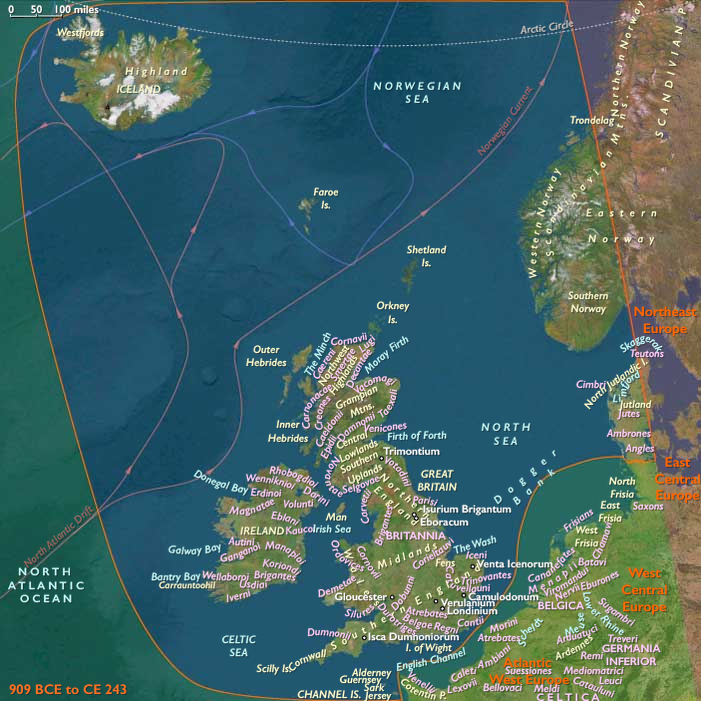
From 100 to 243 CE, Roman influence in Northwest Europe, particularly in southern and central Britain, continued to deepen. The province experienced greater administrative stabilization and territorial consolidation, notably through infrastructure developments and the construction of significant urban and military centers. The border gradually solidified along the line of the Stanegate in Northern England, with the iconic Hadrian’s Wall constructed along this line in 138 CE, fortifying the northern boundary and symbolizing Roman permanence.
Economic Integration and Urban Growth
Roman Britain thrived economically during this period, facilitated by extensive trade networks linking the region with continental Europe and the broader Roman Empire. Towns such as Londinium (London), Eboracum (York), and Camulodunum (Colchester) flourished as administrative, commercial, and cultural hubs. Economic specialization increased, with agriculture, mining, and manufacturing benefiting from Roman technological and organizational innovations.
Social Stratification and Romanized Elites
Roman influence profoundly impacted local social structures, creating clearly defined hierarchies. Romanized indigenous elites held administrative roles, adopted Roman lifestyles, and acted as intermediaries between local populations and imperial authority. The emergence of wealthy villa estates demonstrated the increasing economic and social divide, as Romanized elites enjoyed considerable prosperity and cultural privilege.
Religious Syncretism and Local Traditions
Cultural and religious practices reflected a dynamic synthesis between Roman traditions and indigenous beliefs. Roman gods were worshiped alongside local deities, exemplified by combined cult sites and inscriptions. Ritual practices, including the continued existence of localized ceremonies and offerings, demonstrated resilience and adaptation in the face of cultural change.
Military Presence and Infrastructure
Roman military installations became critical features of the landscape, providing security and facilitating Roman control and communication. Military roads, forts, and defensive walls transformed local settlement patterns, promoting economic connectivity and cultural integration. The Roman army also functioned as an economic stimulus, driving local demand for supplies, labor, and trade.
Agricultural Advances and Regional Prosperity
Roman agricultural methods continued to revolutionize food production, notably in fertile regions such as the Aberdeen lowlands and around present-day Londonderry (Derry). Advanced farming techniques, efficient crop rotation, and improved irrigation contributed significantly to stable food supplies, population growth, and regional prosperity.
Continuing Celtic Resistance and Cultural Autonomy
Despite sustained Roman influence, areas beyond the immediate reach of Roman administration retained significant autonomy. Regions such as northern Britain, Wales, and parts of western Britain preserved strong Celtic cultural identities, actively resisting complete assimilation into the Roman sphere. Repeated military campaigns indicated ongoing tension and intermittent conflict along the Roman frontier.
Cultural Continuity and Early Historical Records of Ireland
Ireland remained largely untouched by Roman conquest, preserving traditional cultural and religious practices centered around ancient ceremonial sites like Newgrange, Knowth, and Dowth. The earliest written records of Ireland came from classical Greco-Roman geographers. Ptolemy, in his Almagest and later in Geography, referred to Ireland as Mikra Brettania (Little Britain), Iouernia, and ultimately as Hibernia or Scotia in Latinized form. He recorded sixteen nations inhabiting Ireland in CE 100. Roman coins discovered at settlements such as Freestone Hill near Gowran and Newgrange highlight some degree of Roman-Irish interaction, though direct relations remain unclear.
Stability in Orkney and Shetland
The Orkney and Shetland Islands continued their cultural and economic traditions with minimal Roman influence, benefiting from sustained maritime trade and local industries.
Persistent Isolation of Iceland and the Faroe Islands
Throughout this period, the islands of Iceland and the Faroe Islands remained uninhabited due to severe climates and remote geographic conditions. Iceland’s volcanic activity persisted as a critical tool for archaeological dating across Northwest Europe.
Legacy of the Age
By 243 CE, Roman integration had profoundly reshaped economic, social, and cultural landscapes in southern and central Britain, promoting urbanization, economic specialization, and cultural syncretism. Meanwhile, peripheral areas continued their distinctive cultural paths, maintaining vibrant identities and traditions. This duality of Roman influence and local resistance significantly shaped Northwest Europe's historical trajectory into subsequent eras.
People
Groups
- Ireland, ancient
- Britons (historical)
- Irish people
- Britain, Roman
- Roman Empire (Rome): Nerva-Antonine dynasty
- Roman Empire (Rome): Severan dynasty
- Roman Empire (Rome): Non-dynastic
Topics
Commodoties
Subjects
- Commerce
- Architecture
- Environment
- Decorative arts
- Conflict
- Mayhem
- Exploration
- Government
- Custom and Law
- Technology
- Metallurgy
Regions
Subregions
Years: 100 - 243
People
Groups
- Ireland, ancient
- Britons (historical)
- Irish people
- Britain, Roman
- Roman Empire (Rome): Nerva-Antonine dynasty
- Roman Empire (Rome): Severan dynasty
- Roman Empire (Rome): Non-dynastic
Topics
Commodoties
Subjects
- Commerce
- Architecture
- Environment
- Decorative arts
- Conflict
- Mayhem
- Exploration
- Government
- Custom and Law
- Technology
- Metallurgy
Regions
Subregions