
Northwest Europe (1852–1863): Imperial Prosperity, Public Health …
Years: 1852 - 1863
Northwest Europe (1852–1863): Imperial Prosperity, Public Health Advances, and Diplomatic Challenges
Victorian Britain’s "Golden Years"
The period from 1852 to 1863 represented the height of British power, influence, and prosperity, characterized by what historian Bernard Porter has termed Britain’s “Golden Years” (1850–1870). With peace abroad—save the brief yet costly Crimean War (1854–1856)—and remarkable domestic stability, Britain’s national income per capita increased dramatically, growing by half due to sustained industrialization, especially in textiles, machinery, and global trade networks.
A widespread spirit of libertarianism emerged, with minimal government interference, low taxes, and a vibrant sense of personal freedom. Nevertheless, societal power remained concentrated among the aristocracy and gentry, who dominated government, Parliament, the military, and the Church. Rich industrialists, despite their economic success, continued to rank lower in social prestige than titled landowners.
Cholera, Epidemiology, and Public Health Reform
Public health continued as a significant concern, highlighted by London’s severe cholera epidemic of 1853–1854, which claimed 10,739 lives. In a crucial turning point for epidemiology, physician Dr. John Snow traced one local outbreak, responsible for over 500 deaths, to a contaminated water pump in Broad Street, London. Snow’s investigation validated his theory that cholera was water-borne, marking the beginning of modern epidemiological methods—although acceptance of this breakthrough by medical authorities remained gradual, and comprehensive public health reforms took years to implement fully.
Meanwhile, earlier epidemics had already spurred initial sanitation reforms. However, Snow’s landmark discovery profoundly influenced future public health policy, emphasizing sanitation infrastructure, clean water supply, and urban planning improvements in Britain’s rapidly growing cities.
Iceland’s Growing Nationalism and Trade Liberalization
Outside Britain, national consciousness blossomed notably in Iceland, inspired by European romantic and nationalist ideals. Under the influential leadership of Jón Sigurðsson, an Icelandic independence movement emerged strongly during the 1850s. The year 1854 marked a significant step toward economic independence, as Icelandic trade—long monopolized by Danish merchants—opened to other nations, laying foundations for greater Icelandic autonomy and national identity.
Social Reforms and Industrial Regulation
Social reforms continued apace within Britain’s industrial environment. Building upon earlier efforts such as the Mines Act of 1842, Parliament progressively enacted further measures addressing appalling working conditions, child labor, and workplace safety. The Victorian middle class, committed to ideals of "respectability," actively sought to uplift working-class living standards through education, temperance, and social improvement initiatives. Employers adopted paternalistic practices, recognizing trade unions, and frequently provided workers with comprehensive welfare services, including housing, schools, churches, libraries, baths, and gymnasia.
Chartism’s Decline and Working-Class Prosperity
The democratic, working-class movement of Chartism, having peaked in 1848, gradually declined. British workers, increasingly experiencing material prosperity, largely ignored radical foreign agitators such as Karl Marx and instead focused energies on trade unions, cooperative societies, and economic advancement. This shift reflected a new societal consensus, underpinning domestic peace and sustained economic growth.
Thomas Cook and Victorian Leisure
Leisure and tourism blossomed, spearheaded by entrepreneur Thomas Cook. From humble beginnings arranging railway excursions for temperance campaigners in 1841, Cook significantly expanded his business through the 1850s, notably facilitating travel for 150,000 visitors to London’s Great Exhibition (1851). Cook’s tours soon included international destinations, pioneering modern organized travel and broadening leisure opportunities for Britain's growing middle classes.
Industrial Standardization and Technological Innovation
Industrial and technological advances continued, notably through widespread standardization of screw threads and precision engineering—building on Henry Maudslay’s earlier inventions—which facilitated compatibility, mass production, and interchangeability in manufacturing. These developments solidified Britain's global industrial dominance, showcased vividly at the Great Exhibition, and drove Britain's global commercial network.
The Crimean War: Diplomatic and Military Challenges
Although generally peaceful, Britain briefly engaged in significant continental conflict during the Crimean War (1854–1856). Fearing Russian ambitions toward Constantinople and the Bosporus—crucial to Britain's strategic and commercial interests—Britain allied with France and the Ottoman Empire against Russia. Despite victory, the war exposed glaring deficiencies in Britain’s military logistics and health care, notably addressed by reformer Florence Nightingale. High casualties due to disease and poor administration sparked critical reforms in British military organization and public health management.
Lord Palmerston and British Foreign Policy
British foreign policy during this era was dominated by Lord Palmerston (1784–1865), who served as Foreign Secretary and Prime Minister. Palmerston, a fierce nationalist and controversial figure known for aggressive diplomacy and "liberal interventionism," used British naval power to suppress the Atlantic slave trade. His tenure shaped Britain's assertive global posture, marked by patriotic confidence but also underlying diplomatic tensions, notably regarding relations with France’s Napoleon III and concerns over the stability of the Ottoman Empire.
British Diplomacy and the American Civil War
Britain faced significant diplomatic challenges during the American Civil War (1861–1865). British aristocratic leaders tended to favor the Confederacy, attracted by its aristocratic structures and crucial cotton exports for Britain’s textile industry. However, Britain’s working classes, dependent on Northern grain and meat exports—especially following poor British harvests in the late 1850s and early 1860s—strongly supported the Union.
Prince Albert played a crucial diplomatic role in defusing a potential Anglo-American war crisis in late 1861. In 1862, Britain and France contemplated diplomatic intervention favoring the Confederacy, risking war with the United States. However, President Abraham Lincoln’s Emancipation Proclamation announcement in September 1862, making the abolition of slavery a central war aim, eliminated prospects of European intervention on the Confederate side.
Nevertheless, Britain maintained economic engagement with both sides, selling arms, building blockade runners for the Confederacy, and controversially permitting construction of Confederate warships in British shipyards—actions that later sparked diplomatic tensions resolved in America’s favor in the Alabama Claims of 1872.
British Attitudes Toward France and Napoleon III
Despite allying with France during the Crimean War, Britain viewed the Second Empire of Napoleon III with skepticism. Napoleon’s assertive foreign policy, rapid naval buildup, and construction of ironclad warships raised British fears of potential French threats to global maritime dominance, resulting in cautious diplomatic relations and suspicion between the two powers.
Scandinavian Stability and National Identities
Scandinavia, particularly Sweden and Norway, maintained political stability. Norway increasingly asserted its distinct national identity within its union with Sweden, while Denmark continued moderate internal liberalization. This period notably coincided with Iceland’s emerging nationalism and liberalization of its trade policies, reflecting broader nationalist trends across Northern Europe.
Between 1852 and 1863, Northwest Europe—centered on Victorian Britain—experienced unparalleled prosperity, stability, and technological advancement. Public health crises like London's cholera epidemic accelerated sanitary reforms and epidemiological breakthroughs by figures like John Snow. Britain's global diplomatic leadership, industrial dominance, and cautious foreign policy, shaped profoundly by influential statesmen like Lord Palmerston, navigated complex international challenges, including the Crimean War and American Civil War diplomacy. Concurrently, emergent nationalist movements in Iceland and Scandinavia indicated broader regional transformations. Together, these developments epitomized Britain's "Golden Years," reflecting both imperial confidence and emergent modernity shaping the remainder of the nineteenth century.
People
- Abraham Lincoln
- Florence Nightingale
- Henry John Temple, 3rd Viscount Palmerston
- John Snow
- Jón Sigurðsson
- Karl Marx
- Napoleon III
- Prince Albert
- Queen Victoria
- Thomas Cook
Groups
- Irish people
- Christians, Roman Catholic
- Iceland (Danish dependency)
- Ottoman Empire
- Anglicans (Episcopal Church of England)
- Presbyterians
- British Empire
- East India Company, British (United Company of Merchants of England Trading to the East Indies)
- Russian Empire
- Britain (United Kingdom of Great Britain and Ireland)
- Norway, dependent Swedish kingdom of
- Denmark, Kingdom of
- Chartism
- France, Second Empire of
Topics
- Middle Subatlantic Period
- Colonization of Asia, British
- Colonization of the Americas, British
- Industrial Revolution, First
- cholera pandemic, 1846-1860
- Crimean War
- American Civil War (War between the States, War of the Rebellion, War of Secession, War for Southern Independence)
Commodoties
Subjects
- Commerce
- Engineering
- Environment
- Labor and Service
- Fashion
- Decorative arts
- Style
- Conflict
- Faith
- Government
- Scholarship
- Custom and Law
- Finance
- Human Migration
- political movement
- workers' movement
Regions
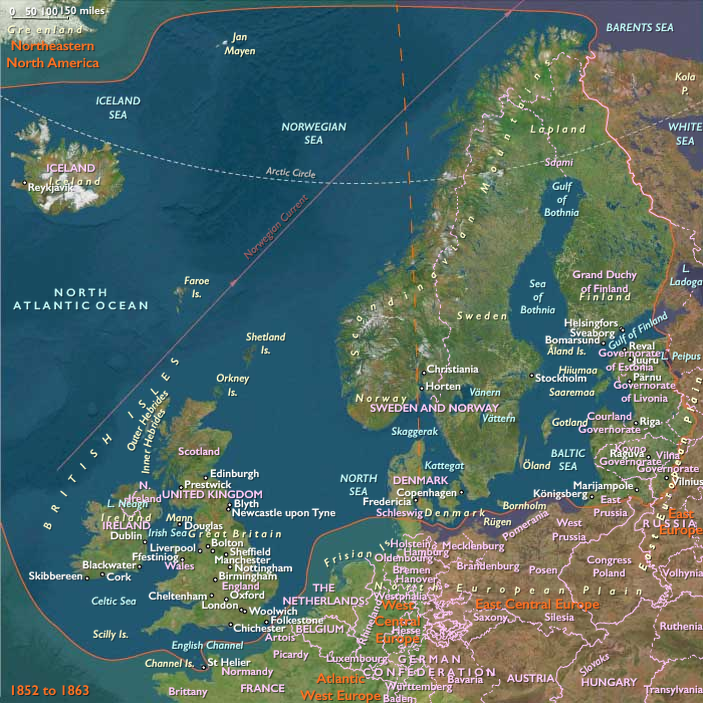
Subregions
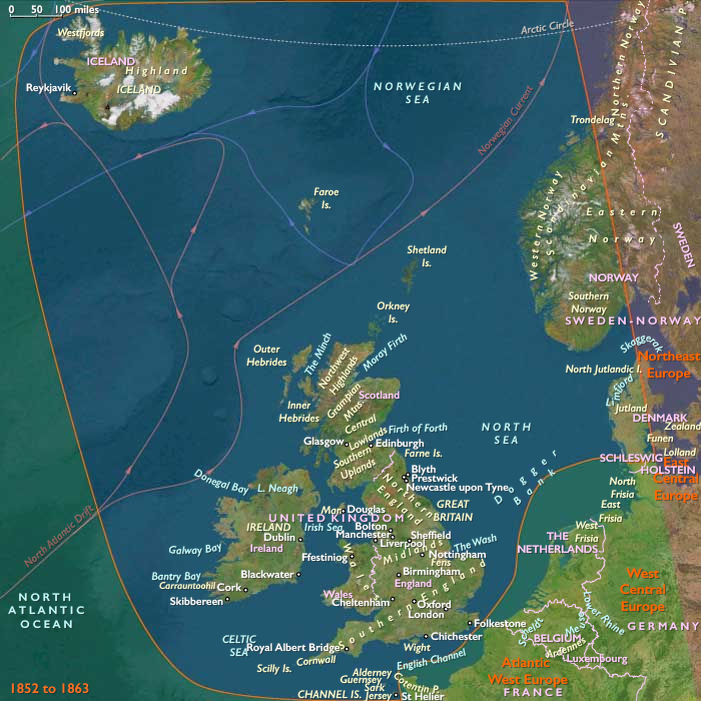
Years: 1852 - 1863
People
- Abraham Lincoln
- Florence Nightingale
- Henry John Temple, 3rd Viscount Palmerston
- John Snow
- Jón Sigurðsson
- Karl Marx
- Napoleon III
- Prince Albert
- Queen Victoria
- Thomas Cook
Groups
- Irish people
- Christians, Roman Catholic
- Iceland (Danish dependency)
- Ottoman Empire
- Anglicans (Episcopal Church of England)
- Presbyterians
- British Empire
- East India Company, British (United Company of Merchants of England Trading to the East Indies)
- Russian Empire
- Britain (United Kingdom of Great Britain and Ireland)
- Norway, dependent Swedish kingdom of
- Denmark, Kingdom of
- Chartism
- France, Second Empire of
Topics
- Middle Subatlantic Period
- Colonization of Asia, British
- Colonization of the Americas, British
- Industrial Revolution, First
- cholera pandemic, 1846-1860
- Crimean War
- American Civil War (War between the States, War of the Rebellion, War of Secession, War for Southern Independence)
Commodoties
Subjects
- Commerce
- Engineering
- Environment
- Labor and Service
- Fashion
- Decorative arts
- Style
- Conflict
- Faith
- Government
- Scholarship
- Custom and Law
- Finance
- Human Migration
- political movement
- workers' movement
Regions
Subregions