
Northwest Europe (1828–1839): Political Reform, Social Movements, …
Years: 1828 - 1839
Northwest Europe (1828–1839): Political Reform, Social Movements, and Industrial Expansion
Political Liberalization and Parliamentary Reform
The years 1828 to 1839 witnessed significant political transformation in Britain, marked by gradual liberalization and major parliamentary reforms. Early reforms included securing civil rights for religious dissenters in 1828, signaling broader social liberalization. Most notably, under the revived and morally energized Whig Party, led by figures such as Lord Grey (Prime Minister 1830–1834), the Great Reform Act of 1832 became a landmark measure. This Act abolished corrupt "rotten" and "pocket" boroughs—where parliamentary seats were controlled by powerful families—and reallocated representation to the burgeoning industrial cities, modestly broadening the electorate.
Though the aristocracy continued to dominate high society, the government, Army, and Royal Navy, these reforms established critical foundations for modern parliamentary democracy, shifting political influence towards urban industrial centers and marking a significant turning point in British political history.
Catholic Emancipation and Ireland
Long-standing tensions in Ireland culminated in significant legislative change through the Roman Catholic Relief Act of 1829, granting Catholics the right to sit in Parliament and public offices. This concession fulfilled the unfulfilled promise of the 1800 Act of Union—initially blocked by King George III—and was secured through tireless campaigning by Irish leader Daniel O'Connell. Nevertheless, substantial grievances and unrest persisted, laying groundwork for future nationalist movements.
The Abolition of Slavery
The Slavery Abolition Act of 1833 was a landmark humanitarian reform, ending slavery throughout the British Empire. Although the British government controversially compensated plantation owners—predominantly wealthy residents of England—with £20 million, the Act represented a profound moral turning point, especially impacting the Caribbean sugar islands, where enslaved populations gained freedom, albeit under transitional "apprenticeship" systems.
The Chartist Movement and Working-Class Activism
The limited scope of the 1832 Reform Act, which notably excluded the working class from voting rights, ignited the Chartist Movement. In 1838, activists issued the People's Charter, demanding universal male suffrage, secret ballots, equal-sized electoral districts, annual parliaments, payment for Members of Parliament, and the abolition of property qualifications. Although viewed with suspicion by elites who saw Chartism as a pathological and radical threat, historians later recognized it as both a continuation of earlier anti-corruption struggles and a significant advance toward democracy in an industrialized society.
Railway Expansion and Industrial Innovation
Britain’s industrial might was significantly enhanced by the rapid expansion of railway technology during this period. The opening of the pioneering Liverpool and Manchester Railway (1830), employing George Stephenson’s innovative locomotive, the Rocket, dramatically improved transportation efficiency, accelerating industrial production and urban growth. Crucial to this expansion were robust rolled wrought-iron rails developed by John Birkinshaw in 1820. Stephenson’s further improvement with reliable lapped joints greatly enhanced rail stability, facilitating the widespread and safe adoption of railways and setting international standards.
The Postal Reform Movement
Britain’s postal system in the 1830s, crucial for an industrializing economy, was notoriously mismanaged—slow, expensive, wasteful, and corrupt. Postal rates were complex, determined by distance and letter sheets; fraud was widespread, and letters were typically paid for by recipients rather than senders. At least 12.5% of British mail traveled free under the personal frank of aristocrats, dignitaries, and members of Parliament. Official censorship and political espionage further undermined public trust.
Anecdotally inspired by observing a poor woman unable to afford to redeem a letter from her fiancé, reformer Rowland Hill campaigned vigorously for reform, highlighting flaws such as complex logging of letters and frequent abuses of the payment-on-receipt system. His efforts, supported by free-trade advocates Richard Cobden and John Ramsey McCulloch—who argued in 1833 that rapid, safe, and affordable postal delivery was essential for commerce—set the stage for the postal system’s radical transformation.
Cultural Revival: Gothic and Rococo Styles
Interior design during the 1830s saw a significant revival of Gothic and Rococo styles, driven by leading interior decorators who reintroduced these sophisticated and decorative forms into fashionable homes. The revival reflected broader cultural trends emphasizing historical romanticism, ornamentation, and the elegant tastes emerging at the dawn of the Victorian era.
Regency to Victorian Transition: Beau Brummell and Social Refinement
The flamboyant era epitomized by Regency dandy Beau Brummell, whose meticulous fashion sense once set standards across Europe, ended decisively with his death in impoverished exile in 1830. British society transitioned toward Victorian standards of modesty, sobriety, and moral propriety, redefining cultural ideals and social conduct.
Romanticism and Opium in Literary Circles
The enduring legacy of Romanticism continued in British literary culture, with late Romantic poets Lord Byron, Percy Bysshe Shelley, and John Keats influencing Victorian literary traditions. Opium experimentation persisted recreationally within English literary circles, reflecting contemporary attitudes toward narcotics, though growing awareness of addiction would soon reshape societal perceptions.
Gender Inequality and Social Realities
Despite social reforms, gender inequalities persisted starkly. Women sometimes resorted to disguising themselves in male clothing to secure better-paying employment, illustrating persistent economic disparities and rigid gender divisions in industrial Britain.
Financial Stability and Insurance Advances
Britain’s financial infrastructure matured significantly, bolstered by actuarial innovations from organizations such as the Society for Equitable Assurances. Life insurance became mainstream, securing middle-class financial stability and underpinning broader public trust in investment and financial systems.
British Diplomacy and Liberal Interventions
Britain’s diplomatic approach during this period, guided by Prime Ministers including Lord Goderich, the Duke of Wellington, Lord Grey, Lord Melbourne, and Sir Robert Peel, promoted cautious liberalism abroad. Britain defended constitutional governance in Portugal (1826), recognized Latin American independence (1824), and supported Greek independence against the Ottoman Empire (1827). A general avoidance of major conflicts lasted until the Crimean War (1853–56).
Scandinavia: Continued Stability and National Development
Scandinavian states remained relatively stable, with Norway increasingly developing distinct national identities and administrative structures within its union with Sweden. Denmark, having adapted to territorial reductions, continued moderate liberal and economic reforms, positioning itself as stable yet peripheral within European geopolitics.
Between 1828 and 1839, Northwest Europe experienced transformative political, economic, and social reforms. Britain’s Whig-led parliamentary reforms, abolition of slavery, and emergence of Chartism reflected a fundamental shift toward liberalization and democracy. Rapid industrial growth, particularly through railway expansion and emerging financial stability, reinforced Britain’s global dominance, while cultural shifts marked the transition toward Victorian morality and social refinement. These developments collectively laid the foundations for Britain’s ongoing ascendancy throughout the Victorian era.
People
- Arthur Wellesley, 1st Duke of Wellington
- Beau Brummell
- Charles Grey, 2nd Earl Grey
- Daniel O'Connell
- F. J. Robinson, 1st Viscount Goderich
- George Gordon, Lord Byron
- George IV of the United Kingdom
- George Stephenson
- John Birkinshaw
- John Keats
- John Ramsay McCulloch
- Percy Bysshe Shelley
- Richard Cobden
- Robert Peel
- Rowland Hill
- William Lamb, 2nd Viscount Melbourne
Groups
- Irish people
- Christians, Roman Catholic
- Iceland (Danish dependency)
- Anglicans (Episcopal Church of England)
- Presbyterians
- British Empire
- East India Company, British (United Company of Merchants of England Trading to the East Indies)
- Britain (United Kingdom of Great Britain and Ireland)
- Norway, dependent Swedish kingdom of
- Denmark, Kingdom of
- Chartism
Topics
- Middle Subatlantic Period
- Colonization of the Americas, British
- Colonization of Asia, British
- Industrial Revolution, First
- Spanish American wars of independence
- Greek War of Independence
Commodoties
Subjects
- Commerce
- Writing
- Environment
- Fashion
- Decorative arts
- Style
- Conflict
- Faith
- Government
- Custom and Law
- Finance
- political movement
- workers' movement
Regions
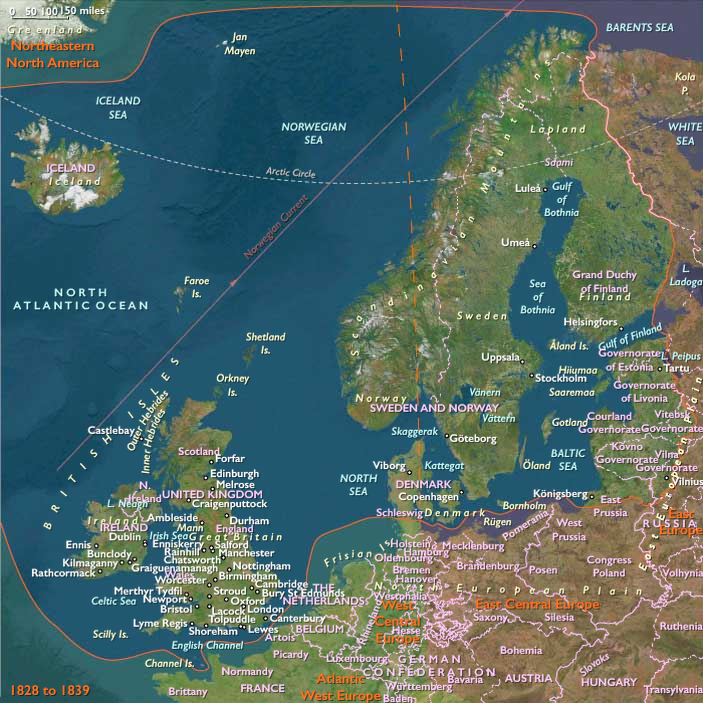
Subregions
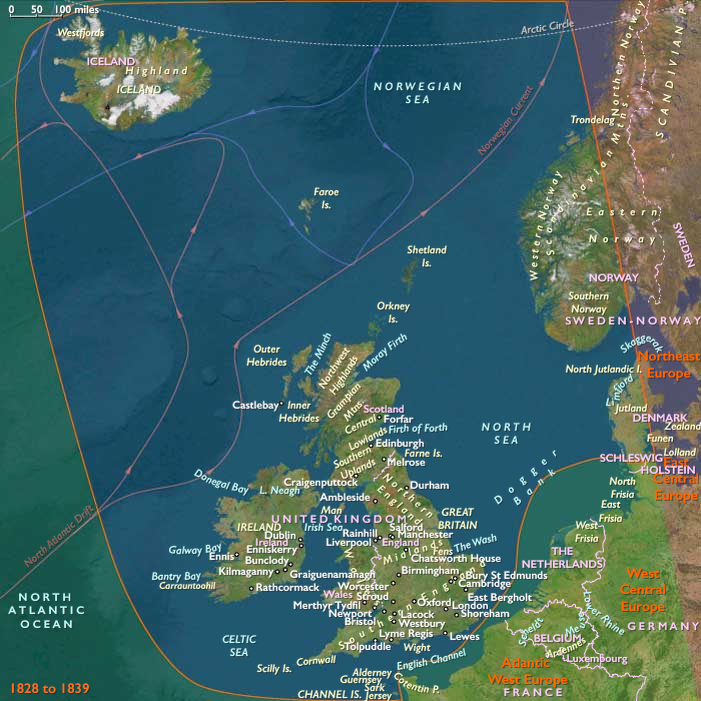
Related Events
Showing 10 events out of 19829 total
Years: 1828 - 1839
People
- Arthur Wellesley, 1st Duke of Wellington
- Beau Brummell
- Charles Grey, 2nd Earl Grey
- Daniel O'Connell
- F. J. Robinson, 1st Viscount Goderich
- George Gordon, Lord Byron
- George IV of the United Kingdom
- George Stephenson
- John Birkinshaw
- John Keats
- John Ramsay McCulloch
- Percy Bysshe Shelley
- Richard Cobden
- Robert Peel
- Rowland Hill
- William Lamb, 2nd Viscount Melbourne
Groups
- Irish people
- Christians, Roman Catholic
- Iceland (Danish dependency)
- Anglicans (Episcopal Church of England)
- Presbyterians
- British Empire
- East India Company, British (United Company of Merchants of England Trading to the East Indies)
- Britain (United Kingdom of Great Britain and Ireland)
- Norway, dependent Swedish kingdom of
- Denmark, Kingdom of
- Chartism
Topics
- Middle Subatlantic Period
- Colonization of the Americas, British
- Colonization of Asia, British
- Industrial Revolution, First
- Spanish American wars of independence
- Greek War of Independence
Commodoties
Subjects
- Commerce
- Writing
- Environment
- Fashion
- Decorative arts
- Style
- Conflict
- Faith
- Government
- Custom and Law
- Finance
- political movement
- workers' movement
Regions
Subregions