
Northwest Europe (1792–1803): Revolutionary Wars, Industrial Innovations, …
Years: 1792 - 1803
Northwest Europe (1792–1803): Revolutionary Wars, Industrial Innovations, and Advances in Navigation
Revolutionary Wars and Britain’s Maritime Dominance
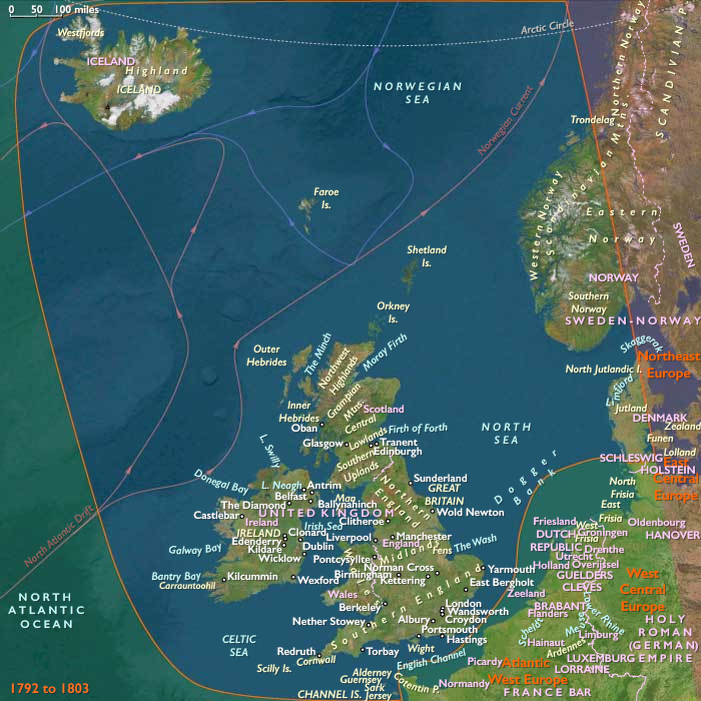
Between 1792 and 1803, Northwest Europe was reshaped by turmoil from the French Revolution and ensuing Revolutionary Wars. The execution of Louis XVI in 1793 intensified conflict, bringing Britain into prolonged warfare against revolutionary France. Britain's naval strength, exemplified by Admiral Horatio Nelson’s decisive victory at the Battle of the Nile (1798), secured its maritime supremacy, allowing it to dominate European rivals and control critical global trade routes. Despite continental instability, Britain strengthened its position as the leading maritime and colonial power.
Accelerating Industrial Revolution and Economic Leadership
Britain’s global ascendancy was substantially reinforced by rapid industrial expansion, initially spurred by earlier influxes of Brazilian gold, which provided capital for industrial investment. Wartime demands for commodities, especially from India through the powerful East India Company, drove unprecedented industrial productivity, setting off cycles of prosperity and rising living standards. The mechanization of British industry—facilitated by steam power innovations pioneered by James Watt—further propelled economic growth, solidifying Britain’s position as the undisputed home of the Industrial Revolution.
James Watt and the Steam Power Revolution
The steam engine developments of James Watt and Matthew Boulton reached maturity during this period. Watt’s inventions—including the double-acting engine, the parallel motion mechanism (1784), throttle valve, and centrifugal governor (1788)—proved crucial for efficient manufacturing and mining operations. Boulton & Watt’s steam engines, five times more efficient than the earlier Newcomen designs, became industry standards, significantly enhancing British manufacturing capabilities and driving industrial productivity.
Edmund Cartwright and the Power Loom
A parallel transformative innovation emerged in textile manufacturing through the power loom, devised by English inventor Edmund Cartwright. Cartwright, educated at Queen Elizabeth Grammar School and University College, Oxford, was a Church of England clergyman who sought to mechanize weaving after observing the efficiencies of mechanical spinning. Although his initial loom (patented 1785) was unsuccessful, by 1789 he developed an improved version that inspired further innovations.
Cartwright continuously refined his loom by adding critical mechanical features—positive let-off motion, warp and weft stop motions, crank and eccentric wheels for differential actuation, automatic shuttle-box mechanisms, and automatic stretching temples. Despite these efforts, fundamental challenges, especially the need to size warps while the loom was stationary, limited commercial viability. An attempt by Robert Grimshaw to deploy 500 power looms at Knott Mill near Manchester in 1790 ended disastrously when arson, likely motivated by fears among handloom weavers, destroyed the factory after only thirty looms had been installed.
Cartwright’s remaining technical problems were resolved in 1803 by William Radcliffe and Thomas Johnson, whose beam warper and dressing sizing machine allowed warps to be sized efficiently outside the loom. Although Cartwright’s immediate commercial success was modest, his foundational innovations paved the way for fully mechanized weaving, profoundly impacting textile production and the industrial landscape. Cartwright eventually received parliamentary recognition in 1809 with a grant of £10,000, and later gained election as a Fellow of the Royal Society (1821).
Marine Chronometers and Navigation Improvements
Advances in maritime navigation accelerated dramatically as marine chronometers—initially prohibitively expensive (about 30% of a ship’s cost)—became progressively more accessible. Initially, adoption of chronometers was slow due to their high precision-manufacturing costs and relatively low production volumes. However, after John Arnold introduced simplified marine chronometers around 1783, and following the expiration of Arnold’s patents in the late 1790s, makers like Thomas Earnshaw began producing reliable and significantly less expensive chronometers.
By the early nineteenth century, chronometer prices had fallen dramatically—from initial prohibitive costs to approximately £25 to £100—representing roughly half to two years' wages for a skilled worker. Lower-cost deck chronometers, though somewhat less accurate than their boxed counterparts, provided many merchant vessels with sufficient navigational accuracy. Despite historians noting limited production volumes, as highlighted by David Landes, the chronometers’ long-lasting reliability meant they seldom required replacement. Consequently, even modest production easily met growing merchant marine demands.
Though initially competing against the Lunar Distances method, marine chronometers increasingly overtook alternative navigation techniques. By the early nineteenth century, navigating without a chronometer became "unwise to unthinkable," transforming maritime trade by greatly enhancing safety, reliability, and economic efficiency. Insurance incentives, practical necessity, and growing maritime commerce accelerated their universal adoption, cementing the marine chronometer as an essential instrument for global navigation and trade.
Adam Smith’s Influence and Economic Liberalism
Economic liberalism, epitomized by Adam Smith’s Wealth of Nations (1776), continued shaping British policy even during revolutionary upheavals. Smith’s advocacy of free markets, limited state interference, and trade liberalization became deeply embedded in British economic thought, underpinning Britain’s thriving industrial and commercial networks amid global conflict.
Cultural Flourishing: Art, Literature, and Leisure
British culture flourished through elegant Rococo portraiture by masters like Joshua Reynolds and Thomas Gainsborough, while literature transitioned toward Romanticism, marked notably by Wordsworth and Coleridge’s Lyrical Ballads (1798). Public leisure evolved at seaside resorts equipped with bathing machines, and culinary convenience was epitomized by the widespread adoption of the sandwich, popularized by the Earl of Sandwich.
Ireland’s Union and Danish-Norwegian Stability
Ireland experienced political upheaval culminating in the 1798 rebellion, which led to the Acts of Union (1800), formally integrating Ireland into Great Britain in 1801. Concurrently, Denmark-Norway maintained cautious neutrality under Frederick VI, fostering domestic stability through agricultural modernization, education reforms, and measured trade liberalization.
Maritime Exploration: Vancouver’s Pacific Voyages
British exploration continued with Captain George Vancouver’s Pacific expeditions (1791–1795), significantly enhancing geographical knowledge and British strategic interests in the Pacific Northwest, vital for subsequent colonial and commercial expansion.
Financial Innovations and Life Insurance Maturity
Financial institutions matured further, driven by actuarial innovations pioneered by institutions like the Society for Equitable Assurances. Life insurance practices increasingly relied on rigorous mortality calculations, underpinning Britain’s expanding middle-class investment and reinforcing economic stability amid wartime uncertainties.
Between 1792 and 1803, Northwest Europe was profoundly reshaped by revolutionary wars, accelerated industrial innovation—particularly in textiles and steam power—and critical advances in maritime navigation driven by more affordable and widespread adoption of marine chronometers. Edmund Cartwright’s power loom, James Watt’s steam engines, and Arnold’s and Earnshaw’s marine chronometers collectively catalyzed Britain's dominance in global commerce, manufacturing, and maritime trade, solidifying its position as an industrial powerhouse at the dawn of the nineteenth century.
People
- Adam Smith
- Edmund Cartwright
- Edward Rowe Mores
- Frederick VI of Denmark and Norway
- George Vancouver
- Horatio Nelson, 1st Viscount Nelson
- James Watt
- John Arnold (watchmaker)
- Joshua Reynolds
- Louis XVI of France
- Matthew Boulton
- Samuel Taylor Coleridge
- Thomas Earnshaw
- Thomas Gainsborough
- William Radcliffe
- William Wordsworth
Groups
- Gaels
- Irish people
- Scottish people
- Christians, Roman Catholic
- English people
- Iceland (Danish dependency)
- Denmark-Norway, Kingdom of
- Anglicans (Episcopal Church of England)
- Ireland, (English) Kingdom of
- Presbyterians
- Thirteen Colonies, The
- Britain, Kingdom of Great
- British Empire
- East India Company, British (United Company of Merchants of England Trading to the East Indies)
- League of Armed Neutrality, First
- Britain (United Kingdom of Great Britain and Ireland)
Topics
- Middle Subatlantic Period
- Portraits, Rococco
- Colonization of the Americas, British
- Colonization of Asia, British
- American Revolution
- American Revolutionary War, or American War of Independence
- Industrial Revolution, First
- French Revolution
- Vancouver Expedition
- French Revolutionary Wars, or “Great French War”
- Irish Rebellion of 1798
- Nile, Battle of the
Commodoties
Subjects
- Commerce
- Writing
- Painting and Drawing
- Public health
- Decorative arts
- Conflict
- Mayhem
- Exploration
- Faith
- Government
- Custom and Law
- Finance
- Metallurgy
- Horology
Regions
Subregions
Years: 1792 - 1803
People
- Adam Smith
- Edmund Cartwright
- Edward Rowe Mores
- Frederick VI of Denmark and Norway
- George Vancouver
- Horatio Nelson, 1st Viscount Nelson
- James Watt
- John Arnold (watchmaker)
- Joshua Reynolds
- Louis XVI of France
- Matthew Boulton
- Samuel Taylor Coleridge
- Thomas Earnshaw
- Thomas Gainsborough
- William Radcliffe
- William Wordsworth
Groups
- Gaels
- Irish people
- Scottish people
- Christians, Roman Catholic
- English people
- Iceland (Danish dependency)
- Denmark-Norway, Kingdom of
- Anglicans (Episcopal Church of England)
- Ireland, (English) Kingdom of
- Presbyterians
- Thirteen Colonies, The
- Britain, Kingdom of Great
- British Empire
- East India Company, British (United Company of Merchants of England Trading to the East Indies)
- League of Armed Neutrality, First
- Britain (United Kingdom of Great Britain and Ireland)
Topics
- Middle Subatlantic Period
- Portraits, Rococco
- Colonization of the Americas, British
- Colonization of Asia, British
- American Revolution
- American Revolutionary War, or American War of Independence
- Industrial Revolution, First
- French Revolution
- Vancouver Expedition
- French Revolutionary Wars, or “Great French War”
- Irish Rebellion of 1798
- Nile, Battle of the
Commodoties
Subjects
- Commerce
- Writing
- Painting and Drawing
- Public health
- Decorative arts
- Conflict
- Mayhem
- Exploration
- Faith
- Government
- Custom and Law
- Finance
- Metallurgy
- Horology
Regions
Subregions