
Northwest Europe (1756–1767): Global War, Economic Thought, …
Years: 1756 - 1767
Northwest Europe (1756–1767): Global War, Economic Thought, and Societal Innovations
The Seven Years' War and British Dominance
From 1756 to 1763, Britain and France engaged in the Seven Years' War, a global conflict fought across Europe, North America, the Caribbean, India, and West Africa. Britain's decisive victory, cemented by key triumphs like the capture of Quebec (1759), culminated in the Treaty of Paris (1763). France lost most of its North American territories, solidifying Britain's global dominance. However, victory left Britain burdened with immense debts, prompting the introduction of controversial colonial taxes—sparking tensions destined to ignite the American Revolution.
Adam Smith and the Birth of Economic Liberalism
The intellectual environment of Northwest Europe was profoundly shaped by the rise of Enlightenment figures such as Adam Smith, born in Kirkcaldy, Scotland, in 1723. Educated at the University of Glasgow under moral philosopher Francis Hutcheson, Smith developed his commitment to liberty, reason, and free speech. After a difficult tenure at Oxford, which he criticized harshly for intellectual stagnation, Smith began delivering popular public lectures in Edinburgh in 1748, sponsored by the Philosophical Society of Edinburgh under Lord Kames.
Smith’s lectures covered rhetoric and belles-lettres, but notably introduced his emerging economic philosophy—what he termed the "obvious and simple system of natural liberty." Although not naturally gifted as an orator, Smith's clarity and innovative ideas garnered success. In 1759, Smith published The Theory of Moral Sentiments, laying the ethical and psychological groundwork for his later masterpiece, The Wealth of Nations (1776). Departing from his teacher Hutcheson’s notion of an inherent moral sense, Smith developed a pluralistic moral philosophy centered on sympathy—the imaginative capacity to understand others' experiences. His work significantly reshaped moral philosophy and established the foundations of modern economics.
John Harrison’s Triumph and Precision Navigation
Meanwhile, John Harrison finally resolved the critical maritime longitude problem with his revolutionary marine chronometer, H4, tested successfully on a voyage to Jamaica in 1761–1762. Despite resistance from proponents of astronomical methods, Harrison’s chronometer achieved near-perfect accuracy, leading the Board of Longitude to award him a significant portion of the Longitude Prize in 1765. His invention dramatically improved maritime safety and strengthened British naval and commercial power.
Gaol Fever and Public Health Crises
Public health remained a significant concern. In 1759, an English authority estimated that nearly one-quarter of prisoners died annually from gaol fever (typhus), a disease notorious for repeatedly spreading from overcrowded, unsanitary prisons like Newgate Prison into London's general population. These outbreaks highlighted urgent public health vulnerabilities and slowly galvanized support for improvements in sanitation and prison conditions.
Champion Brothers and Industrial Struggles
Industrial developments continued around Bristol and Swansea, spearheaded by metallurgist William Champion and his brother John Champion. In 1758, John patented an improved calcination process for converting zinc sulfide (zinc blende) into zinc oxide for use in retorts, further advancing zinc metallurgy. Despite this technical innovation, William Champion struggled financially by 1761, unsuccessfully seeking incorporation and new investors for his ambitious zinc works at Warmley. By 1765, Champion's financial difficulties escalated, culminating in bankruptcy in 1768 and his dismissal from the Warmley Company. The works were sold in 1769 to the Bristol Brass Company, which never fully utilized their potential.
The Emergence of Modern Life Insurance
Financial innovation also marked this era. Modern life insurance, rooted in Roman-era "burial clubs," was significantly refined. The Amicable Society for a Perpetual Assurance Office, founded in London in 1706, had initially offered basic life assurance. By the 1750s, mathematician James Dodson, building on Edmond Halley's pioneering mortality tables (1693), attempted to form a new company offering more scientifically-based long-term insurance but was rejected due to his age. His protégé, Edward Rowe Mores, successfully established the Society for Equitable Assurances on Lives and Survivorship in 1762—the world's first mutual life insurer. Mores introduced age-based premiums derived from mortality rates, revolutionizing insurance practices and introducing the business role of "actuary."
Culinary Innovations: The Sandwich
Cultural innovations also emerged in everyday life. The modern sandwich gained popularity around 1762, famously attributed to John Montagu, 4th Earl of Sandwich, who purportedly requested meat between bread slices for convenience at gaming tables or his busy naval office. This simple innovation, though long preceded by various forms of food-on-bread across cultures—from the unleavened wraps of ancient Jewish sage Hillel to the open-faced Dutch belegde broodje—entered English polite society, quickly spreading through Europe's social elites.
Leisure and the Bathing Machine
Leisure and health culture expanded at coastal resorts, aided by inventions like the bathing machine. Originating in the 1730s, with designs attributed to Benjamin Beale at Margate around 1750, bathing machines became increasingly common, reflecting changing cultural attitudes toward modesty, public leisure, and healthful recreation.
Rococo Portraiture and British Art
In visual arts, the Rococo era saw portraiture flourish. Britain produced influential artists, including the blunt realism of William Hogarth and the refined, Van Dyck-inspired elegance of Thomas Gainsborough, Joshua Reynolds, Francis Hayman, and the Swiss-born Angelica Kauffman. Their work embodied the period’s cultural complexities, capturing society's sophistication and contradictions through vivid, compelling portraiture.
Denmark-Norway’s Quiet Prosperity
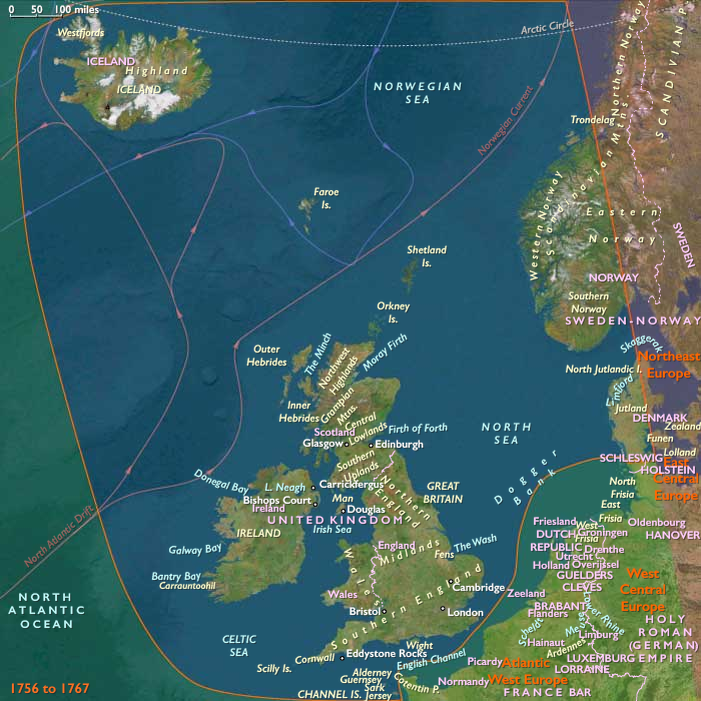
Under Frederick V, Denmark-Norway quietly prospered, enhancing trade through Copenhagen, though overshadowed by Britain’s global dominance. Peripheral territories—Iceland, Faroe Islands, Shetland, and Orkney—remained economically modest, with limited integration into broader European markets.
Ireland’s Continued Struggles
Ireland suffered persistent economic hardship under restrictive Penal Laws, exacerbating rural poverty and fueling continued emigration to North America. Despite pockets of Enlightenment influence in Dublin and Belfast, most rural areas languished economically.
Between 1756 and 1767, Northwest Europe experienced critical shifts driven by global warfare, Adam Smith’s economic liberalism, innovations in maritime navigation by John Harrison, and significant advancements in public health awareness, industrial metallurgy, financial services, culinary practices, and leisure culture. These transformations, both profound and everyday, shaped the trajectory of Northwest Europe, positioning it at the forefront of global power and innovation on the eve of the Industrial Revolution.
People
- Adam Smith
- Angelika Kauffmann
- Edward Rowe Mores
- Francis Hayman
- Frederick V of Denmark
- Henry Home, Lord Kames
- James Dodson
- John Harrison
- John Montagu, 4th Earl of Sandwich
- Joshua Reynolds
- Thomas Gainsborough
- William Champion
- William Hogarth
Groups
- Gaels
- Irish people
- Scottish people
- Christians, Roman Catholic
- English people
- Scotland, Kingdom of
- Iceland (Danish dependency)
- Anglicans (Episcopal Church of England)
- Denmark-Norway, Kingdom of
- Ireland, (English) Kingdom of
- Presbyterians
- France, (Bourbon) Kingdom of
- East India Company, British (The Company of Merchants of London Trading into the East Indies)
- Britain, Kingdom of Great
- British Empire
Topics
- Middle Subatlantic Period
- Portraits, Rococco
- Colonization of the Americas, British
- Colonization of Asia, British
- Seven Years' War
- Plains of Abraham, Battle of the
Commodoties
Subjects
- Commerce
- Writing
- Painting and Drawing
- Public health
- Decorative arts
- Conflict
- Mayhem
- Faith
- Government
- Custom and Law
- Human Migration
- Horology
- Metallurgy
Regions
Subregions
Years: 1756 - 1767
People
- Adam Smith
- Angelika Kauffmann
- Edward Rowe Mores
- Francis Hayman
- Frederick V of Denmark
- Henry Home, Lord Kames
- James Dodson
- John Harrison
- John Montagu, 4th Earl of Sandwich
- Joshua Reynolds
- Thomas Gainsborough
- William Champion
- William Hogarth
Groups
- Gaels
- Irish people
- Scottish people
- Christians, Roman Catholic
- English people
- Scotland, Kingdom of
- Iceland (Danish dependency)
- Anglicans (Episcopal Church of England)
- Denmark-Norway, Kingdom of
- Ireland, (English) Kingdom of
- Presbyterians
- France, (Bourbon) Kingdom of
- East India Company, British (The Company of Merchants of London Trading into the East Indies)
- Britain, Kingdom of Great
- British Empire
Topics
- Middle Subatlantic Period
- Portraits, Rococco
- Colonization of the Americas, British
- Colonization of Asia, British
- Seven Years' War
- Plains of Abraham, Battle of the
Commodoties
Subjects
- Commerce
- Writing
- Painting and Drawing
- Public health
- Decorative arts
- Conflict
- Mayhem
- Faith
- Government
- Custom and Law
- Human Migration
- Horology
- Metallurgy
Regions
Subregions