
Northwest Europe (1708–1719): Union, Wars of Succession, …
Years: 1708 - 1719
Northwest Europe (1708–1719): Union, Wars of Succession, and Expanding Maritime Dominance
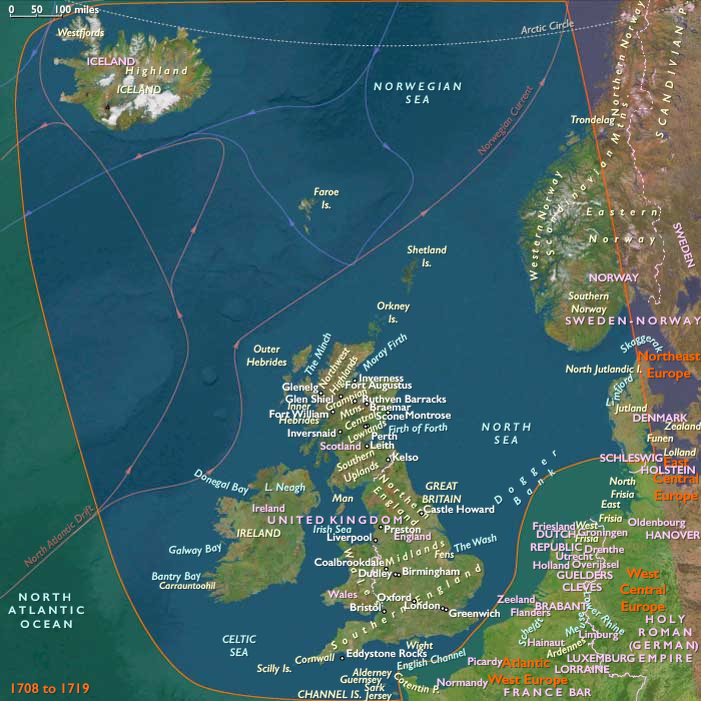
The Union of Great Britain
In 1707, the Acts of Union formally unified England and Scotland into the single political entity of Great Britain. This monumental event transformed the political landscape of Northwest Europe, consolidating royal and parliamentary authority. The Union followed decades of economic pressure intensified by Scotland’s disastrous Darien Scheme, which had drained Scottish finances, compelling acceptance of the union despite widespread opposition among Scots. The integration combined English economic might with Scottish manpower, greatly enhancing Britain's international presence and imperial ambitions.
War of the Spanish Succession and the Treaty of Utrecht
Throughout this period, Northwest Europe remained embroiled in the War of the Spanish Succession (1701–1714), a major continental and colonial conflict rooted in disputes over succession to the Spanish throne. England (now Great Britain) and Denmark-Norway participated actively, countering French ambitions in Europe and abroad. The conflict concluded with the pivotal Treaty of Utrecht (1713), securing substantial gains for Great Britain. These included Gibraltar and Minorca in the Mediterranean, and extensive trading rights—particularly the asiento (the exclusive right to trade slaves to Spanish America)—cementing Britain's status as a major maritime and colonial power.
Resolution of the East India Companies Rivalry
In 1708, the fierce internal competition between the old East India Company and the newer, government-backed English Company Trading to the East Indies was resolved through a formal merger. In practice, it had become clear that the original East India Company had scarcely faced measurable competition from its rival, whose operations had been largely overshadowed by the older entity’s extensive infrastructure, trade networks, and influential stockholders.
The merger occurred through a carefully orchestrated tripartite indenture involving both companies and the British state. Under this arrangement, the newly amalgamated entity—officially titled the United Company of Merchants of England Trading to the East Indies—lent the Treasury the substantial sum of £3,200,000. In return, the government granted the company exclusive trading privileges for a period of three years, after which the arrangement was to be reviewed. In 1712, another parliamentary act renewed the company's status even after the debts had been repaid, reinforcing its dominance in British commerce with India and Asia, and further consolidating Great Britain's global economic influence.
Danish-Norwegian Consolidation and Reforms
In Denmark-Norway, King Frederick IV continued the centralization of state authority. The suspension of the Danish diet, firmly in place, allowed the king to implement streamlined administrative reforms aimed at modernizing state functions. Frederick IV also sought to strengthen naval defenses and foster maritime commerce, aiming to assert Denmark-Norway’s influence despite its limited resources. His administration promoted economic reforms, attempting to improve agriculture and domestic industries while enhancing control over far-flung territories such as Iceland, Greenland, and the Faroe Islands.
Cultural and Intellectual Progress
This era in Northwest Europe marked ongoing intellectual and cultural developments, especially in Britain. Influential figures like Joseph Addison and Richard Steele contributed significantly to literary culture through the launch of The Tatler (1709–1711) and The Spectator (1711–1712), pioneering modern journalism and periodical essays. These publications profoundly shaped public discourse, reinforcing the values of Enlightenment reason, polite society, and political debate.
In parallel with intellectual developments, new forms of furniture reflecting social and scholarly habits emerged. Notably, the “cockfighting chair”—a broad chair with sweeping armrests forming a yoke with the back rail, attached to an integrated reading desk—was first manufactured in England during the early eighteenth century, originally designed for use in private libraries. The seat’s curved shape allowed users to sit astride facing the back of the chair, conveniently positioned to read or write. Though initially misidentified as chairs designed for viewing cockfights—owing to illustrations depicting them at such events—they were more accurately termed reading chairs, symbolizing a growing culture of leisure, literacy, and refinement among Britain’s upper and educated classes.
Jacobite Unrest and the Hanoverian Succession
Despite political unity, internal tensions continued in Great Britain. Following Queen Anne’s death in 1714, the crown passed to George I of the German House of Hanover, bypassing Catholic claimants and reinforcing the Protestant succession. This triggered renewed Jacobite rebellions in Scotland and parts of northern England. The most significant uprising occurred in 1715, led by James Francis Edward Stuart (the "Old Pretender"). The rebellion briefly threatened the stability of the new Hanoverian monarchy but was decisively suppressed, reaffirming Hanoverian control and the authority of Parliament over dynastic claims.
Ireland Under Penal Laws
Ireland remained under severe repression, as the Penal Laws continued to disenfranchise the Catholic majority politically and economically. These restrictions not only solidified Protestant dominance but hindered economic growth, exacerbating tensions that would persist throughout the eighteenth century. Dublin, nevertheless, experienced modest growth, reflecting Ireland's limited economic interaction with expanding British trade networks.
Iceland and Atlantic Islands
In Iceland, the Faroes, Shetlands, and Orkneys, little changed in economic and social conditions. Isolated, subsistence-based economies continued, with fishing, sheep farming, and modest trade defining daily life. Danish administrative oversight tightened incrementally, reflecting Frederick IV's centralizing reforms, though these territories remained peripheral and relatively autonomous in practice.
In sum, 1708–1719 saw Northwest Europe transformed by political union, major international conflicts, maritime ascendancy, and internal tensions. The formation of Great Britain, consolidation of Denmark-Norway’s centralized monarchy, the critical resolution of commercial rivalry through the formation of the United East India Company, cultural enlightenment as exemplified by innovations such as the reading chair, and suppression of Jacobite threats collectively laid the groundwork for the region’s continuing rise as a dominant force in European and global affairs.
People
- Anne, Queen of Great Britain
- Frederick IV of Denmark
- George I of Great Britain
- Isaac Newton
- James Francis Edward Stuart
- Joseph Addison
- Richard Steele
Groups
- Gaels
- Irish people
- Scottish people
- Christians, Roman Catholic
- English people
- Scotland, Kingdom of
- Iceland (Danish dependency)
- Spanish Empire
- Anglicans (Episcopal Church of England)
- Denmark-Norway, Kingdom of
- Ireland, (English) Kingdom of
- Presbyterians
- East India Company, British (The Company of Merchants of London Trading into the East Indies)
- England, (Orange and Stewart) Kingdom of
- Spain, Bourbon Kingdom of
- England, (Stuart) Kingdom of
- Britain, Kingdom of Great
- British Empire
Topics
- Middle Subatlantic Period
- Colonization of Asia, English
- Colonization of the Americas, English
- Ulster, Plantation of
- Spanish Succession, War of the
- Jacobite Invasion of 1708
- Jacobite Rising of 1715-16 (”The Fifteen”)
- Jacobite Rebellion/Rising of 1719 ('The Nineteen')
Commodoties
Subjects
Regions
Subregions
Years: 1708 - 1719
People
- Anne, Queen of Great Britain
- Frederick IV of Denmark
- George I of Great Britain
- Isaac Newton
- James Francis Edward Stuart
- Joseph Addison
- Richard Steele
Groups
- Gaels
- Irish people
- Scottish people
- Christians, Roman Catholic
- English people
- Scotland, Kingdom of
- Iceland (Danish dependency)
- Spanish Empire
- Anglicans (Episcopal Church of England)
- Denmark-Norway, Kingdom of
- Ireland, (English) Kingdom of
- Presbyterians
- East India Company, British (The Company of Merchants of London Trading into the East Indies)
- England, (Orange and Stewart) Kingdom of
- Spain, Bourbon Kingdom of
- England, (Stuart) Kingdom of
- Britain, Kingdom of Great
- British Empire
Topics
- Middle Subatlantic Period
- Colonization of Asia, English
- Colonization of the Americas, English
- Ulster, Plantation of
- Spanish Succession, War of the
- Jacobite Invasion of 1708
- Jacobite Rising of 1715-16 (”The Fifteen”)
- Jacobite Rebellion/Rising of 1719 ('The Nineteen')
Commodoties
Subjects
Regions
Subregions