
Northwest Europe (1684–1827 CE): Naval Supremacy, Industrial …
Years: 1684 - 1827
Northwest Europe (1684–1827 CE): Naval Supremacy, Industrial Beginnings, and Atlantic Revolutions
Geography & Environmental Context
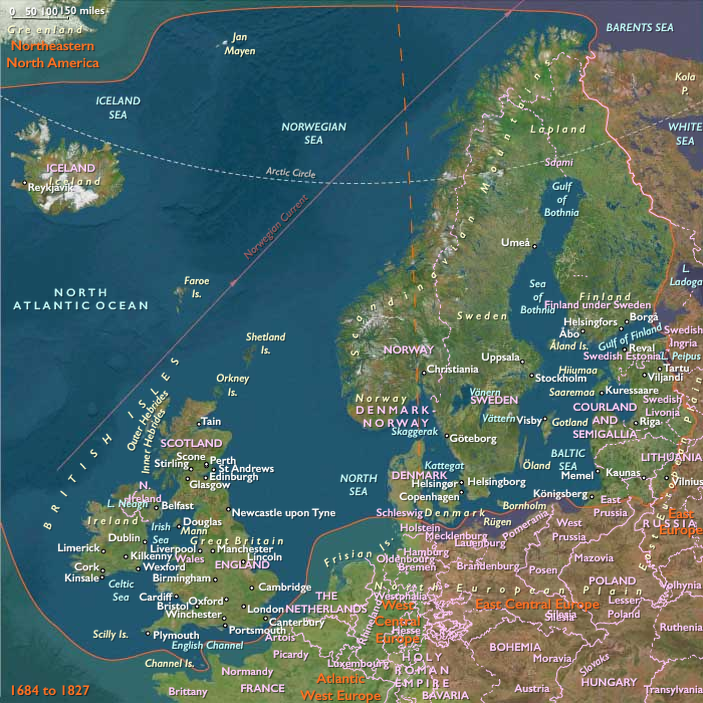
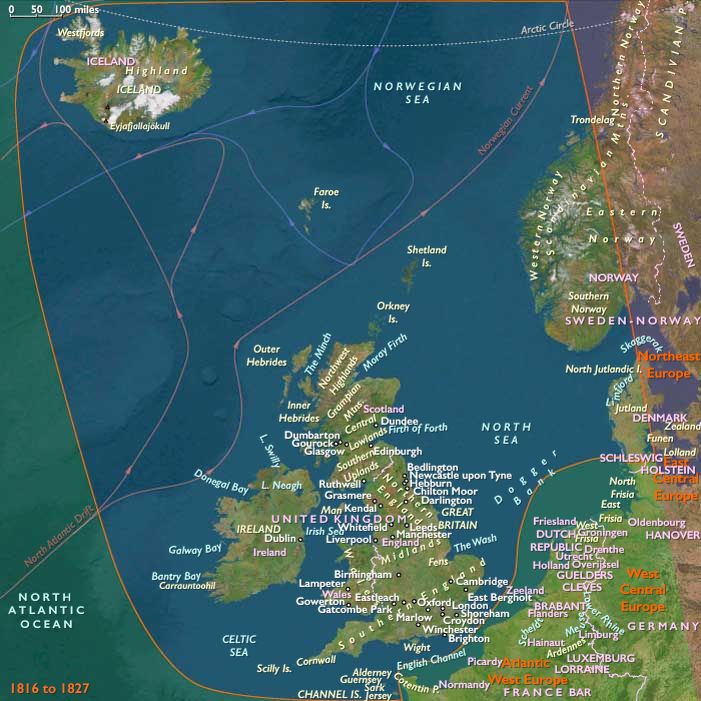
Northwest Europe remained defined by Iceland, Ireland, the United Kingdom, western Norway, and western Denmark. Anchors included the Clyde, Mersey, and Thames estuaries, the fjords of Bergen and Stavanger, the Irish Sea basin, and the Øresund linking Denmark to Baltic trade. London, Dublin, Edinburgh, Copenhagen, and Bergen stood as gateways to both Atlantic and northern commerce.
Climate & Environmental Shifts
The Little Ice Age lingered into the early 18th century: harsh winters (notably 1708–1709) and the Tambora eruption’s “Year Without a Summer” (1816–1817) caused widespread crop failure and famine in Ireland and Iceland. Norwegian fisheries buffered poor harvests; Denmark exported grain to famine-struck Britain. Iceland endured repeated volcanic eruptions (e.g., Laki, 1783–84) that devastated livestock and depopulated regions.
Subsistence & Settlement
-
Britain & Ireland: Wheat and barley dominated England’s southeast; oats, potatoes, and cattle were staples in Ireland and Scotland. Highland clearances displaced tenants into coastal fisheries and emigration.
-
Denmark (west): Grain and cattle estates expanded under absolutist reforms, exporting to Britain and Germany.
-
Norway: Cod and herring exports underpinned subsistence; inland peasants mixed grain, livestock, and timber.
-
Iceland: Sheep and fishing remained lifelines; volcanic famines forced Danish crown relief shipments.
Urban growth accelerated: London became Europe’s largest city; Glasgow, Liverpool, and Belfastthrived on Atlantic trade; Copenhagen prospered as a naval and mercantile hub; Bergen remained Norway’s leading port.
Technology & Material Culture
-
Agriculture: The Agricultural Revolution spread in Britain (enclosure, crop rotation, mechanization); Denmark adopted similar reforms.
-
Industry: Britain pioneered textiles, iron, and coal industries; canals, then early railways, transformed transport.
-
Shipbuilding & navigation: Copper-sheathed hulls, chronometers, and stronger warships expanded reach.
-
Material culture: Printed newspapers, broadsheets, and novels reached mass audiences; industrial goods spread into rural households.
Movement & Interaction Corridors
-
Atlantic empires: Britain projected naval power to North America, the Caribbean, Africa, and India. Ireland was a provisioning hub for the Royal Navy.
-
Norwegian & Danish trades: Timber, tar, hemp, and fish exported to Britain; Denmark’s Øresund toll remained lucrative until Napoleonic upheavals.
-
Wars & blockades: Anglo-French wars, the Napoleonic Wars, and the Gunboat War (1807–1814) involved Denmark–Norway directly; Copenhagen was bombarded (1807).
-
Migration: Irish, Scottish, and Norwegian emigrants moved to North America in growing numbers, driven by poverty and war.
Cultural & Symbolic Expressions
-
Britain & Ireland: The Glorious Revolution (1688), Acts of Union (1707, 1801), and parliamentary politics fostered new identities; Irish uprisings (1798) reflected resistance to incorporation.
-
Scandinavia: Denmark became an absolutist state; Norway remained under Danish rule until 1814, then entered union with Sweden.
-
Iceland: Lutheran traditions, sagas, and poetry endured under Danish oversight.
-
Culture & Enlightenment: London and Edinburgh thrived as centers of Enlightenment learning; novels (Defoe, Austen), Romantic poetry (Wordsworth, Byron), and Scandinavian hymnody flourished.
Environmental Adaptation & Resilience
-
Ireland: The potato’s spread provided resilience until blight crises late in this era.
-
Norway & Iceland: Fisheries buffered poor harvests; communal sharing and crown provisioning softened famine.
-
Britain & Denmark: Enclosure, scientific farming, and estate management expanded surpluses; industrial transport widened supply networks.
Transition
Between 1684 and 1827, Northwest Europe became the engine of global naval power and industrial change. Britain’s empire grew through maritime supremacy, its Industrial Revolution reshaping economy and society. Denmark–Norway faced naval defeat and political realignment; Iceland endured volcanic and climatic catastrophe; Ireland became both a keystone of empire and a locus of discontent. By the 1820s, Northwest Europe stood as the world’s leading maritime–industrial region, yet carried within it the strains of colonial rivalry, rural poverty, and national unrest.
People
- Charles I
- Charles II
- Christian III
- Edward VI of England
- Elizabeth I
- Francis Bacon
- Henry VIII of England
- Isaac Newton
- James I
- James II
- Johannes Vermeer
- John Knox
- Jón Arason
- Mary I of England and Ireland
- Oliver Cromwell
- Rembrandt van Rijn
- Robert Boyle
- William Shakespeare
Groups
- Christians, Roman Catholic
- Ireland, (English) Lordship of
- Scotland, Kingdom of
- Iceland (Danish dependency)
- England, (Tudor) Kingdom of
- Lutheranism
- Protestantism
- Denmark-Norway, Kingdom of
- Anglicans (Episcopal Church of England)
- Presbyterians
- Spain, Habsburg Kingdom of
- Norway, dependent Danish kingdom of
- East India Company, British (The Company of Merchants of London Trading into the East Indies)
- Dutch East India Company (Vereenigde Oostindische Compagnie or VOC in Dutch, literally "United East Indies Company")
- England, (Stuart) Kingdom of
- England, Commonwealth of
- England, (Stewart, Restored) Kingdom of
Topics
- Little Ice Age, Warm Phase I
- Little Ice Age (LIA)
- English Reformation
- Dutch Golden Age
- Spanish Armada, Defeat of the
- Nine Years' War in Ireland, or Tyrone's Rebellion
- Ulster, Plantation of
- Flight of the Earls
- English Civil War, First, or Great
- English Civil War, Second
- English Civil War, Third
- English Restoration
Subjects
- Commerce
- Writing
- Painting and Drawing
- Performing Arts
- Environment
- Public health
- Conflict
- Mayhem
- Faith
- Government
- Scholarship
- Custom and Law
- Catastrophe
- Mathematics
- Physics and Mechanics
- Optics
- Chemistry
- Science
Regions
Subregions
Years: 1684 - 1827
People
- Charles I
- Charles II
- Christian III
- Edward VI of England
- Elizabeth I
- Francis Bacon
- Henry VIII of England
- Isaac Newton
- James I
- James II
- Johannes Vermeer
- John Knox
- Jón Arason
- Mary I of England and Ireland
- Oliver Cromwell
- Rembrandt van Rijn
- Robert Boyle
- William Shakespeare
Groups
- Christians, Roman Catholic
- Ireland, (English) Lordship of
- Scotland, Kingdom of
- Iceland (Danish dependency)
- England, (Tudor) Kingdom of
- Lutheranism
- Protestantism
- Denmark-Norway, Kingdom of
- Anglicans (Episcopal Church of England)
- Presbyterians
- Spain, Habsburg Kingdom of
- Norway, dependent Danish kingdom of
- East India Company, British (The Company of Merchants of London Trading into the East Indies)
- Dutch East India Company (Vereenigde Oostindische Compagnie or VOC in Dutch, literally "United East Indies Company")
- England, (Stuart) Kingdom of
- England, Commonwealth of
- England, (Stewart, Restored) Kingdom of
Topics
- Little Ice Age, Warm Phase I
- Little Ice Age (LIA)
- English Reformation
- Dutch Golden Age
- Spanish Armada, Defeat of the
- Nine Years' War in Ireland, or Tyrone's Rebellion
- Ulster, Plantation of
- Flight of the Earls
- English Civil War, First, or Great
- English Civil War, Second
- English Civil War, Third
- English Restoration
Subjects
- Commerce
- Writing
- Painting and Drawing
- Performing Arts
- Environment
- Public health
- Conflict
- Mayhem
- Faith
- Government
- Scholarship
- Custom and Law
- Catastrophe
- Mathematics
- Physics and Mechanics
- Optics
- Chemistry
- Science
Regions
Subregions