
Northwest Europe (1444–1455 CE): Dynastic Tensions and …
Years: 1444 - 1455
Northwest Europe (1444–1455 CE): Dynastic Tensions and Cultural Advances
England: Growing Tensions and Prelude to Civil War
The reign of Henry VI became increasingly fraught, characterized by worsening political instability and the deterioration of English holdings in France. Losses such as Normandy in 1450 deepened discontent among nobles and commoners alike, contributing to internal strife. Henry VI, England’s Lancastrian king, proved ineffectual and unstable as he matured, prompting those dissatisfied with government by his favorites to rally around Richard, Duke of York, head of the rival House of York. Armed clashes had occurred previously between supporters of Henry and Richard, but the first open fighting broke out in 1455, marking the onset of the Wars of the Roses.
Scotland: Stability and Cultural Growth
Following the reforms initiated by James I, Scotland enjoyed relative stability under his successor, James II. James II, ascending to the throne as a child in 1437, gradually consolidated his rule throughout the 1440s and early 1450s. His reign saw the continued growth of royal authority, further weakening the power of the nobility. Cultural activities flourished, reflecting broader European influences and enhancing the country's literary and artistic heritage.
Ireland: Gaelic Autonomy and Cultural Flourishing
Gaelic lordships continued to assert their dominance across Ireland, maintaining their autonomy and cultural identity against limited English authority. The O’Neill and O’Brien clans solidified their regional power bases, and Irish literary traditions thrived, marked by vibrant poetry and annalistic writing that preserved and celebrated Gaelic heritage. English control remained limited primarily to The Pale, with attempts at expansion encountering persistent resistance.
Scandinavia: Instability within the Kalmar Union
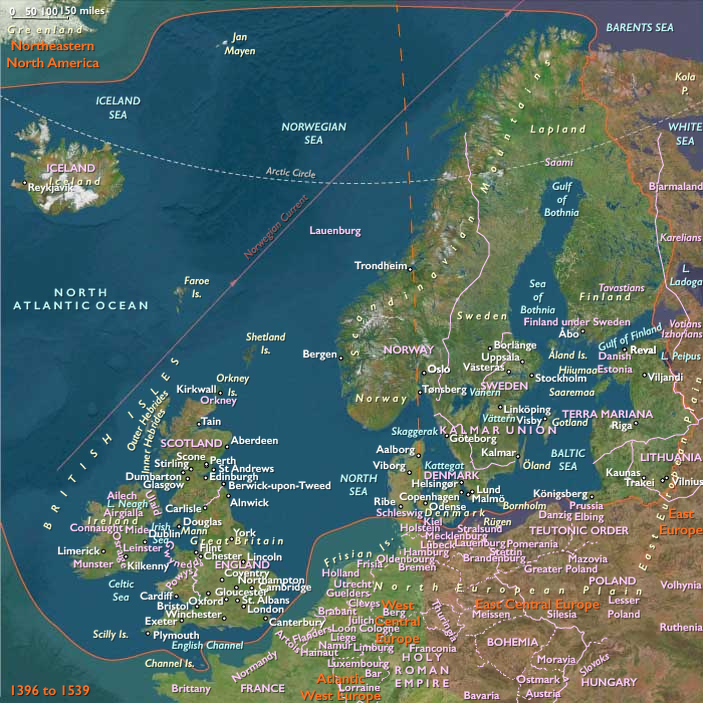
The Kalmar Union, under King Eric of Pomerania and later under King Christopher of Bavaria and then Christian I, experienced persistent internal tensions. Sweden's dissatisfaction with union policies increased, sparking periodic revolts and political unrest. Despite these ongoing challenges, the union persisted, albeit tenuously, through diplomatic maneuvers and fragile agreements.
Iceland: Literary and Cultural Vigor
Within the broader Scandinavian political context, Iceland maintained its cultural vitality. The island continued to produce significant literary works, particularly historical sagas and chronicles that documented its rich past and preserved its distinct identity. Icelandic literature served not only as historical records but also as symbols of cultural pride and resilience in a changing political landscape.
Cultural and Artistic Developments
The period witnessed significant cultural developments across Northwest Europe. Architectural advancements, notably at York Minster, continued to exemplify the evolving Perpendicular Gothic style. The innovative compositions of John Dunstaple and contemporaries continued to shape European music, spreading harmonically rich practices centered around intervals of thirds and sixths. These artistic achievements highlighted the region's continued intellectual vibrancy amid political uncertainty.
Legacy of the Era
By 1455 CE, Northwest Europe stood on the brink of transformative upheaval. England faced imminent civil war, Scotland enjoyed strengthened central authority and cultural growth, Ireland continued its robust Gaelic traditions, and the Kalmar Union grappled with internal dissent. These complex dynamics were balanced by impressive cultural advances, showcasing the region's resilience and creativity during this turbulent period.
People
- Christian I
- Christopher of Bavaria
- Henry VI
- James I, King of Scots
- James II of Scotland
- John Dunstaple
- Richard of York
Groups
- Gaels
- Irish people
- Ireland, medieval
- England, (Anglo-Saxon) Kingdom of
- Icelandic Commonwealth, or Icelandic Free State
- Christians, Roman Catholic
- Scotland, Kingdom of
- France, (Valois) Kingdom of
- Kalmar Union (of Denmark, Norway and Sweden)
Topics
- Middle Subatlantic Period
- Subatlantic Period
- Hundred Years' War
- Hundred Years' War: French Victory
- Roses, Wars of the
Subjects
Regions
Subregions
Related Events
Showing 10 events out of 41742 total
Years: 1444 - 1455
People
- Christian I
- Christopher of Bavaria
- Henry VI
- James I, King of Scots
- James II of Scotland
- John Dunstaple
- Richard of York
Groups
- Gaels
- Irish people
- Ireland, medieval
- England, (Anglo-Saxon) Kingdom of
- Icelandic Commonwealth, or Icelandic Free State
- Christians, Roman Catholic
- Scotland, Kingdom of
- France, (Valois) Kingdom of
- Kalmar Union (of Denmark, Norway and Sweden)
Topics
- Middle Subatlantic Period
- Subatlantic Period
- Hundred Years' War
- Hundred Years' War: French Victory
- Roses, Wars of the
Subjects
Regions
Subregions