
Northwest Europe (1420–1431 CE): Dynastic Ambitions and …
Years: 1420 - 1431
Northwest Europe (1420–1431 CE): Dynastic Ambitions and Regional Turmoil
England: Triumph and Turmoil
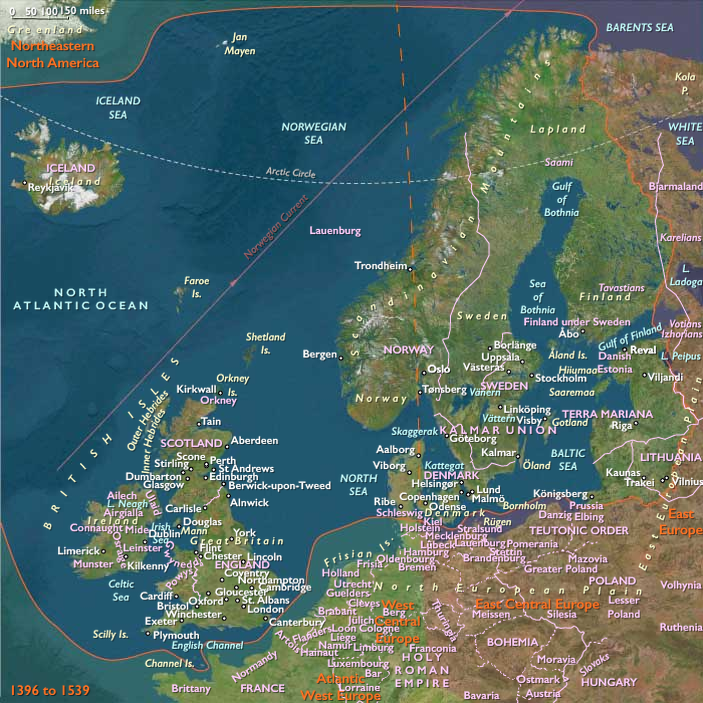
Following his triumph at Agincourt in 1415, Henry V of England sought to solidify English control over France through both military prowess and diplomatic strategy. The Treaty of Troyes (1420) granted Henry the French crown upon the death of the current French king, Charles VI, and arranged his marriage to Catherine of Valois, effectively disinheriting the Dauphin Charles (the future Charles VII). Henry continued military campaigns to enforce these claims until his untimely death in 1422. His infant son ascended the throne as Henry VI, with England and France plunged into further instability.
Scotland: Continued Regency and Captivity
Scotland, still suffering from internal divisions and external threats, continued under the regency of the Duke of Albany until his death in 1420, succeeded by his son, Murdoch Stewart. Meanwhile, James I remained captive in England, shaping his perspectives and ambitions from afar. James’s continued captivity fostered Scottish political uncertainty and increased factionalism among the Scottish nobility. James I is generally considered to be the author of The Kingis Quair ("The King's Book"), a long poem about his captivity and about his romance with Joan Beaufort.
Ireland: Gaelic Resurgence and English Struggles
In Ireland, Gaelic chieftains maintained their dominance and increasingly asserted autonomy from English control. The Anglo-Norman authority was restricted further, with territorial control largely limited to The Pale. Irish leaders, including powerful clans like the O’Neills and the O’Briens, solidified their influence, resisting attempts by English forces to regain lost territory.
Scandinavia: Internal Stability, External Tensions
The Kalmar Union, under the rule of King Eric of Pomerania, faced mounting internal tensions, especially in Sweden, where opposition to the centralizing policies grew. Despite these internal frictions, the union largely remained intact, preserving relative regional stability. King Eric continued to manage the delicate balance of power among the Scandinavian kingdoms, but underlying disputes hinted at future challenges.
Iceland: Preservation of Cultural Heritage
Within the Kalmar Union, Iceland preserved its distinct cultural heritage. Literary production flourished, notably through sagas, chronicles, and poetic traditions, maintaining Iceland's cultural identity amid political subordination. This period saw a sustained commitment to the transmission and preservation of Icelandic historical and literary traditions.
Cultural and Architectural Developments
Cultural life across Northwest Europe remained vibrant. Architectural projects, such as the ongoing construction and elaboration of York Minster in the Perpendicular Gothic style, demonstrated sustained artistic and technical ambition. In music, the influence of composers such as John Dunstaple continued to expand, with his innovative harmonic techniques gaining recognition across Europe. Dunstaple's compositions often featured mass-ordinary cycles, with movements unified by musical themes or a cantus firmus. His harmonic innovations were based notably on the intervals of the third and the sixth.
Legacy of the Era
By 1431 CE, Northwest Europe was characterized by dynastic ambitions intertwined with deep regional and political complexities. England grappled with securing its extensive claims in France under the weakened rule of young Henry VI; Scotland awaited the return of its captive king to restore stability; Ireland saw Gaelic dominance largely uncontested; and the Kalmar Union faced persistent internal pressures. Amid these political dynamics, cultural flourishing provided continuity, underscoring the resilience and creativity that defined this transformative era.
People
- Catherine of Valois
- Charles VI of France
- Charles VII of France
- Eric of Pomerania
- Henry V of England
- Henry VI
- James I, King of Scots
- John Dunstaple
- Murdoch Stewart
- Robert Stewart
Groups
- Gaels
- Irish people
- Ireland, medieval
- England, (Anglo-Saxon) Kingdom of
- Icelandic Commonwealth, or Icelandic Free State
- Christians, Roman Catholic
- Scotland, Kingdom of
- France, (Valois) Kingdom of
- Kalmar Union (of Denmark, Norway and Sweden)
Topics
- Middle Subatlantic Period
- Subatlantic Period
- Hundred Years' War
- Hundred Years' War: Second Peace
- Hundred Years' War: Resumption of the war under Henry V
Subjects
Regions
Subregions
Related Events
Showing 10 events out of 42254 total
Years: 1420 - 1431
People
- Catherine of Valois
- Charles VI of France
- Charles VII of France
- Eric of Pomerania
- Henry V of England
- Henry VI
- James I, King of Scots
- John Dunstaple
- Murdoch Stewart
- Robert Stewart
Groups
- Gaels
- Irish people
- Ireland, medieval
- England, (Anglo-Saxon) Kingdom of
- Icelandic Commonwealth, or Icelandic Free State
- Christians, Roman Catholic
- Scotland, Kingdom of
- France, (Valois) Kingdom of
- Kalmar Union (of Denmark, Norway and Sweden)
Topics
- Middle Subatlantic Period
- Subatlantic Period
- Hundred Years' War
- Hundred Years' War: Second Peace
- Hundred Years' War: Resumption of the war under Henry V
Subjects
Regions
Subregions