
Northwest Europe (1396–1407 CE): Dynastic Shifts and …
Years: 1396 - 1407
Northwest Europe (1396–1407 CE): Dynastic Shifts and Cultural Transformations
England: Dynastic Struggles and Internal Rebellions
The political turmoil under Richard II reached a climax in 1399 when the king was overthrown by his cousin, Henry Bolingbroke, who ascended the throne as Henry IV. Richard's deposition underscored the fragility of royal authority, setting the stage for the later Wars of the Roses. Henry IV's early reign was marred by internal unrest, notably the Epiphany Rising of 1400, a failed attempt to restore Richard II, who subsequently died under suspicious circumstances.
Religious dissent continued through the activities of the Lollards, followers of the late John Wycliffe, who died in 1384. Their critical stance on church wealth and clerical authority led to increasing persecution under Henry IV, as the crown sought stability through suppressing heresy. A significant Welsh uprising, known as the Glyndŵr Rising, began in 1400, led by Owain Glyndŵr, representing a major effort by the Welsh to assert independence from English dominance.
Scotland: Internal Conflict and Dynastic Crisis
In Scotland, Robert III faced persistent border conflicts with England and deep internal divisions. His rule saw growing tensions involving his brother, the Duke of Albany. In 1402, Robert's heir, David Stewart, Duke of Rothesay, died under suspicious circumstances while imprisoned by Albany, deepening the kingdom's political uncertainty and dynastic instability.
Ireland: Gaelic Dominance and Anglo-Norman Weakness
Gaelic chieftains such as the powerful O'Neill and O'Brien clans further solidified their control, diminishing English authority confined within The Pale. Gaelic culture and traditional laws dominated, reinforcing regional independence and the enduring legacy of Gaelic autonomy.
Scandinavia: Formation of the Kalmar Union
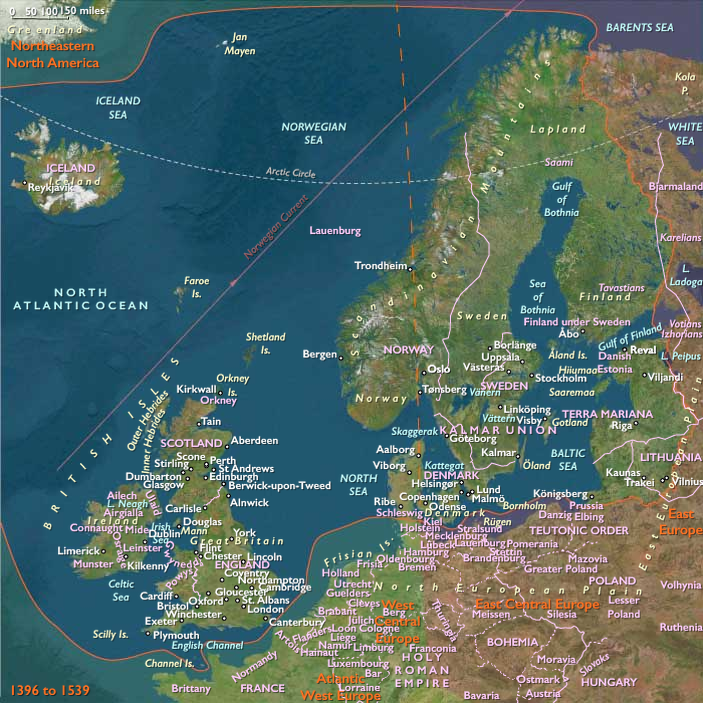
The political alignment of Denmark, Norway, and Sweden was consolidated under Queen Margaret I, culminating in the establishment of the Kalmar Union in 1397. This union reshaped Scandinavian politics by uniting these kingdoms under a single monarchy, enhancing royal centralization and regional cooperation.
Iceland: Literary Resilience Amid Political Changes
Despite political subordination within the Kalmar Union, Iceland preserved its literary and cultural traditions. Sagas such as Njal's Saga (completed circa 1290, still influential) continued to circulate, emphasizing Iceland’s intellectual resilience and distinct cultural identity.
Social and Economic Shifts: Post-Plague Realignment
The devastating Black Death, which had reached England in 1348, dramatically reshaped Northwest Europe's socio-economic landscape. By 1400, England's population had plummeted from approximately seven million to two million. This demographic collapse allowed peasants greater leverage in negotiating wages and conditions, weakening traditional feudal structures and contributing to long-term economic transformation.
Cultural Innovations: Architecture and Music
Despite political unrest, cultural achievements flourished. The ongoing construction of York Minster, progressing in the Perpendicular Gothic architectural style, symbolized enduring religious devotion and societal resilience. In music, English composers like John Dunstaple and Leonel Power advanced musical composition through innovative mass-ordinary cycles and pioneering use of harmonic intervals (thirds and sixths), employing the cantus firmus technique extensively.
Legacy of the Era
By 1407 CE, Northwest Europe had experienced profound political upheavals, religious tensions, and notable cultural achievements. Dynastic struggles in England and Scotland, Gaelic consolidation in Ireland, the formation of the Kalmar Union, and resilient cultural expressions in architecture and music collectively marked a significant transitional era, shaping regional identities and laying foundations for future developments.
People
- David Stewart
- Geoffrey Chaucer
- Henry IV of England
- John Dunstaple
- Leonel Power
- Margaret I of Denmark
- Owain Glyndŵr
- Richard II of England
- Robert III, King of Scots
- Robert Stewart
Groups
- Gaels
- Irish people
- Denmark, Kingdom of
- Ireland, medieval
- England, (Anglo-Saxon) Kingdom of
- Icelandic Commonwealth, or Icelandic Free State
- Sweden, Kingdom of
- Norway, independent Kingdom of
- Christians, Roman Catholic
- Franciscans, or Order of St. Francis
- Dominicans, or Order of St. Dominic
- Castile, Crown of
- Scotland, Kingdom of
- France, (Valois) Kingdom of
- Lollardy
- Kalmar Union (of Denmark, Norway and Sweden)
Topics
- Middle Subatlantic Period
- Subatlantic Period
- Hundred Years' War
- Anglo-Scottish Wars
- Hundred Years' War: Second Peace
- Epiphany Rising
Subjects
- Commerce
- Writing
- Architecture
- Performing Arts
- Conflict
- Mayhem
- Faith
- Government
- Custom and Law
- religious movement
Regions
Subregions
Years: 1396 - 1407
People
- David Stewart
- Geoffrey Chaucer
- Henry IV of England
- John Dunstaple
- Leonel Power
- Margaret I of Denmark
- Owain Glyndŵr
- Richard II of England
- Robert III, King of Scots
- Robert Stewart
Groups
- Gaels
- Irish people
- Denmark, Kingdom of
- Ireland, medieval
- England, (Anglo-Saxon) Kingdom of
- Icelandic Commonwealth, or Icelandic Free State
- Sweden, Kingdom of
- Norway, independent Kingdom of
- Christians, Roman Catholic
- Franciscans, or Order of St. Francis
- Dominicans, or Order of St. Dominic
- Castile, Crown of
- Scotland, Kingdom of
- France, (Valois) Kingdom of
- Lollardy
- Kalmar Union (of Denmark, Norway and Sweden)
Topics
- Middle Subatlantic Period
- Subatlantic Period
- Hundred Years' War
- Anglo-Scottish Wars
- Hundred Years' War: Second Peace
- Epiphany Rising
Subjects
- Commerce
- Writing
- Architecture
- Performing Arts
- Conflict
- Mayhem
- Faith
- Government
- Custom and Law
- religious movement
Regions
Subregions