
Northwest Europe (1396–1539 CE): North Sea Commons, …
Years: 1396 - 1539
Northwest Europe (1396–1539 CE): North Sea Commons, Island Kingdoms, and Tudor Beginnings
Geographic & Environmental Context
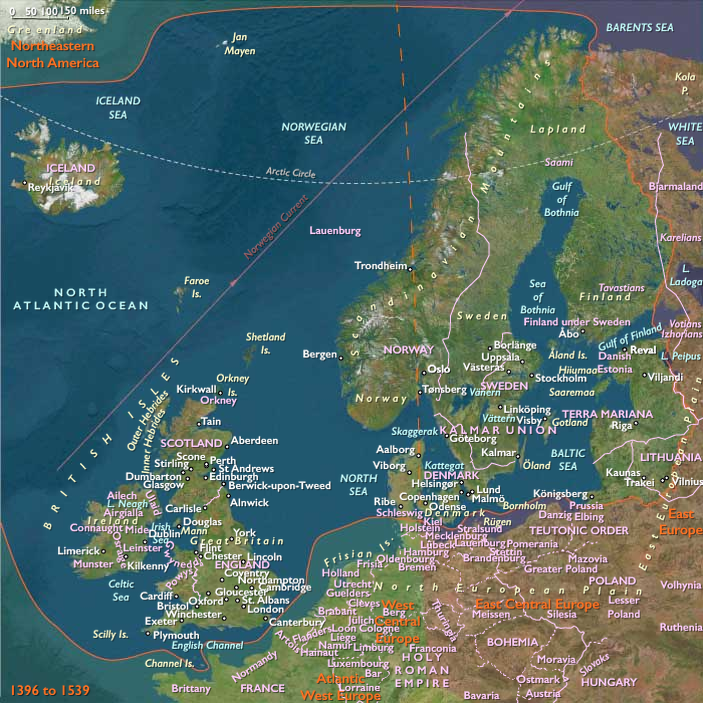
The subregion of Northwest Europe includes the British–Irish archipelago, Iceland and the Faroes, and the ocean-facing rims of western Norway and western Denmark. Anchors span the North Atlantic fisheries (Iceland, Faroes, Shetland–Orkney), the North Sea littoral (Jutland, Yorkshire–East Anglia, Firths of Forth and Clyde), the Irish Sea and Channel approaches, and inland cores such as the Thames–Severn lowlands, Scottish Highlands/Islands, and Irish midlands. River corridors (Thames, Severn, Humber), firths, and sounds tied agrarian interiors to maritime trade, while the Norwegian fjords and Jutland bights faced wind-heavy seas.
Climate & Environmental Shifts
The Little Ice Age sharpened cold and storminess:
-
North Atlantic fringe (Iceland, Faroes, west Norway): longer sea-ice seasons and harsher gales; erratic cod/herring runs shaped fishing booms and busts.
-
Britain & Ireland: cooler winters, wet summers in some decades; harvest failures recurred locally; severe storms and surges disrupted coasts.
-
Jutland & North Sea: shifting bars and storm surges altered havens; dunes advanced on exposed shores.
Despite volatility, fisheries and mixed husbandry buffered many communities.
Subsistence & Settlement
-
Lowland farms (England, eastern Ireland, Jutland): wheat, rye, barley, oats; cattle, sheep, and dairying; open-field systems persisted in much of England, while enclosed demesnes and pastures spread unevenly.
-
Uplands & isles (Scotland, Wales, west Ireland, Norway): oats, barley, stock-rearing, and transhumant dairying; peat fuel; kelp and shore-gathering in island economies.
-
Iceland & Faroes: subsistence grain marginal; livelihoods centered on cod, dried fish, seabirds, sheep, and trade with Bergen–Hanse merchants.
-
Towns & ports: London (Thames) surged as a staple market; York, Bristol, Dublin, Cork, Edinburgh/Leith, Aberdeen, Bergen, and Aalborg tied hinterlands to sea lanes.
Technology & Material Culture
-
Maritime craft: clinker-built hulks and cogs gave way to round-hulled naos and early caravels; North Sea sailing rigs adapted to shoals and tides; Icelandic and Norse open boats remained crucial.
-
Arms & fortification: English longbow remained decisive into the mid-15th century; early handguns and field guns appeared; castles evolved toward gun-forts and, in Scotland/Ireland, tower houses.
-
Print & craft: William Caxton introduced printing to England (1476); cloth finishing (East Anglia, Yorkshire), tin/lead (Cornwall), and shipwrighting expanded.
-
Architecture & art: Perpendicular Gothic in England; late medieval parish art in Ireland; stave-church legacies and stone churches in west Norway; bardic manuscripts in Gaelic lands; saga copying continued in Icelandic scriptoria.
Movement & Interaction Corridors
-
North Sea/Irish Sea lanes: carried wool, cloth, salt fish (herring, cod), wine, salt, and iron; London, Hull, and east-coast ports linked to Hanseatic towns and Bergen’s fish market.
-
Atlantic ventures: Bristol merchants probed western waters; John Cabot’s voyage (1497) opened English awareness of Newfoundland’s cod banks.
-
Fjord & Jutland coasts: Bergen–Hanse convoy cycles and Jutland’s cattle/grain exports sustained Norway–Denmark’s Atlantic rim.
-
Isles networks: Birlinn and galley traffic knit Hebrides, Islay, Kintyre, Man, and Ulster; inter-island lordships balanced sea power and kin ties.
Cultural & Symbolic Expressions
-
Monarchy & law: English common law courts stabilized after civil war; Scottish kings balanced Highland/Lowland blocs; Gaelic lordships in Ireland maintained Brehon law and bardic patronage alongside the English Pale.
-
Language & letters: Middle English matured into Tudor English; Scots literature flourished (Dunbar, Henryson); Gaelic poetry remained courtly and genealogical; Icelandic annals and sagas preserved memory.
-
Devotion & reform: Late medieval piety—guild altars, pilgrimages (St. Andrews, Walsingham, St. David’s)—coexisted with early humanism; by the 1530s, England’s break with Rome began to reorder ritual and property.
Environmental Adaptation & Resilience
-
Mixed portfolios: grain–livestock rotations, dairying, and woodland management hedged climatic risk; parish granaries and seigneurial stores mitigated famine.
-
Fisheries & curing: salt fish, stockfish, and barrelled herring stabilized caloric intake and trade; salt-pan and coopers’ crafts were critical.
-
Field systems & enclosure: commons and open fields balanced with piecemeal enclosure to protect flocks and improve yields; drainage in fens and dike work on exposed coasts guarded arable.
-
Island adaptations: peat, driftwood, and turf for fuel; drying sheds and fish lofts; seasonal transhumance to shielings.
Technology & Power Shifts (Conflict Dynamics)
-
Hundred Years’ War (to 1453): English chevauchées faded after Joan of Arc’s campaigns (1429); defeat at Castillon (1453) ended English rule in France, redirecting power struggles homeward.
-
Wars of the Roses (1455–1487): Yorkist–Lancastrian civil war saw set-piece battles—Towton (1461), Tewkesbury (1471)—culminating in Tudor victory at Bosworth Field (1485); Henry VII stabilized crown finances and order.
-
Anglo-Scottish warpoints: Border raids persisted; Scotland’s defeat at Flodden (1513) killed James IV, reshaping regency politics.
-
Ireland: Tudor authority remained thin beyond the Pale; Gaelic confederacies and earldoms contested royal initiatives; intermittent wars foreshadowed later Tudor conquest.
-
Scandinavia: Denmark–Norway ruled the Atlantic rim; Bergen’s Hanse links endured; the Count’s Feud (1534–1536) in Denmark–Norway (closing years of this age) ushered in the Lutheran Reformation and tighter royal control.
-
Sea conflict: Privateering and piracy flickered in the Channel and North Sea; naval gunnery began to matter in convoy defense.
Transition
By 1539 CE, Northwest Europe had shifted from external continental wars to internal consolidation and oceanic horizons. England emerged under the Tudors with an embryonic navy and a royal church; Scotland balanced Franco-Scottish ties after Flodden; Ireland’s patchwork lordships and the Pale foreshadowed Tudor campaigns; Denmark–Norway steered the North Atlantic trades toward Lutheran monarchy; Iceland and the Faroes remained fishing outposts within this orbit. Fisheries, wool–cloth trades, and mixed husbandry underwrote resilience in a stormier climate, while printing and court centralization set the stage for later religious and imperial transformations.
People
- Anne Boleyn
- Catherine of Aragon
- Desiderius Erasmus of Rotterdam
- Elizabeth I
- Hans Tausen
- Henry V of England
- Henry VII of England
- Henry VIII of England
- Hieronymus Bosch
- Jan van Eyck
- Jane Seymour
- Martin Luther
- Mary I of England and Ireland
- Thomas More
- William Dunbar
Groups
- Greenland, Norwegian Crown Colony of
- Christians, Roman Catholic
- England, (Plantagenet, Angevin) Kingdom of
- Ireland, (English) Lordship of
- Portugal, Burgundian (Alfonsine) Kingdom of
- Iceland (Norwegian dependency)
- Scotland, Kingdom of
- France, (Valois) Kingdom of
- Hanseatic League
- Denmark, Kingdom of (Personal Union of Denmark and Norway)
- Portugal, Avizan (Joannine) Kingdom of
- Kalmar Union (of Denmark, Norway and Sweden)
- England, (Plantagenet, Lancastrian) Kingdom of
- Iceland (Danish dependency)
- England, (Plantagenet, Yorkist) Kingdom of
- England, (Plantagenet, Lancastrian) Kingdom of
- England, (Plantagenet, Yorkist) Kingdom of
- England, (Tudor) Kingdom of
- Protestantism
- Kalmar Union (of Denmark and Norway)
- Denmark-Norway, Kingdom of
- Anglicans (Episcopal Church of England)
Topics
- Little Ice Age (LIA)
- Little Ice Age, Warm Phase I
- Hundred Years' War
- Black Death, or Great Plague
- Agincourt, Battle of
- Jack Cade's Rebellion
- Roses, Wars of the
- Renaissance, Northern
- Bosworth Field, Battle of
- Protestant Reformation
- English Reformation
Subjects
- Commerce
- Writing
- Painting and Drawing
- Performing Arts
- Environment
- Public health
- Conflict
- Mayhem
- Faith
- Government
- Scholarship
- Custom and Law
- Catastrophe
Regions
Subregions

Years: 1396 - 1539
People
- Anne Boleyn
- Catherine of Aragon
- Desiderius Erasmus of Rotterdam
- Elizabeth I
- Hans Tausen
- Henry V of England
- Henry VII of England
- Henry VIII of England
- Hieronymus Bosch
- Jan van Eyck
- Jane Seymour
- Martin Luther
- Mary I of England and Ireland
- Thomas More
- William Dunbar
Groups
- Greenland, Norwegian Crown Colony of
- Christians, Roman Catholic
- England, (Plantagenet, Angevin) Kingdom of
- Ireland, (English) Lordship of
- Portugal, Burgundian (Alfonsine) Kingdom of
- Iceland (Norwegian dependency)
- Scotland, Kingdom of
- France, (Valois) Kingdom of
- Hanseatic League
- Denmark, Kingdom of (Personal Union of Denmark and Norway)
- Portugal, Avizan (Joannine) Kingdom of
- Kalmar Union (of Denmark, Norway and Sweden)
- England, (Plantagenet, Lancastrian) Kingdom of
- Iceland (Danish dependency)
- England, (Plantagenet, Yorkist) Kingdom of
- England, (Plantagenet, Lancastrian) Kingdom of
- England, (Plantagenet, Yorkist) Kingdom of
- England, (Tudor) Kingdom of
- Protestantism
- Kalmar Union (of Denmark and Norway)
- Denmark-Norway, Kingdom of
- Anglicans (Episcopal Church of England)
Topics
- Little Ice Age (LIA)
- Little Ice Age, Warm Phase I
- Hundred Years' War
- Black Death, or Great Plague
- Agincourt, Battle of
- Jack Cade's Rebellion
- Roses, Wars of the
- Renaissance, Northern
- Bosworth Field, Battle of
- Protestant Reformation
- English Reformation
Subjects
- Commerce
- Writing
- Painting and Drawing
- Performing Arts
- Environment
- Public health
- Conflict
- Mayhem
- Faith
- Government
- Scholarship
- Custom and Law
- Catastrophe
Regions
Subregions