
Northwest Europe (1228–1239 CE): Stability, Expansion, and …
Years: 1228 - 1239
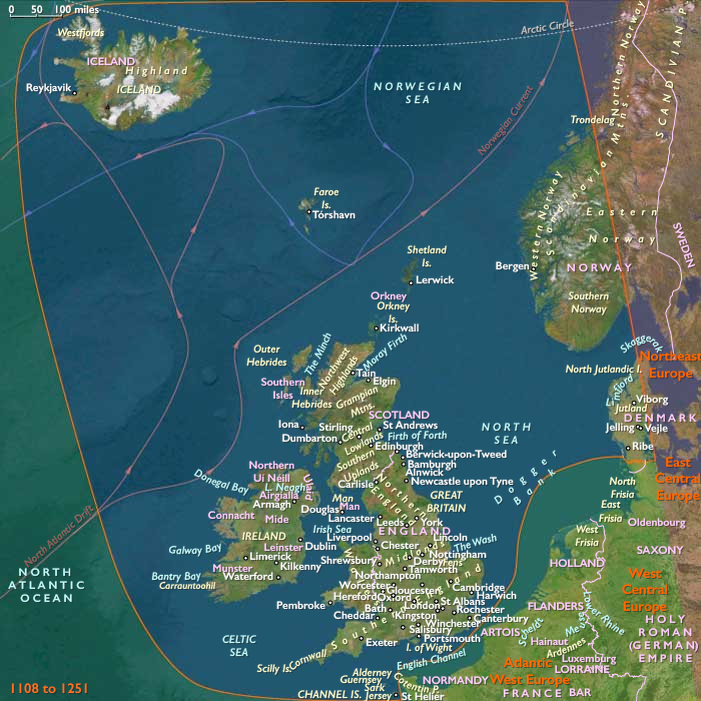
Northwest Europe (1228–1239 CE): Stability, Expansion, and Cultural Flourishing
England: Governance and Diplomacy
The reign of Henry III (r. 1216–1272) continued to solidify, as he emerged from regency and began exercising personal authority. His rule was characterized by ongoing negotiations with the baronial class and consolidating royal power, reinforced by his diplomatic marriage in 1236 to Eleanor of Provence, which strengthened international ties. Henry's governance, however, remained challenged by financial pressures and baronial tensions, foreshadowing future conflicts.
Scotland: Territorial Consolidation
Under Alexander II (r. 1214–1249), Scotland further expanded royal authority northward and westward into the Highlands and Isles. His military and diplomatic endeavors, including successful campaigns against rebellious nobles, further secured his internal power and continued to bolster Scotland's independence from English interference.
Ireland: Anglo-Norman Integration and Gaelic Resilience
The Anglo-Norman presence deepened, characterized by the expansion of feudal holdings, fortifications, and towns. However, significant Gaelic resistance persisted, especially in regions like Connacht and Ulster, highlighting the ongoing tension and complex integration between Anglo-Norman settlers and the indigenous Gaelic population.
Denmark: Reassertion and Renewal
Following his release from imprisonment, Valdemar II (r. 1202–1241) worked to restore Denmark’s dominance. While territories lost were difficult to fully reclaim, Valdemar's administration refocused on internal governance and maintaining influence through strategic diplomacy and consolidation of existing holdings.
Norway: Centralization and Cultural Renaissance
Håkon IV Håkonsson (r. 1217–1263) further consolidated Norway, reducing internal conflicts significantly by 1239. He enhanced royal authority and fostered economic growth through trade expansion, particularly with England and continental Europe. Cultural prosperity continued as the translation and adaptation of continental literature into Old Norse flourished, highlighted by Brother Robert’s literary adaptations, significantly enriching Norwegian literary traditions.
Iceland: Literary and Cultural Prosperity
Iceland remained politically autonomous under its traditional governance through the Althing, and experienced continued literary vibrancy. The period saw further growth of Icelandic saga traditions and historical literature, notably through the ongoing works of Snorri Sturluson. His contributions continued to profoundly shape Icelandic identity and cultural heritage.
Economic and Trade Expansion
Commerce across Northwest Europe expanded markedly during this era. England, Flanders, Denmark, and Norway were actively engaged in increasingly sophisticated trade networks. Commodities like wool, timber, fish, and exotic spices such as sugar, cinnamon, ginger, and nutmeg were traded extensively, bolstering urban growth and economic prosperity throughout the region.
Religious Influence and Education
The Dominican Order firmly established itself during this era, significantly influencing religious life, education, and intellectual discourse. Dominican friars became prominent educators and preachers, significantly shaping theological thought and urban spiritual life across Northwest Europe, fostering reform and scholarly exchange.
Legacy of the Era
By 1239 CE, Northwest Europe experienced enhanced stability, economic growth, and cultural enrichment. England navigated the challenges of royal governance; Scotland expanded and strengthened its territorial and royal authority; Ireland continued the complex interplay between Anglo-Norman settlers and Gaelic traditions; Denmark focused on internal stabilization and renewal; Norway achieved internal unity and cultural prosperity; and Iceland continued its rich literary and cultural traditions. Collectively, these developments provided a robust foundation for the political, economic, and cultural trajectories of Northwest Europe in subsequent decades.
People
- Alexander II of Scotland
- Eleanor of Provence
- Haakon IV of Norway
- Henry III of England
- Snorri Sturluson
- Valdemar II of Denmark
Groups
- Gaels
- Irish people
- Estonia, independent
- Denmark, Kingdom of
- Ireland, medieval
- Flanders, County of
- Alba (Scotland), Scots Kingdom of
- England, (Anglo-Saxon) Kingdom of
- Icelandic Commonwealth, or Icelandic Free State
- Normans
- Norway, independent Kingdom of
- Christians, Roman Catholic
- Dominicans, or Order of St. Dominic
- Estonia, Danish
Topics
Commodoties
Subjects
Regions

Subregions
Years: 1228 - 1239
People
- Alexander II of Scotland
- Eleanor of Provence
- Haakon IV of Norway
- Henry III of England
- Snorri Sturluson
- Valdemar II of Denmark
Groups
- Gaels
- Irish people
- Estonia, independent
- Denmark, Kingdom of
- Ireland, medieval
- Flanders, County of
- Alba (Scotland), Scots Kingdom of
- England, (Anglo-Saxon) Kingdom of
- Icelandic Commonwealth, or Icelandic Free State
- Normans
- Norway, independent Kingdom of
- Christians, Roman Catholic
- Dominicans, or Order of St. Dominic
- Estonia, Danish
Topics
Commodoties
Subjects
Regions
Subregions