
Northwest Europe (1204–1215 CE): Struggles for Power …
Years: 1204 - 1215
Northwest Europe (1204–1215 CE): Struggles for Power and Territorial Reconfigurations
England: Magna Carta and Rebellion
The reign of King John (r. 1199–1216) was marked by political turmoil, territorial losses, and clashes with the nobility. John's failed campaigns to reclaim territories in France, notably Normandy in 1204, weakened his authority and led to heavy taxation at home. His strained relationship with the barons culminated in rebellion, forcing him to seal the Magna Carta in 1215, a pivotal document limiting royal authority and establishing fundamental legal protections.
Scotland: Continued Stability and Expansion
Under William the Lion (r. 1165–1214), Scotland maintained its internal stability and territorial integrity. William effectively managed alliances with English nobles and skillfully navigated tensions with King John, preserving Scotland's sovereignty. His death in 1214 transitioned power smoothly to his son, Alexander II, ensuring continued stability and laying groundwork for further consolidation of Scottish royal power.
Ireland: Anglo-Norman Integration and Resistance
In Ireland, Anglo-Norman lords expanded their territories and strengthened control through the building of fortresses and establishment of towns. Yet, resistance persisted from Gaelic Irish clans. The period witnessed ongoing conflict, with alliances forming and dissolving between Norman settlers and native rulers, creating a complex landscape of power dynamics throughout the island.
Denmark: Dominance and Expansion under Valdemar II
Valdemar II (the Victorious) (r. 1202–1241) consolidated Danish supremacy in the Baltic region through military conquests and diplomatic alliances. His capture of key strategic locations such as Estonia in 1219 further elevated Denmark’s regional power. Domestically, Valdemar's reign was characterized by administrative reforms and strengthened royal authority.
Norway: Succession and Civil Strife
After Sverre Sigurdsson's death in 1202, Norway faced renewed internal conflict and civil strife. Sverre's successors struggled to maintain his centralized authority, as disputes erupted between rival factions, notably the Baglers and Birkebeiner. King Inge Bårdsson (r. 1204–1217) sought to stabilize the kingdom but faced continual challenges and periodic violence, undermining Norway’s unity.
Iceland: Continued Cultural Achievement
Iceland continued to flourish culturally during this era, maintaining its unique political system governed by the Althing. Literary achievements, including the recording and preservation of Norse sagas, underscored the island’s cultural vibrancy. Icelandic autonomy and relative peace allowed cultural and scholarly pursuits to thrive.
Economic and Cultural Exchanges
Crusaders returning from the Holy Land introduced new commodities, notably sugar, which supplemented honey as Europe's primary sweetener. Venetian sugar estates near Tyre exported sugar to Europe, praised by chroniclers like William of Tyre for its health benefits. Almonds, cinnamon, ginger, and nutmeg were also imported, becoming valued additions to royal banquets and shaping the tastes of Europe's elite.
Religious and Cultural Developments
Throughout Northwest Europe, monastic orders, especially the Cistercians and the newly founded Franciscan order, expanded their influence. These groups emphasized poverty, preaching, and direct engagement with local populations, significantly influencing religious life and education throughout the region.
Legacy of the Era
By 1215 CE, Northwest Europe had witnessed transformative shifts. England’s Magna Carta became a cornerstone of constitutional governance. Scotland retained internal stability and independence, while Ireland experienced deepening Anglo-Norman settlement alongside resilient native resistance. Denmark reached new heights under Valdemar II, consolidating Baltic dominance. Norway, however, grappled with succession struggles, compromising national stability. Iceland sustained its cultural golden age, contributing lasting literary and historical legacies.
People
- Alexander II of Scotland
- Canute VI of Demnark
- Inge II of Norway
- John of England
- Sverre of Norway
- Valdemar II of Denmark
- William the Lion
Groups
- Gaels
- Irish people
- Estonia, independent
- Denmark, Kingdom of
- Ireland, medieval
- Alba (Scotland), Scots Kingdom of
- England, (Anglo-Saxon) Kingdom of
- Icelandic Commonwealth, or Icelandic Free State
- Normans
- Norway, independent Kingdom of
- Christians, Roman Catholic
- Cistercians, Order of the (White Friars)
- Franciscans, or Order of St. Francis
Topics
Commodoties
Subjects
Regions
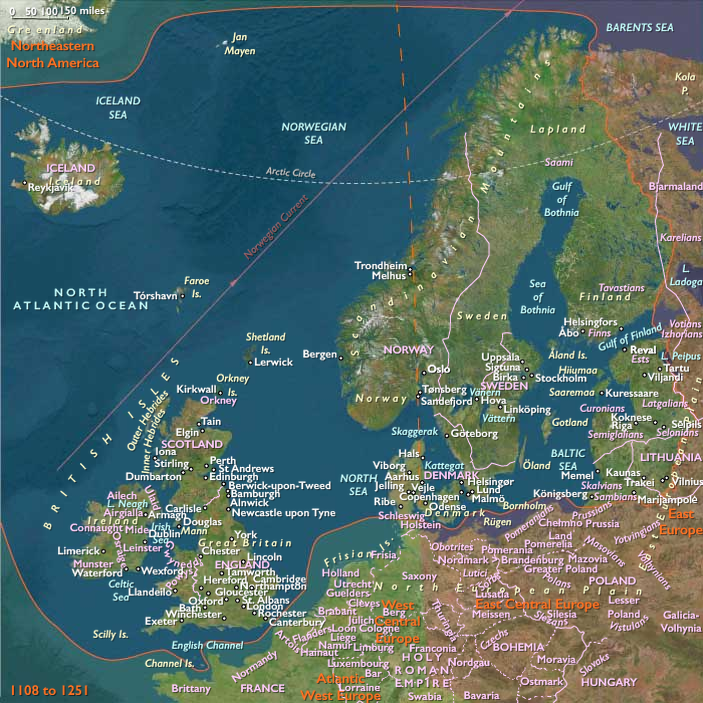
Subregions
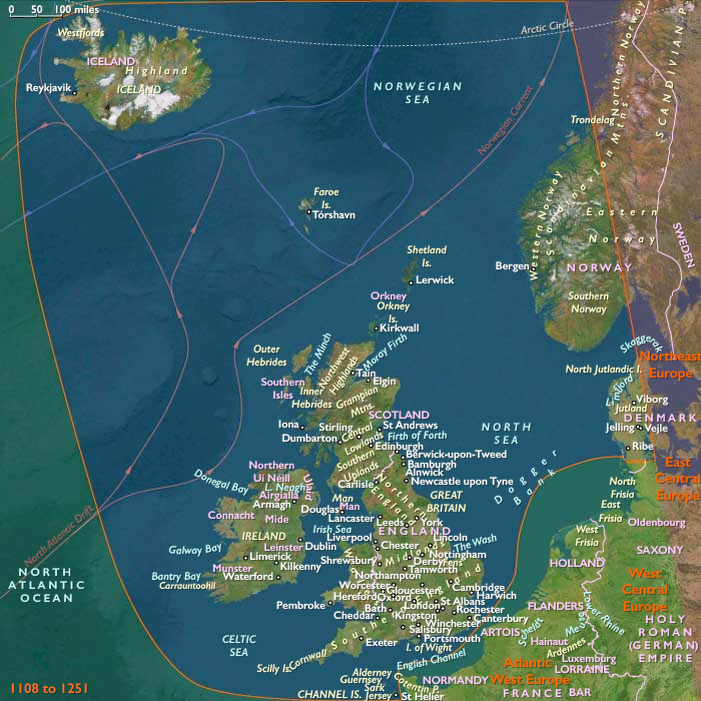
Related Events
Showing 1 events out of 1 total
Years: 1204 - 1215
People
- Alexander II of Scotland
- Canute VI of Demnark
- Inge II of Norway
- John of England
- Sverre of Norway
- Valdemar II of Denmark
- William the Lion
Groups
- Gaels
- Irish people
- Estonia, independent
- Denmark, Kingdom of
- Ireland, medieval
- Alba (Scotland), Scots Kingdom of
- England, (Anglo-Saxon) Kingdom of
- Icelandic Commonwealth, or Icelandic Free State
- Normans
- Norway, independent Kingdom of
- Christians, Roman Catholic
- Cistercians, Order of the (White Friars)
- Franciscans, or Order of St. Francis
Topics
Commodoties
Subjects
Regions
Subregions