
Northwest Europe (1180–1191 CE): Power Struggles and …
Years: 1180 - 1191
Northwest Europe (1180–1191 CE): Power Struggles and Territorial Consolidation
England: The Later Years of Henry II
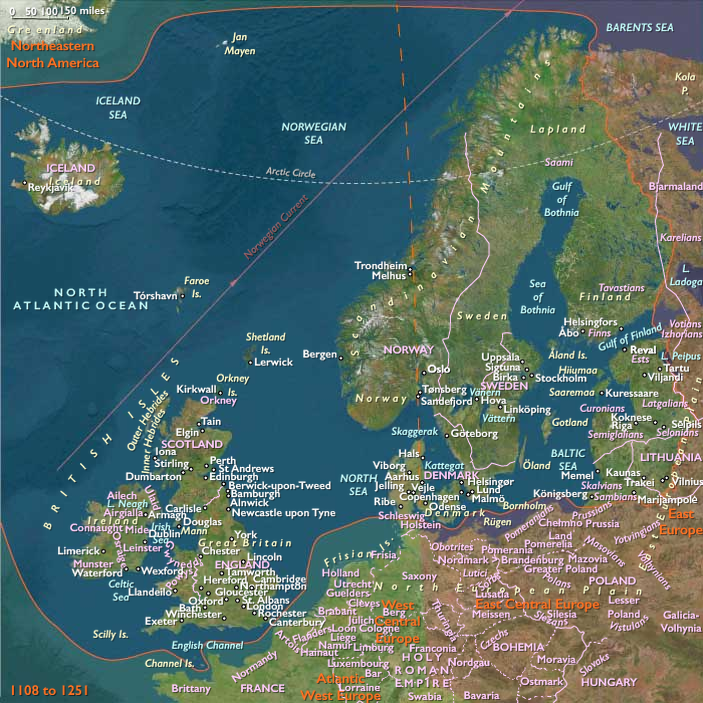
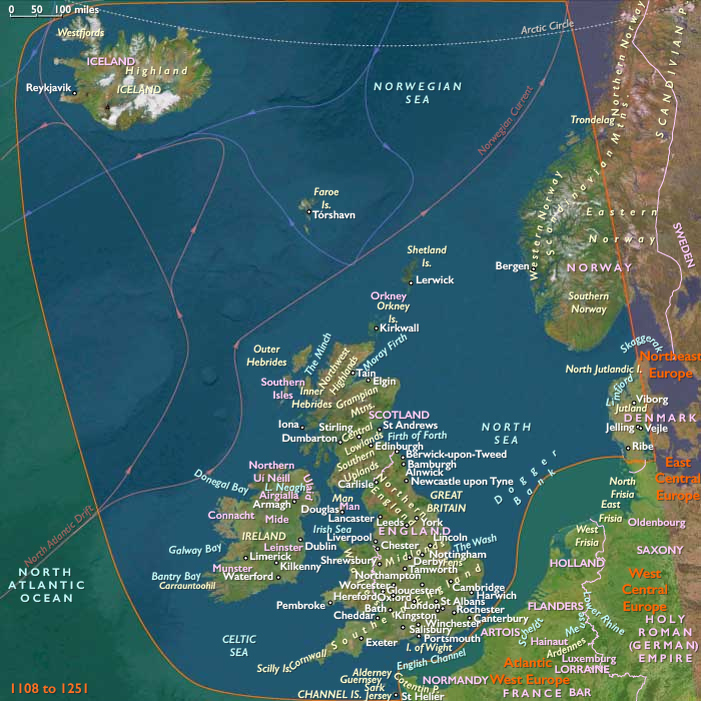
The later reign of Henry II (1154–1189) continued to be marked by family conflict and administrative advancement. His sons, notably Richard I (the Lionheart) and John, remained contentious figures, frequently challenging their father's authority. Despite internal family strife, Henry further developed England’s administrative structures, reinforcing the legal foundations established earlier. His death in 1189 paved the way for Richard I, renowned for his military prowess and engagement in the Third Crusade, which began immediately upon his accession.
Scotland: Reaffirmation of Sovereignty under William the Lion
William the Lion (r. 1165–1214), following his humiliation under the Treaty of Falaise, gradually re-established Scottish autonomy. The period saw William negotiating carefully to regain castles and lands lost to English control. The relationship with England improved after Richard I ascended to the English throne, resulting in the Quitclaim of Canterbury (1189), in which Richard formally relinquished the overlordship claims established by the Treaty of Falaise, significantly restoring Scottish independence.
Ireland: Anglo-Norman Consolidation and Expansion
Anglo-Norman presence in Ireland expanded steadily, consolidating power in regions such as Leinster and establishing significant settlements. Prince John, appointed Lord of Ireland by his father Henry II in 1185, launched a largely unsuccessful initial campaign characterized by poor leadership and strained relations with both Normans and native Irish rulers. Nevertheless, the period entrenched the Anglo-Norman presence, laying a complex foundation for subsequent centuries of English governance and cultural fusion.
Denmark: Stability under King Canute VI
Following the death of Valdemar I in 1182, his son Canute VI (r. 1182–1202) ascended to the Danish throne. Canute VI’s reign marked a period of stability and expansion, notably continuing successful military campaigns initiated by his father, significantly reinforcing Danish dominance in the Baltic region. His reign strengthened the kingdom internally, maintaining strong alliances with the Church and nobility.
Norway: Ongoing Civil Wars
Norway remained turbulent, with continued civil wars and rivalry among claimants to the throne. Sverre Sigurdsson emerged prominently, claiming descent from King Sigurd II and attracting widespread support. After a decisive victory in 1184, Sverre effectively solidified his position, becoming king. Despite this, tensions remained high, with ongoing conflicts against various noble and ecclesiastical factions.
Iceland and the North Atlantic: Cultural Continuity
Iceland continued its cultural flourishing during this period, maintaining independence and societal stability. The Althing, the island's democratic assembly, remained active in managing disputes and governance. Icelandic literature thrived, preserving traditions, law, and oral histories in sagas and chronicles, reinforcing the island’s distinct cultural identity.
Religious and Cultural Developments
Monastic institutions across Northwest Europe continued to thrive, contributing significantly to agriculture, learning, and culture. The Cistercian Order, in particular, expanded rapidly, establishing numerous influential monasteries. The commencement of the Third Crusade in 1189, prominently involving Richard I of England, reflected the era's intense religious and martial fervor, significantly influencing European politics and society.
Legacy of the Era
By 1191 CE, Northwest Europe was shaped by significant territorial realignments and evolving political structures. Richard I’s accession transformed England's international role through crusading zeal, Scotland regained substantial independence under William the Lion, and Anglo-Norman influence firmly rooted itself in Ireland. Denmark experienced sustained stability under Canute VI, and Norway transitioned toward relative stability under Sverre Sigurdsson. Iceland continued its role as a cultural bastion, preserving traditions amidst broader geopolitical shifts.
People
- Canute VI of Demnark
- Henry II of England
- John of England
- Richard I of England
- Sverre of Norway
- Valdemar I of Denmark
- William the Lion
Groups
- Leinster (Laigin), Irish kingdom of
- Anglo-Saxons
- Welsh people
- Denmark, Kingdom of
- Ireland, medieval
- Alba (Scotland), Scots Kingdom of
- Normandy, Duchy of
- England, (Anglo-Saxon) Kingdom of
- Icelandic Commonwealth, or Icelandic Free State
- Normans
- Norway, independent Kingdom of
- Christians, Roman Catholic
- Cistercians, Order of the (White Friars)
Topics
- Medieval Warm Period (MWP) or Medieval Climate Optimum
- Crusades, The
- Norway, civil war in
- Anarchy, the, or The Nineteen Year Winter, or English Dynastic War
- Danish Civil War of 1137-57
- Crusade, Third
Subjects
Regions
Subregions
Years: 1180 - 1191
People
- Canute VI of Demnark
- Henry II of England
- John of England
- Richard I of England
- Sverre of Norway
- Valdemar I of Denmark
- William the Lion
Groups
- Leinster (Laigin), Irish kingdom of
- Anglo-Saxons
- Welsh people
- Denmark, Kingdom of
- Ireland, medieval
- Alba (Scotland), Scots Kingdom of
- Normandy, Duchy of
- England, (Anglo-Saxon) Kingdom of
- Icelandic Commonwealth, or Icelandic Free State
- Normans
- Norway, independent Kingdom of
- Christians, Roman Catholic
- Cistercians, Order of the (White Friars)
Topics
- Medieval Warm Period (MWP) or Medieval Climate Optimum
- Crusades, The
- Norway, civil war in
- Anarchy, the, or The Nineteen Year Winter, or English Dynastic War
- Danish Civil War of 1137-57
- Crusade, Third
Subjects
Regions
Subregions