
Northwest Europe (1108–1119 CE): Royal Administration and …
Years: 1108 - 1119
Northwest Europe (1108–1119 CE): Royal Administration and Crusading Influence
England: Consolidation under Henry I
From 1108 to 1119, Henry I strengthened the administrative structure of England, enhancing the power of the monarchy through institutional reforms. His most significant achievement was the formalization of the Exchequer, a sophisticated system to oversee royal finances and taxation. Henry actively promoted legal reforms and improved governance, earning a reputation for justice and effectiveness. The decisive Battle of Tinchebray (1106) had firmly reestablished English control over Normandy, allowing Henry to focus on internal affairs and fortify royal authority.
Scotland: Stability under Alexander I
Alexander I of Scotland (r. 1107–1124) continued the policies of stability and Norman integration initiated by his predecessors. He maintained peaceful relations with England, especially given his familial connections through his sister Matilda's marriage to Henry I. Alexander fostered ecclesiastical reform, aligning the Scottish Church more closely with Continental practices, and encouraged monastic foundations, which contributed significantly to the kingdom’s cultural and economic advancement.
Ireland: Flourishing Trade amid Political Fragmentation
Ireland remained politically fragmented during this period, yet its Norse-Gaelic coastal cities—especially Dublin and Limerick—continued to flourish economically. These urban centers thrived through maritime commerce and trade networks across the Irish Sea and beyond. Although no significant political unification occurred, the prosperity of these towns ensured Ireland’s continued economic relevance within Northwest Europe.
Denmark and Norway: Peaceful Prosperity and Crusading Ventures
In Denmark, the reign of King Niels (r. 1104–1134) continued to be marked by internal stability, economic growth, and ecclesiastical patronage. Niels supported the construction and expansion of religious institutions, strengthening the monarchy’s cultural legitimacy and influence.
Norway’s international prominence increased under King Sigurd I Jorsalfar (r. 1103–1130), notably due to his participation in the Norwegian Crusade (1107–1110). Sigurd’s successful expedition to the Holy Land brought significant prestige and treasures back to Norway, enhancing his kingdom’s standing both domestically and abroad. This crusading effort reflected broader European religious fervor and illustrated Norway’s integration into European affairs.
Iceland and North Atlantic Settlements: Continued Cultural Strength
Iceland continued its cultural and economic stability, with the Althing sustaining its role as a central institution of governance. The North Atlantic communities preserved their cultural vitality through literary and historical traditions, thereby maintaining a distinct identity within the Norse cultural sphere.
Religious and Cultural Impact
The crusading ideals prevalent in Europe continued to profoundly influence Northwest European society. Ecclesiastical establishments expanded significantly, reflecting broader European trends towards religious reform and the growth of monasticism. This period saw increased cultural exchanges, driven by the experiences and influences of crusaders like Sigurd I, which fostered broader European integration.
Legacy of the Era
By the close of 1119 CE, Northwest Europe had experienced significant administrative, religious, and cultural consolidation. England’s administrative reforms under Henry I, Scotland’s internal stability under Alexander I, Denmark’s peaceful prosperity, and Norway’s enhanced international prestige through crusading adventures shaped a period of notable growth and integration. Ireland's economic strength continued despite political fragmentation, and Iceland and the North Atlantic communities maintained their cultural heritage, further embedding the region within the broader fabric of medieval European civilization.
People
Groups
- Anglo-Saxons
- Denmark, Kingdom of
- Ireland, medieval
- Alba (Scotland), Scots Kingdom of
- Normandy, Duchy of
- England, (Anglo-Saxon) Kingdom of
- Icelandic Commonwealth, or Icelandic Free State
- Normans
- Norway, independent Kingdom of
- Christians, Roman Catholic
Topics
- Medieval Warm Period (MWP) or Medieval Climate Optimum
- Crusade, First
- Crusades, The
- Tinchebrai, Battle of
- Norwegian Crusade
Commodoties
Subjects
Regions

Subregions
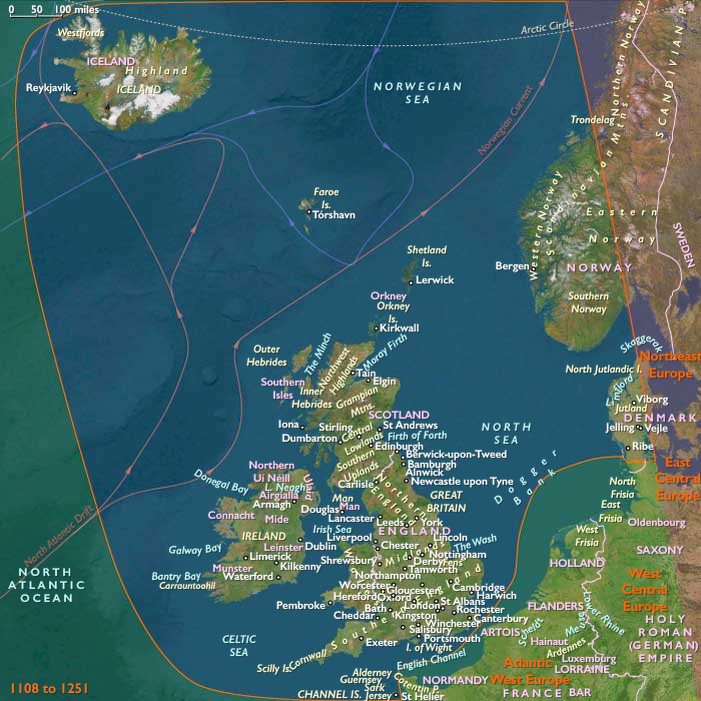
Years: 1108 - 1119
People
Groups
- Anglo-Saxons
- Denmark, Kingdom of
- Ireland, medieval
- Alba (Scotland), Scots Kingdom of
- Normandy, Duchy of
- England, (Anglo-Saxon) Kingdom of
- Icelandic Commonwealth, or Icelandic Free State
- Normans
- Norway, independent Kingdom of
- Christians, Roman Catholic
Topics
- Medieval Warm Period (MWP) or Medieval Climate Optimum
- Crusade, First
- Crusades, The
- Tinchebrai, Battle of
- Norwegian Crusade
Commodoties
Subjects
Regions
Subregions