
Northwest Europe (1036–1047 CE): Fragmentation, Power Struggles, …
Years: 1036 - 1047
Northwest Europe (1036–1047 CE): Fragmentation, Power Struggles, and Dynastic Change
England: Decline of Cnut’s Empire
The stability achieved under Cnut the Great rapidly dissolved following his death in 1035, plunging England into political uncertainty and dynastic struggles. Cnut's sons—Harold Harefoot and Harthacnut—contended bitterly for the throne, fracturing royal authority and generating instability throughout England from 1036 to 1042.
Initially, Harold Harefoot claimed power, ruling England from 1035 to 1040. His short reign was turbulent and marked by internal rivalries, particularly with his half-brother Harthacnut, son of Emma of Normandy. Harold’s sudden death in 1040 allowed Harthacnut, already king of Denmark, to assume the English throne. However, Harthacnut’s harsh taxation and authoritarian rule quickly alienated the nobility and populace, exacerbating England’s internal divisions.
In 1042, following Harthacnut’s sudden death, the English nobility, eager for stability, restored the Anglo-Saxon lineage by placing Edward the Confessor, son of Æthelred the Unready and Emma of Normandy, on the throne. Edward’s accession marked the end of Danish rule in England and the restoration of the House of Wessex. His reign, though beginning amid uncertainty, laid foundations for relative peace and stability, reviving English cultural and political identity.
Scotland: Instability and Dynastic Transition
Scotland witnessed critical dynastic shifts following the death of Malcolm II in 1034. Malcolm’s grandson, Duncan I, ascended the throne, attempting to sustain his predecessor’s achievements. However, Duncan’s rule faced immediate opposition from rival claimants. His brief reign was plagued by instability, culminating in his defeat and death at the hands of Macbeth, the Mormaer (Earl) of Moray, in 1040.
Macbeth’s subsequent rise as King of Scotland (1040–1057) initiated a period of relative internal stability and strong governance. Contrary to later portrayals in Shakespeare’s drama, Macbeth’s historical reign brought notable prosperity and strengthened royal authority, benefiting from diplomatic and religious ties with Europe, notably Rome.
Ireland: Persistent Fragmentation
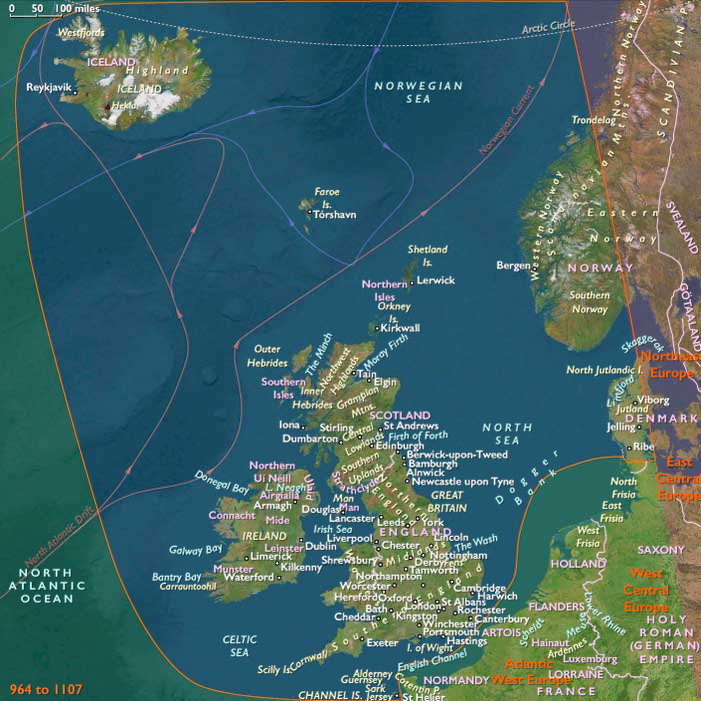
Throughout 1036–1047, Ireland continued to grapple with political fragmentation following the absence of a dominant High King after Brian Boru’s death in 1014. Various regional kings, particularly in Munster, Connacht, Leinster, and Ulster, vied for dominance without achieving national unity. Intermittent alliances and conflicts marked the political landscape. Despite this political instability, Ireland’s monastic tradition remained vibrant, ensuring cultural and scholarly continuity.
Norway and Denmark: Return to Separate Kingdoms
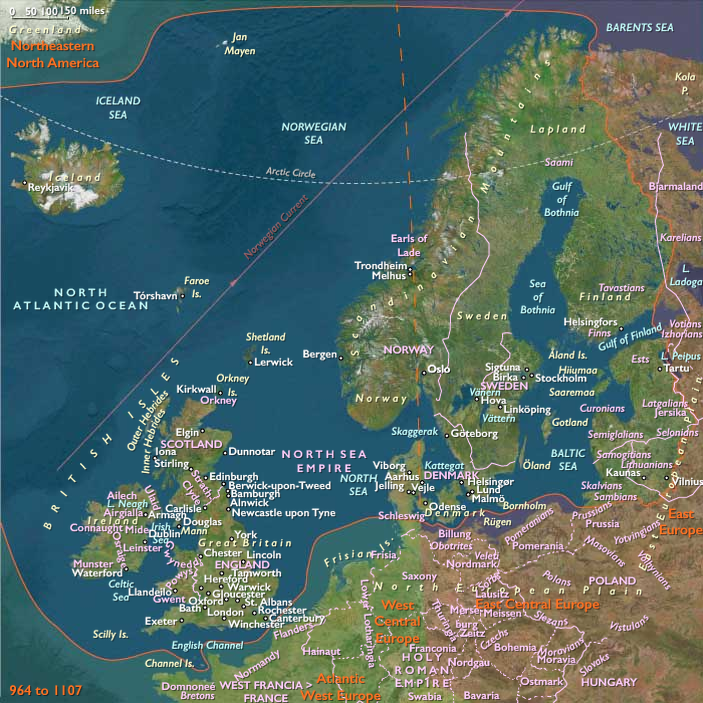
Cnut’s death had shattered the cohesion of his North Sea Empire. In Norway, after years of foreign rule, local authority was reestablished. Following the martyrdom and subsequent canonization of Olaf Haraldsson (Saint Olaf) in 1030, Norway’s identity and unity strengthened around his cult. Olaf’s son, Magnus the Good, assumed the throne in 1035, and by 1042, Magnus had also secured Denmark, temporarily uniting the two kingdoms. Magnus’s brief but successful reign restored Scandinavian autonomy, distancing Norway and Denmark from English affairs.
Iceland and Norse Atlantic Communities
During 1036–1047, Iceland continued to prosper under its unique parliamentary system, the Althing, and stable Christian institutions. The island’s population expanded, and its saga literature developed significantly, solidifying Iceland’s cultural identity. Similarly, Norse communities in the Faroes, Shetland, and Orkney experienced cultural stability and economic vitality, thriving through fishing, farming, and extensive maritime trade networks linking Scandinavia, Scotland, and Ireland.
Cultural and Religious Developments
This period witnessed significant religious consolidation. The veneration of Saint Olaf flourished widely across Scandinavia and Britain, becoming central to Northern European spirituality. The popularization of Olaf’s cult significantly contributed to the further Christianization of Norway and strengthened cultural ties across the North Sea region.
In England, the accession of Edward the Confessor in 1042 spurred renewed interest in Anglo-Saxon culture, law, and piety. His patronage would later lead to significant ecclesiastical reforms and religious revivals. The period also saw increased interactions with continental Europe, notably Normandy, influencing English architecture, culture, and political structures.
Legacy of the Era
By 1047 CE, Northwest Europe had experienced profound dynastic and political realignments. The collapse of Cnut’s empire returned England, Norway, and Denmark to independent governance, each reestablishing distinct identities. In Scotland, Macbeth’s rule provided renewed stability following a turbulent succession. Ireland’s enduring fragmentation contrasted sharply with regional stability elsewhere, yet continued to sustain rich cultural traditions. Iceland and the Norse Atlantic communities flourished culturally and economically, enhancing their distinct regional identities.
Thus, this period served as a transitional phase, reshaping regional alliances and identities, setting the stage for critical developments in Northwest Europe’s medieval history.
People
- Duncan I of Scotland
- Edward the Confessor
- Emma of Normandy
- Eric Haakonsson
- Harold Harefoot
- Harthacnut
- Macbeth
- Magnus the Good
- Malcolm II of Scotland
- Olaf II Haraldsson
- Æthelred the Unready
Groups
- Gaels
- Ulaid (eastern Ulster), Irish kingdom of
- Connaught (Connacht), Irish kingdom of
- Leinster (Laigin), Irish kingdom of
- Munster (Muma), Irish kingdom of
- Anglo-Saxons
- Christianity, Chalcedonian
- Denmark, Kingdom of
- Vikings
- Ireland, medieval
- Norway, independent Kingdom of
- Alba (Scotland), Scots Kingdom of
- England, (Anglo-Saxon) Kingdom of
- Icelandic Commonwealth, or Icelandic Free State
Topics
Subjects
Regions
Subregions
Related Events
Showing 4 events out of 4 total
Years: 1036 - 1047
People
- Duncan I of Scotland
- Edward the Confessor
- Emma of Normandy
- Eric Haakonsson
- Harold Harefoot
- Harthacnut
- Macbeth
- Magnus the Good
- Malcolm II of Scotland
- Olaf II Haraldsson
- Æthelred the Unready
Groups
- Gaels
- Ulaid (eastern Ulster), Irish kingdom of
- Connaught (Connacht), Irish kingdom of
- Leinster (Laigin), Irish kingdom of
- Munster (Muma), Irish kingdom of
- Anglo-Saxons
- Christianity, Chalcedonian
- Denmark, Kingdom of
- Vikings
- Ireland, medieval
- Norway, independent Kingdom of
- Alba (Scotland), Scots Kingdom of
- England, (Anglo-Saxon) Kingdom of
- Icelandic Commonwealth, or Icelandic Free State
Topics
Subjects
Regions
Subregions