
Northwest Europe (1024–1035 CE): Consolidation, Succession, and …
Years: 1024 - 1035
Northwest Europe (1024–1035 CE): Consolidation, Succession, and New Alliances
England: Consolidation Under Cnut the Great
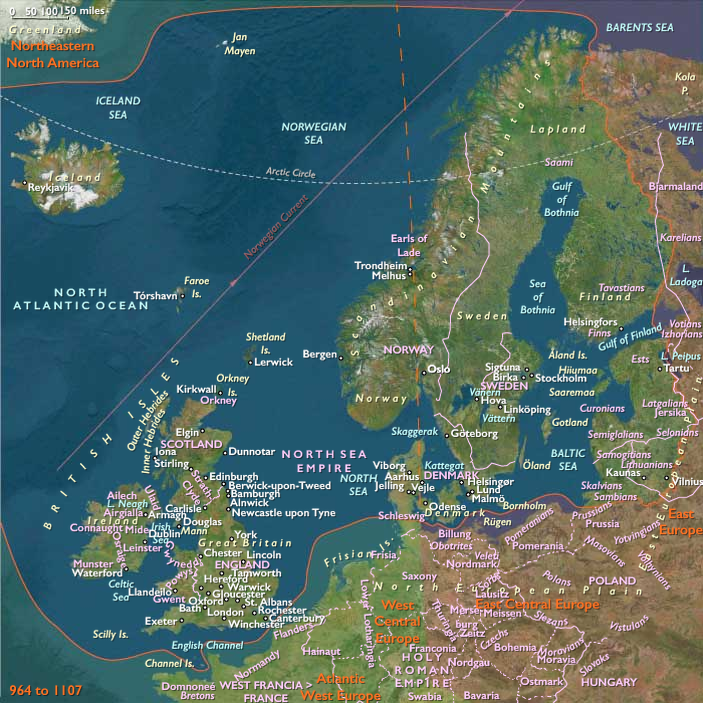
From 1024–1035 CE, Cnut the Great (r. 1016–1035) firmly established his rule in England, bringing a period of unprecedented stability after years of turmoil. Cnut effectively combined Danish and English governance, marrying Æthelred the Unready’s widow, Emma of Normandy, which helped legitimize his claim and stabilize Anglo-Saxon acceptance of Danish rule. He carefully maintained balanced relationships between his realms in England, Denmark, and Norway, thus solidifying the "North Sea Empire."
In this decade, England benefited from peace, renewed trade, and the implementation of strong, centralized government. Cnut respected and adapted existing Anglo-Saxon administrative structures, issuing laws reflecting both Danish and English traditions, and successfully integrated Danish nobility into the English ruling class, facilitating cultural exchanges and reducing ethnic tensions.
Scotland: Malcolm II’s Continued Rule
In Scotland, Malcolm II (r. 1005–1034) maintained a stable and assertive reign, strengthening central royal authority. By 1031, he had secured recognition of Scottish overlordship over the kingdom of Strathclyde, decisively influencing Scotland’s territorial cohesion. Malcolm’s death in 1034 would lead to a complex succession, as he was succeeded by his grandson Duncan I, setting the stage for significant internal strife in subsequent decades.
Ireland: Fragmentation after Brian Boru’s Legacy
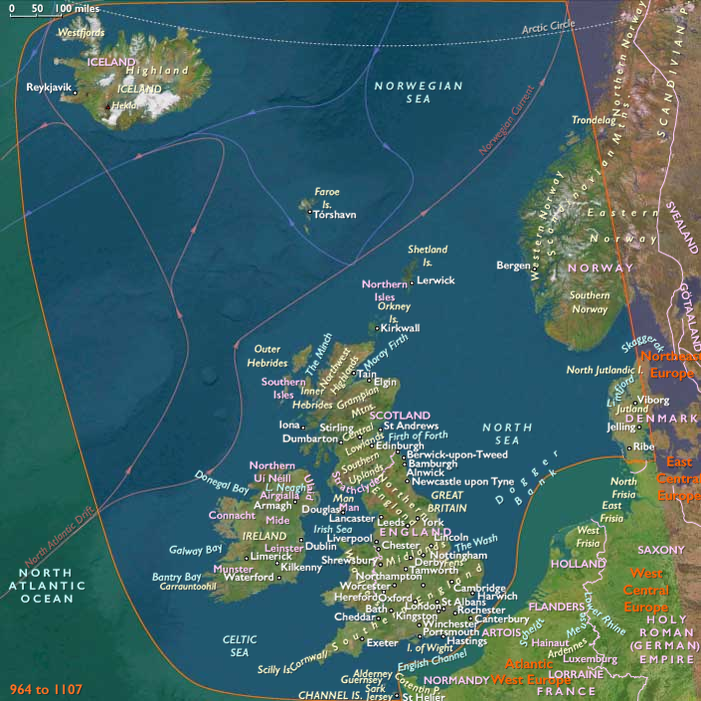
Following the death of Brian Boru (1014), Ireland remained politically fractured. Throughout 1024–1035, no singular high king emerged to replace Brian's dominance. Rather, Ireland was divided into competing regional kingdoms, notably Munster, Leinster, Connacht, and Ulster. Each pursued autonomy, often forming short-lived alliances or engaging in intermittent warfare. Despite instability, Ireland continued as a vital center of monastic scholarship and cultural vitality, preserving rich traditions and literary heritage.
Norway and Denmark: Cnut’s North Sea Empire
In 1028, Cnut expanded his authority to Norway, solidifying his North Sea Empire. He secured recognition as king of Norway after expelling the Norwegian king, Olaf Haraldsson (later known as Saint Olaf). This remarkable consolidation brought England, Denmark, and Norway under a single monarch, marking a pinnacle of Danish influence in Northwest Europe. Eric Haakonsson, Earl of Northumbria, remained a crucial ally and administrator in England and the northern territories until his death around 1024. Cnut’s vast empire fostered unprecedented cross-cultural contact and trade, shaping regional politics significantly.
Iceland and the Norse Atlantic Settlements: Stability and Cultural Growth
During 1024–1035, Iceland continued to benefit from stable governance under the Althing system and newly-established Christian institutions. Its religious transition facilitated deeper European connections, enhancing literary activities, including the growth of sagas and genealogical literature. Norse communities in the Faroes, Orkney, and Shetland remained stable, economically active, and culturally vibrant, maintaining significant autonomy and ongoing trade networks linking them closely with the North Sea Empire.
Intellectual and Religious Life
This period witnessed notable religious developments. The veneration of Saint Olaf Haraldsson, killed at the Battle of Stiklestad (1030) after attempting to regain Norway, quickly spread throughout Scandinavia and England, significantly influencing religious practices and pilgrimages. Olaf’s martyrdom and subsequent canonization greatly bolstered Christianization in Scandinavia, reinforcing cultural integration within Cnut’s domains.
In England, monastic communities flourished under stable royal patronage. Intellectual life continued to prosper through chronicles, such as continued entries in the Anglo-Saxon Chronicle, which recorded key contemporary events and offered valuable historical insights.
Succession Crisis after Cnut’s Death
The stability achieved by Cnut unraveled swiftly following his death in 1035. He was succeeded briefly by his sons Harold Harefoot and Harthacnut, whose rivalries and ineffective rule resulted in renewed uncertainty and eventual disintegration of the North Sea Empire. This succession crisis set the stage for England’s political instability and increased local tensions in the ensuing decades.
Legacy of the Era
By the close of 1035 CE, Northwest Europe had experienced remarkable political unification under Cnut’s North Sea Empire, alongside continuing fragmentation in Ireland and gradual stabilization in Scotland. Iceland and the Norse settlements thrived culturally and economically, bolstered by stable institutions and Christianization. The death of Cnut in 1035 marked a turning point, ushering in a new phase of fragmentation and power struggles that would reshape regional dynamics profoundly in subsequent decades.
People
- Brian Boru
- Cnut the Great
- Duncan I of Scotland
- Emma of Normandy
- Eric Haakonsson
- Harold Harefoot
- Harthacnut
- Malcolm II of Scotland
- Olaf II Haraldsson
- Æthelred the Unready
Groups
- Gaels
- Ulaid (eastern Ulster), Irish kingdom of
- Connaught (Connacht), Irish kingdom of
- Osraige (Irish kingdom)
- Leinster (Laigin), Irish kingdom of
- Anglo-Saxons
- Munster (Muma), Irish kingdom of
- Ailech (Aileach), Irish kingdom of
- Meath (Mide, or Midhe), Irish kingdom of
- Christianity, Chalcedonian
- Oriel (Airgialla), Irish kingdom of
- Breifne, (Irish) Kingdom of
- Denmark, Kingdom of
- Vikings
- Ireland, medieval
- Dublin, Kingdom of
- Norway, independent Kingdom of
- Alba (Scotland), Scots Kingdom of
- England, (Anglo-Saxon) Kingdom of
- Icelandic Commonwealth, or Icelandic Free State
- North Sea Empire
Topics
Subjects
Regions
Subregions
Related Events
Showing 10 events out of 51637 total
Years: 1024 - 1035
People
- Brian Boru
- Cnut the Great
- Duncan I of Scotland
- Emma of Normandy
- Eric Haakonsson
- Harold Harefoot
- Harthacnut
- Malcolm II of Scotland
- Olaf II Haraldsson
- Æthelred the Unready
Groups
- Gaels
- Ulaid (eastern Ulster), Irish kingdom of
- Connaught (Connacht), Irish kingdom of
- Osraige (Irish kingdom)
- Leinster (Laigin), Irish kingdom of
- Anglo-Saxons
- Munster (Muma), Irish kingdom of
- Ailech (Aileach), Irish kingdom of
- Meath (Mide, or Midhe), Irish kingdom of
- Christianity, Chalcedonian
- Oriel (Airgialla), Irish kingdom of
- Breifne, (Irish) Kingdom of
- Denmark, Kingdom of
- Vikings
- Ireland, medieval
- Dublin, Kingdom of
- Norway, independent Kingdom of
- Alba (Scotland), Scots Kingdom of
- England, (Anglo-Saxon) Kingdom of
- Icelandic Commonwealth, or Icelandic Free State
- North Sea Empire
Topics
Subjects
Regions
Subregions