
Northwest Europe (1012–1023 CE): Danish Domination, Irish …
Years: 1012 - 1023
Northwest Europe (1012–1023 CE): Danish Domination, Irish Struggles, and Regional Transformations
England: Danish Conquest under Sweyn and Cnut
The period from 1012 to 1023 CE marked a dramatic turning point in England’s history. Following years of Danish raids led by Sweyn Forkbeard, tensions exploded after King Æthelred the Unready ordered the St. Brice's Day massacre. In 1013 CE, Sweyn launched a decisive invasion, rapidly overcoming English resistance. Æthelred fled to Normandy, allowing Sweyn to become the first Danish king of England. Sweyn's sudden death in 1014 briefly returned Æthelred to power but brought further turmoil.
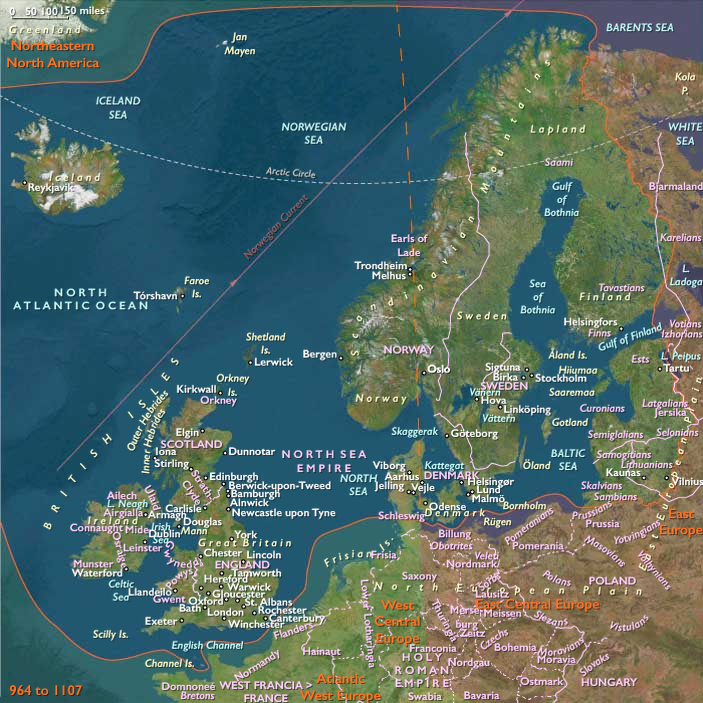
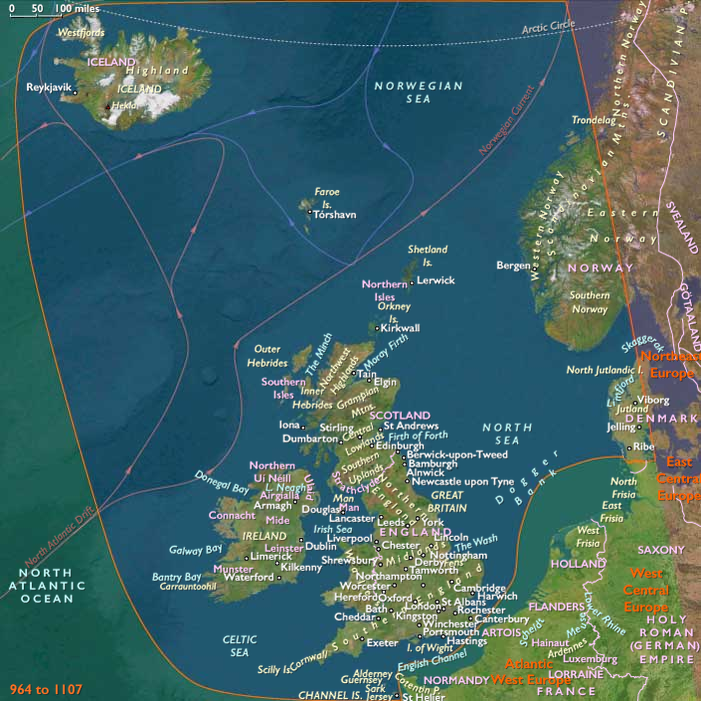
In midsummer 1015, Sweyn’s son Cnut (later known as Canute the Great) launched a powerful new invasion fleet, landing at Sandwich, Kent, virtually unopposed. Cnut's forces quickly moved through Wessex, ravaging Dorset, Wiltshire, and Somerset. Eadric Streona, the influential but notoriously unreliable alderman, initially assembled an English fleet but promptly submitted to Cnut. Unopposed, the Scandinavian army advanced into Mercia and plundered northward into Northumbria, where its ruler, Uhtred the Bold, was murdered. Subsequently, Northumbria was granted to Cnut’s ally, Eric Haakonsson, who had left Norway around 1014 or 1015 specifically to support Cnut’s campaign.
When Cnut's army turned south again toward London in early 1016, Æthelred died, and his son Edmund Ironside ascended to the throne. Edmund briefly rallied English resistance, but after several fierce battles and an inconclusive siege of London, he agreed with Cnut to divide the kingdom. Edmund’s death just months later cleared the path for Cnut, who became undisputed king of England in 1017. Cnut divided England into four territories: Wessex he retained for himself; East Anglia he gave to the Danish chieftain Thorkell the Tall; Northumbria went to Eric Haakonsson; and Mercia was returned to Eadric Streona—who was swiftly executed later that year for treachery. Cnut’s reign thus established a Danish-dominated North Sea empire that significantly reshaped the region.
Ireland: Brian Boru’s Last Years and the Battle of Clontarf
In Ireland, tensions grew following High King Brian Boru’s divorce from his formidable wife, Queen Gormflaith, in the early 1010s. Gormflaith subsequently began orchestrating opposition to Brian, fueling rising discontent among the Leinstermen. Relations with Leinster had deteriorated so sharply that by 1012, open rebellion erupted, challenging Brian’s rule.
This opposition climaxed dramatically at the Battle of Clontarf on April 23, 1014. Brian’s forces confronted a broad coalition of rebellious Leinstermen and their Norse allies from Dublin and overseas. Although Brian’s army achieved victory, dramatically weakening Norse influence in Ireland, Brian himself was slain during the battle. His death removed a unifying figure, plunging Ireland back into political fragmentation.
Scotland: Stability Under Malcolm II
In Scotland, Malcolm II (r. 1005–1034) continued to solidify central authority. Throughout this period, Malcolm expanded his territories, notably securing control over Lothian. This consolidation provided critical stability and reinforced Alba’s internal coherence amidst the broader instability in Britain and Ireland.
Iceland: Consolidation of Christian Institutions
Following Iceland’s peaceful adoption of Christianity (1000 CE), the Icelandic Commonwealth further integrated ecclesiastical institutions and Christian laws into daily governance. The peaceful religious transition allowed Iceland to develop closer cultural ties with the European mainland without sacrificing the autonomy of its unique parliamentary system, the Althing.
Norse Settlements: Maritime Networks and Cultural Stability
Communities in Orkney, Shetland, and the Hebrides remained economically prosperous and culturally distinctive during this period, even as Norse power declined in Ireland after Clontarf. These island settlements continued as important maritime hubs, balancing cultural influences from Scandinavia, Ireland, and Anglo-Saxon England.
Literary and Cultural Developments
Around 1000 CE, the compilation of the Irish Dindseanchas cataloged legendary sites on the Hill of Tara, reinforcing the symbolic cultural unity Brian Boru sought. Meanwhile, around 950–960 CE, the compilation of the Cædmon manuscript in England reflected continuing vibrant intellectual and literary traditions, despite the turbulent political backdrop.
Legacy of the Era
By 1023 CE, Northwest Europe had undergone profound transformations. Cnut’s consolidation of power in England established a durable Danish presence, dramatically reshaping political alliances and territorial administration. Brian Boru’s reign and subsequent death at Clontarf marked a pivotal point for Ireland, sparking renewed political fragmentation exacerbated by personal rivalries and rebellions, notably those incited by Gormflaith. Meanwhile, Malcolm II’s stable governance in Scotland contrasted sharply with instability elsewhere. Iceland’s embrace of Christianity strengthened its European cultural alignment while preserving political independence.
These complex interwoven events set critical precedents, laying the groundwork for continued change in Northwest Europe throughout the eleventh century.
People
- Amlaíb Cuarán
- Brian Boru
- Cnut the Great
- Eadric Streona
- Edmund Ironside
- Eric Haakonsson
- Gormlaith ingen Murchada
- Kenneth III of Scotland
- Malcolm II of Scotland
- Olaf Tryggvason
- Sweyn Forkbeard
- Thorkell the Tall
- Uhtred of Bamburgh
- Æthelred the Unready
Groups
- Gaels
- Leinster (Laigin), Irish kingdom of
- Anglo-Saxons
- Christianity, Chalcedonian
- Denmark, Kingdom of
- Vikings
- Ireland, medieval
- Dublin, Kingdom of
- Norway, independent Kingdom of
- Alba (Scotland), Scots Kingdom of
- England, (Anglo-Saxon) Kingdom of
- Icelandic Commonwealth, or Icelandic Free State
- North Sea Empire
Topics
- Viking Raids in Ireland
- Viking Raids
- Viking Raids in England, Later
- Medieval Warm Period (MWP) or Medieval Climate Optimum
- St. Brice's Day massacre
- Leinster revolt against Brian Boru, Second
- Clontarf, Battle of
Subjects
- Commerce
- Writing
- Painting and Drawing
- Conflict
- Mayhem
- Exploration
- Faith
- Government
- Custom and Law
- Human Migration
Regions
Subregions
Years: 1012 - 1023
People
- Amlaíb Cuarán
- Brian Boru
- Cnut the Great
- Eadric Streona
- Edmund Ironside
- Eric Haakonsson
- Gormlaith ingen Murchada
- Kenneth III of Scotland
- Malcolm II of Scotland
- Olaf Tryggvason
- Sweyn Forkbeard
- Thorkell the Tall
- Uhtred of Bamburgh
- Æthelred the Unready
Groups
- Gaels
- Leinster (Laigin), Irish kingdom of
- Anglo-Saxons
- Christianity, Chalcedonian
- Denmark, Kingdom of
- Vikings
- Ireland, medieval
- Dublin, Kingdom of
- Norway, independent Kingdom of
- Alba (Scotland), Scots Kingdom of
- England, (Anglo-Saxon) Kingdom of
- Icelandic Commonwealth, or Icelandic Free State
- North Sea Empire
Topics
- Viking Raids in Ireland
- Viking Raids
- Viking Raids in England, Later
- Medieval Warm Period (MWP) or Medieval Climate Optimum
- St. Brice's Day massacre
- Leinster revolt against Brian Boru, Second
- Clontarf, Battle of
Subjects
- Commerce
- Writing
- Painting and Drawing
- Conflict
- Mayhem
- Exploration
- Faith
- Government
- Custom and Law
- Human Migration
Regions
Subregions