
Northern West Indies (1828–1971 CE): Emancipation, Colonial …
Years: 1828 - 1971
Northern West Indies (1828–1971 CE): Emancipation, Colonial Realignments, and Naval Strongholds
Geographic & Environmental Context
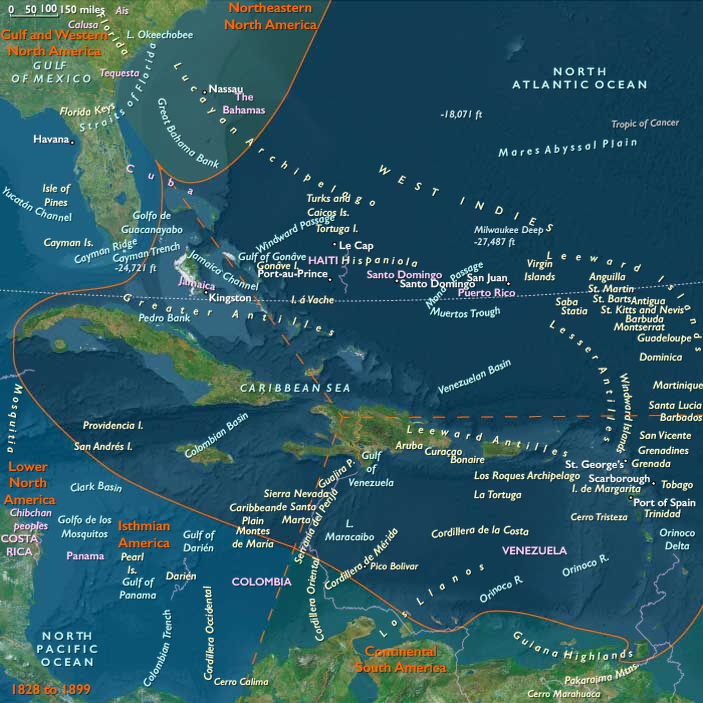
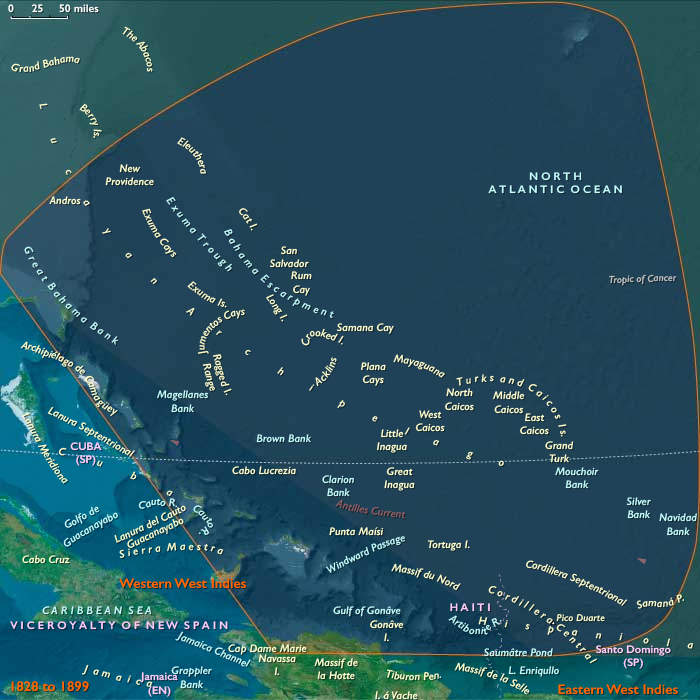
The subregion of Northern West Indies includes Bermuda, the Turks and Caicos, northern Hispaniola, and the Outer Bahamas (Grand Bahama, Abaco, Eleuthera, Cat Island, San Salvador, Long Island, Crooked Island, Mayaguana, Little Inagua, and eastern Great Inagua). The Inner Bahamas belong to the Western West Indies. Anchors included the Bahama Banks, Bermuda’s naval dockyards, the Caicos salt pans, and the northern valleys of Hispaniola.
Climate & Environmental Shifts
Storms continued to buffet the region, with major hurricanes striking the Bahamas in 1866 and 1926. Bermuda endured destructive storms in 1880 and 1922 but remained climatically stable overall. Hispaniola’s north faced droughts and flooding, complicating farming and ranching.
Subsistence & Settlement
-
Bermuda: After slavery’s abolition (1834), freed communities pursued farming, fishing, and maritime trades. British dockyards expanded, turning Bermuda into the “Gibraltar of the West.” By the mid-20th century, tourism and U.S. military bases reshaped the economy.
-
Bahamas: Enslaved people gained emancipation in 1834; plantation agriculture collapsed, replaced by sponging, fishing, and subsistence farming. Nassau grew as a colonial capital. In the 20th century, tourism, finance, and U.S. investment surged.
-
Turks and Caicos: Salt exports remained dominant into the late 19th century, declining only in the 20th. Migration to the Bahamas and U.S. marked demographic change.
-
Northern Hispaniola: The Haitian Revolution (1791–1804) reshaped the region; by this period, Cap-Haïtien and Santiago de los Caballeros endured as urban centers within divided Hispaniola (Haiti and the Dominican Republic after 1844).
Technology & Material Culture
British naval technology dominated Bermuda, with forts, dockyards, and stone lighthouses. Bahamian and Turks Islanders built wooden sloops for sponging and fishing. Urban Nassau adopted colonial Georgian architecture. Hispaniola’s north displayed plantation remnants, wooden vernacular homes, and Catholic churches.
Movement & Interaction Corridors
-
Bermuda’s dockyards supported Britain’s Atlantic fleet, later hosting U.S. bases during World War II and the Cold War.
-
Bahamian sloops plied inter-island trade in salt, fish, and sponges.
-
Migrants moved between Turks and Caicos, the Bahamas, and Florida.
-
Steamships and later airplanes connected Nassau and Bermuda to New York and London.
-
Hispaniola’s north engaged in coffee, cacao, and tobacco exports.
Cultural & Symbolic Expressions
-
Afro-Bermudian and Afro-Bahamian communities preserved oral traditions, drumming, and festival rituals like Junkanoo.
-
Catholic festivals persisted in Hispaniola, blending with African practices.
-
Anglican and Methodist revivals in Bermuda and the Bahamas shaped colonial identity.
-
Tourism promoted symbolic images of white beaches, palm trees, and colorful festivals.
Environmental Adaptation & Resilience
Communities rebuilt repeatedly after hurricanes, adapting architecture with stone and storm shutters. Cropping systems diversified: cassava, maize, and root crops supplemented fragile soils. Fishing and sponging replaced plantations. African-descended communities relied on kinship networks and cultural resilience to endure marginalization.
Transition
By 1971 CE, the Northern West Indies was deeply entwined with Britain and the United States. Bermuda remained a key Cold War naval base and tourist destination. The Bahamas, on the verge of independence (achieved in 1973), had shifted toward finance and tourism. Turks and Caicos lingered as a British dependency. Northern Hispaniola remained split between Haiti and the Dominican Republic, both struggling with political turbulence. Across the subregion, emancipation, migration, and global naval strategies had transformed fragile slave economies into maritime crossroads of empire, culture, and resilience.
People
Groups
- French people (Latins)
- English people
- Santo Domingo, Captaincy General of
- Santo Domingo, Real Audiencia de
- Spaniards (Latins)
- Spain, Habsburg Kingdom of
- France, (Bourbon) Kingdom of
- Saint Domingue, French Colony of
- Bermuda (United Kingdom overseas territory)
- Santo Domingo (Spanish Colony)
- France, Kingdom of (constitutional monarchy)
- French First Republic
- Santo Domingo (French Colony)
- Haiti, Republic of
- France, (first) Empire of
- Haiti, Kingdom of northern
- Santo Domingo, Captaincy General of
- France, constitutional monarchy of
- Dominican Republic
- Santo Domingo (Haitian-occupied)
- Dominican Republic (restored)
Topics
- Colonization of the Americas, Spanish
- Santo Domingo, Haitian Occupation of
- American Civil War (War between the States, War of the Rebellion, War of Secession, War for Southern Independence)
- Haiti, United States occupation of
- Santo Domingo, Military Government of
- Dominican Occupation Revolt
- Haitian Occupation Revolt of 1918-19
- Dominican "Era of Trujillo"
- World War, Second (World War II)
Commodoties
Subjects
Regions
Subregions
Related Events
Showing 10 events out of 19829 total
Years: 1828 - 1971
People
Groups
- French people (Latins)
- English people
- Santo Domingo, Captaincy General of
- Santo Domingo, Real Audiencia de
- Spaniards (Latins)
- Spain, Habsburg Kingdom of
- France, (Bourbon) Kingdom of
- Saint Domingue, French Colony of
- Bermuda (United Kingdom overseas territory)
- Santo Domingo (Spanish Colony)
- France, Kingdom of (constitutional monarchy)
- French First Republic
- Santo Domingo (French Colony)
- Haiti, Republic of
- France, (first) Empire of
- Haiti, Kingdom of northern
- Santo Domingo, Captaincy General of
- France, constitutional monarchy of
- Dominican Republic
- Santo Domingo (Haitian-occupied)
- Dominican Republic (restored)
Topics
- Colonization of the Americas, Spanish
- Santo Domingo, Haitian Occupation of
- American Civil War (War between the States, War of the Rebellion, War of Secession, War for Southern Independence)
- Haiti, United States occupation of
- Santo Domingo, Military Government of
- Dominican Occupation Revolt
- Haitian Occupation Revolt of 1918-19
- Dominican "Era of Trujillo"
- World War, Second (World War II)
Commodoties
Subjects
Regions
Subregions