
Northern West Indies (1396–1539 CE): Taíno Worlds …
Years: 1396 - 1539
Northern West Indies (1396–1539 CE): Taíno Worlds and Atlantic Crossings
Geographic & Environmental Context
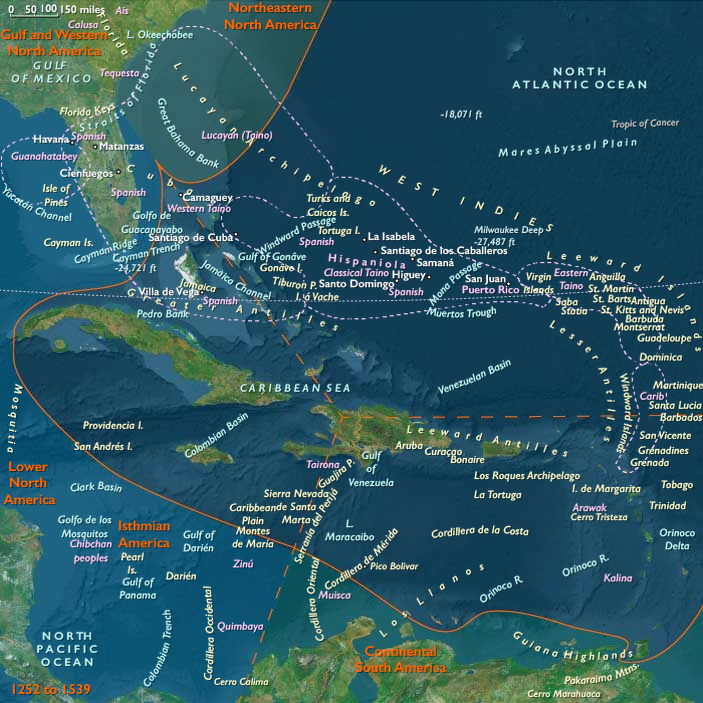
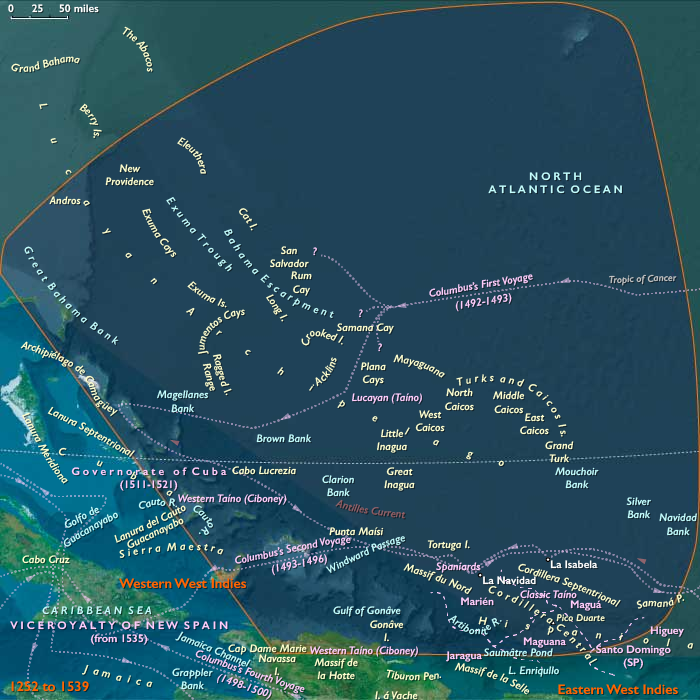
The subregion of Northern West Indies includes Bermuda, the Turks and Caicos, northern Hispaniola, and the Outer Bahamas (Grand Bahama, Abaco, Eleuthera, Cat Island, San Salvador, Long Island, Crooked Island, Mayaguana, Little Inagua, and eastern Great Inagua). The Inner Bahamas belong to the Western West Indies. Anchors included the Bahama Banks, the Caicos archipelago, Bermuda’s volcanic outcrop, and the Cibao Valley of northern Hispaniola. This was a world of shallow reefs, sandy cays, blue holes, and fertile valleys on Hispaniola, where limestone plateaus contrasted with rugged northern highlands. Warm waters of the Gulf Stream brushed these islands, carrying marine abundance and, by the early 16th century, European fleets.
Climate & Environmental Shifts
The Little Ice Age brought modest shifts: stronger hurricane cycles swept the Bahamas and Hispaniola, while rainfall variability shaped agriculture. On Bermuda, isolated and uninhabited, the subtropical climate sustained cedar forests and seabird colonies. The Gulf Stream maintained productive marine ecosystems, though storm surges reshaped low-lying cays.
Subsistence & Settlement
-
Northern Hispaniola: Populated by Taíno chiefdoms (cacicazgos), who cultivated cassava, maize, beans, peppers, and sweet potato in conucos (mounded fields). Villages clustered in valleys and along rivers, ruled by caciques with stratified social order. Fishing, manatee hunting, and shellfishing supplemented diets.
-
Turks and Caicos, Bahamas: Supported smaller Taíno communities, relying on root crops, palm fruits, and intensive fishing. Canoes connected island groups.
-
Bermuda: Still uninhabited, an ecological haven for seabirds, turtles, and dense cedar forests.
Technology & Material Culture
Taíno crafted dugout canoes, stone celts, shell tools, woven cotton hammocks, and wooden zemí idols embodying deities and ancestors. Pottery (Saladoid-descended) decorated domestic life. Cotton textiles, jewelry of shell and gold (on Hispaniola), and elaborate ritual regalia reinforced social hierarchies. European arrival in 1492 introduced iron, glass beads, and firearms, but also disease.
Movement & Interaction Corridors
-
Taíno sea lanes: Canoes traversed between Hispaniola, the Bahamas, and Caicos, moving food, tools, and ritual goods.
-
Gulf Stream: Channeled fish and turtles, later European ships.
-
European arrival: Columbus’s first landfall at San Salvador (Guanahaní) in 1492 marked the transformation of the subregion into a corridor of conquest. Hispaniola became Spain’s first colony, with La Isabela (1494) and Santo Domingo (1498, though the latter lies in southern Hispaniola). The north coast hosted ports like Puerto Plata and Monte Cristi.
Cultural & Symbolic Expressions
Taíno spirituality centered on zemí idols, ancestor veneration, and rituals of cohoba (hallucinogenic snuff). Ceremonial ball courts (batey) reinforced cosmological order. Songs, dances (areítos), and oral tradition bound communities. Contact with Spaniards introduced Christianity, often violently; churches and forts were imposed on Taíno landscapes. Bermuda, untouched, remained a symbolic void for Europeans until later accidental landfalls.
Environmental Adaptation & Resilience
Taíno managed fragile soils through shifting conuco fields, polyculture, and reliance on root crops. Fishing and shellfishing diversified subsistence. Communities adapted socially through alliances and exchanges. Yet epidemics, warfare, and enslavement after 1492 devastated populations—especially in Hispaniola, where collapse was rapid and near-total by 1539.
Transition
By 1539 CE, the Northern West Indies had been transformed. Taíno polities endured in fragmented form, especially in remote Bahamian and Caicos islands, but northern Hispaniola was firmly within Spain’s colonial orbit. Bermuda remained uninhabited but was mapped by Iberian sailors as part of Atlantic routes. The subregion, once a thriving Taíno maritime network, had become one of the first crucibles of European empire in the Americas.
People
Groups
- Arawak peoples (Amerind tribe)
- Taíno
- Lucayans
- French people (Latins)
- English people
- Spain, Habsburg Kingdom of
- Spaniards (Latins)
- Eleutheran Adventurers
Topics
Commodoties
Subjects
Regions
Subregions
Years: 1396 - 1539
People
Groups
- Arawak peoples (Amerind tribe)
- Taíno
- Lucayans
- French people (Latins)
- English people
- Spain, Habsburg Kingdom of
- Spaniards (Latins)
- Eleutheran Adventurers
Topics
Commodoties
Subjects
Regions
Subregions