
The West Indies (1396–1539 CE) Taíno …
Years: 1396 - 1539
The West Indies (1396–1539 CE)
Taíno Worlds, Kalinago Seas, and the First Atlantic Conquests
Geography & Environmental Framework
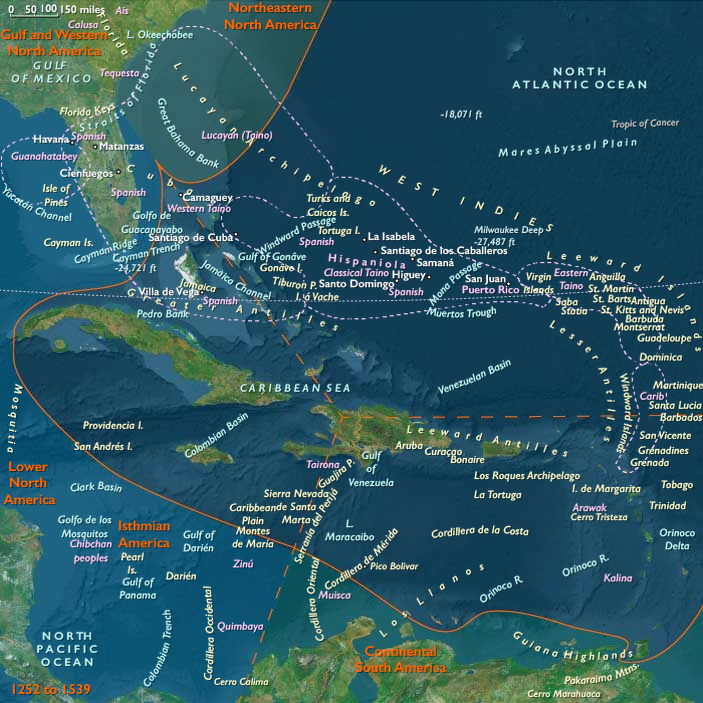
Stretching from Bermuda and the Bahamas to Trinidad and the Lesser Antilles, the West Indies in the fifteenth and early sixteenth centuries formed a crescent of islands bridging two worlds: the tropical Americas and the open Atlantic.
Three great clusters defined the region:
-
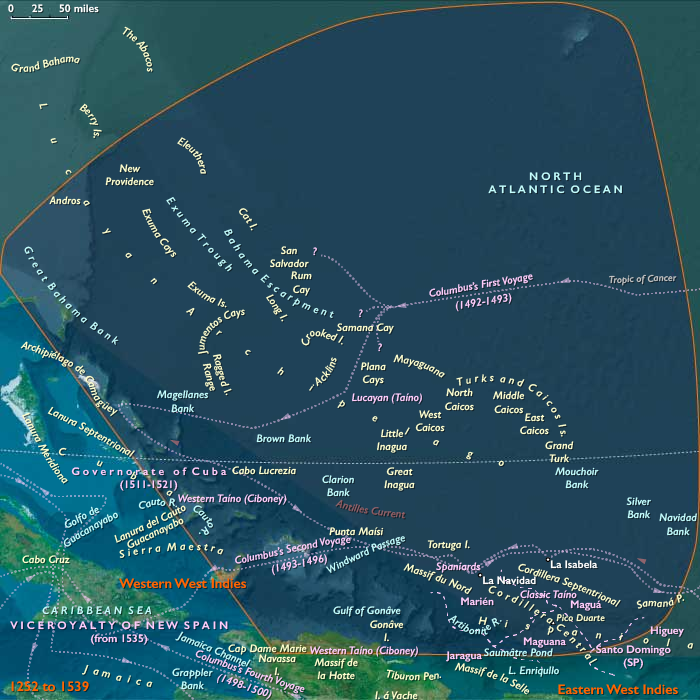
the Northern West Indies—Bermuda, the Bahamas, Turks and Caicos, and northern Hispaniola;
-
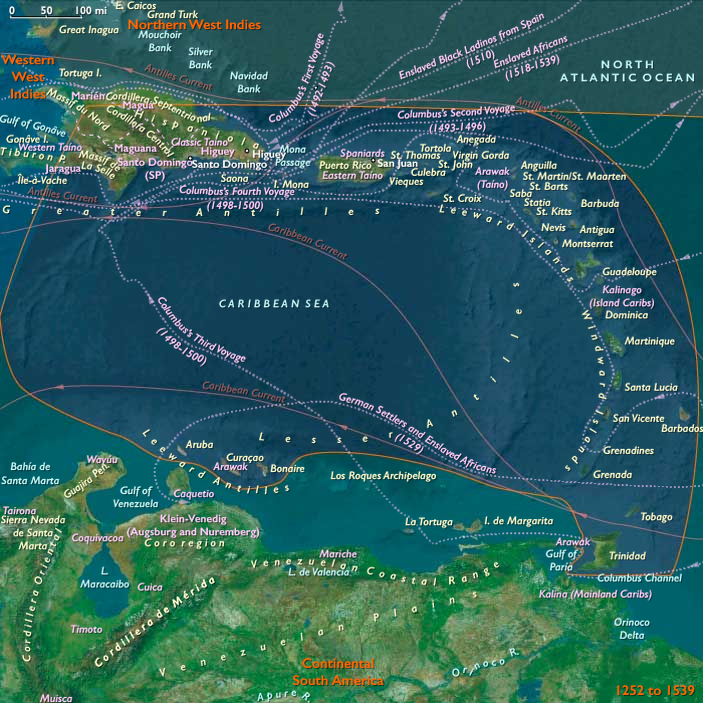
the Eastern West Indies—Puerto Rico, Hispaniola’s eastern valleys, Trinidad, and the volcanic arc of the Lesser Antilles;
-
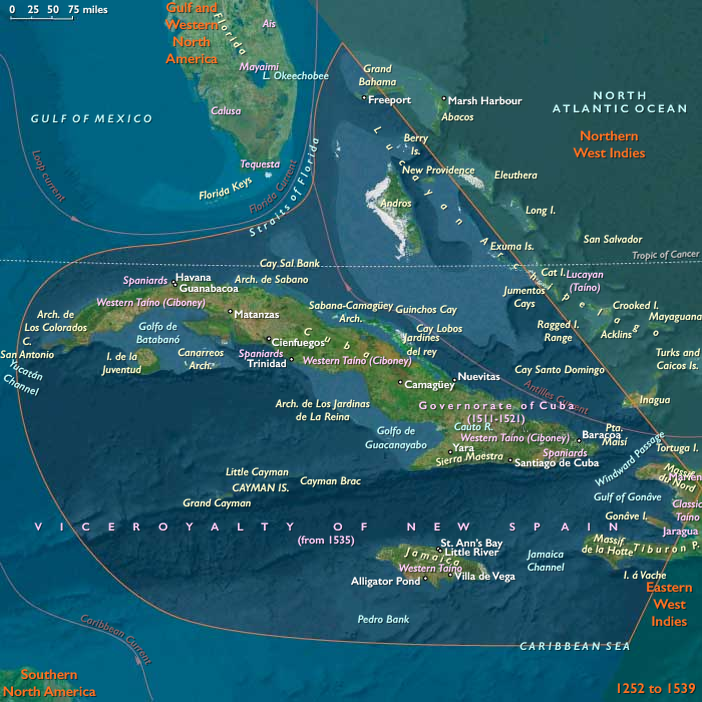
and the Western West Indies—Cuba, Jamaica, the Cayman Islands, and the Inner Bahamas.
This was a realm of coral banks, fertile alluvial plains, mangrove lagoons, and volcanic ridges swept by the trade winds. The Gulf Stream carried marine abundance northward while drawing future transatlantic routes across its current.
The Little Ice Age introduced modest cooling and intensified storm seasons. Hurricanes scoured cays and coastal plains, yet rainfall nourished tropical crops. Fertile volcanic soils on Hispaniola, Puerto Rico, Cuba, and Jamaica sustained dense agriculture, while the limestone islands of the Bahamas and Caicos required careful rotation and seaborne exchange.
Societies and Subsistence
Before European arrival, the West Indies were home to two major cultural traditions—Taíno and Kalinago (Carib)—each bound by canoe networks, kinship, and ritual economies that spanned the sea.
Taíno Chiefdoms
Across Cuba, Jamaica, Hispaniola, and Puerto Rico, the Taíno organized into hierarchical cacicazgos ruled by hereditary caciques. Their societies combined agriculture, fishing, and craft production in well-planned villages.
Agriculture: Root crops—cassava, sweet potato, and yam—formed the subsistence core, planted in raised conucos(mounded fields) that preserved soil fertility and moisture. Maize, beans, and peppers supplemented diets; cotton provided fiber for cloth and nets.
Fisheries and foraging: Canoe fleets harvested fish, shellfish, and manatees, while inland groups hunted hutia and iguana. Inter-island trade moved food, ornaments, and ceremonial goods across hundreds of kilometers.
Settlement patterns: Villages clustered along river valleys and coasts, centered on batey plazas and ceremonial ball courts that doubled as civic spaces. Populations were dense in the Cibao Valley of Hispaniola, the plains of Cuba, and the river valleys of Puerto Rico.
Kalinago Mariners
Farther southeast, from Trinidad through the Lesser Antilles, Kalinago (Carib) communities emphasized mobility, warfare, and seaborne exchange. Their houses of palm and reed dotted volcanic slopes near fishing grounds. Gardens of cassava and plantain alternated with hunting and raiding expeditions across island chains. Kalinago warriors, renowned canoe-builders and navigators, connected South America’s Orinoco delta to the Antilles through constant movement.
Peripheral Worlds
The low-lying Bahamas supported small Taíno populations linked by canoe to Hispaniola and Cuba; the Turks and Caicos functioned as seasonal fishing outposts. The Caymans and Bermuda remained uninhabited, rich in seabirds and turtles—ecological reserves soon to draw European attention.
Technology & Material Culture
Indigenous technology harmonized with maritime landscapes.
Dugout canoes, some exceeding twenty meters, moved goods and people between islands. Stone celts, shell adzes, and polished tools shaped wood and fiber; cotton hammocks, nets, and woven baskets filled domestic life. Pottery of Saladoid descent displayed incised geometric patterns. Wooden zemí idols embodied deities and ancestors, serving as the spiritual heart of Taíno ritual.
Adornment carried political meaning: gold pendants on Hispaniola, shell necklaces in the Bahamas, and feather capes on Cuba signaled rank and lineage. Kalinago artisans produced bows and poisoned arrows, carving ceremonial paddles and trophies that proclaimed prowess.
After 1492, Spanish iron, glass beads, and cloth entered the islands, transforming aesthetics and trade even as disease and conquest accelerated collapse.
Movement & Interaction Corridors
The sea was the West Indies’ great highway.
Canoes followed predictable trade-wind loops between the islands, while deep channels—the Old Bahama Channel, the Windward Passage, and the Anegada Passage—linked regional clusters.
Taíno navigators oriented by stars, currents, and bird flight, maintaining contact from Hispaniola to Cuba and the Bahamas. Kalinago raiders crossed from Trinidad to Dominica and Guadeloupe, exchanging goods or waging war.
From 1492 onward, these networks collided with Atlantic crossings.
Christopher Columbus first landed on San Salvador (Guanahaní) in the Bahamas, continued to Cuba and Hispaniola, and by his second voyage (1493) reached Puerto Rico and the Lesser Antilles. La Isabela (1494) and Santo Domingo (1498) became the first European towns of the Americas. The Caribbean—once an Indigenous maritime world—was transformed into Spain’s initial colonial theater.
Cultural & Symbolic Expressions
Religion and ritual structured every level of Taíno and Kalinago life.
Taíno worship centered on wooden and stone zemí idols representing creator spirits and ancestors. Cohoba(hallucinogenic snuff) ceremonies brought shamans into communion with deities, while areíto dances and songs celebrated lineage and fertility.
Kalinago spirituality emphasized war and transformation—spirits of the sea, forest, and ancestors guarded their island realms.
Both peoples treated the sea as sacred space: a living medium binding communities, not separating them. Ball courts, plazas, and rock carvings encoded mythic cycles linking humans to cosmic order.
Spanish colonization imposed Christianity with violence, replacing temples with churches and ball courts with fortresses. Yet hybrid practices—hidden zemís, syncretic rituals—survived in remote valleys and islands.
Environmental Adaptation & Resilience
Agricultural systems embodied deep ecological intelligence.
Mounded conucos conserved moisture, composted organic matter, and resisted erosion; root crops ensured harvests through hurricanes and droughts. Rotational gardening, fishing, and forest foraging diversified subsistence.
Kalinago mobility provided resilience—raiding and exchange substituted for failed crops.
Even under Spanish assault, Indigenous strategies adapted: survivors retreated to uplands, outlying cays, and the Guiana coast, merging with maroon and African communities that would emerge later.
By 1539, however, epidemic disease, slavery, and ecological disruption had devastated most settled Taíno populations. Only small enclaves remained in mountainous Hispaniola, eastern Cuba, and the Bahamas, where blended communities preserved fragments of ancestral culture.
Technology & Power Shifts (Conflict Dynamics)
Between 1492 and 1539, the West Indies became the crucible of European empire.
-
The Spanish Crown claimed the islands under the Capitulaciones of Santa Fe; colonization radiated from Hispaniola to Puerto Rico (1508), Jamaica (1494), and Cuba (1511).
-
Gold mining, encomienda labor, and forced conversion dismantled Indigenous authority.
-
The Kalinago held out longer, attacking Spanish ships from Guadeloupe and Dominica, maintaining partial independence into the seventeenth century.
-
Uninhabited islands—Bermuda, Caymans, Turks and Caicos—entered nautical charts as vital waypoints for the Iberian Atlantic.
The demographic collapse was unprecedented: within a generation, Taíno and allied peoples were reduced from hundreds of thousands to a fraction of their former numbers.
Transition (to 1540 CE)
By 1539 CE, the West Indies had been transformed from an Indigenous maritime world into the first stage of the Atlantic colonial order. Cuba, Jamaica, Hispaniola, and Puerto Rico were Spanish provinces; the Bahamas lay depopulated by slave raids; the Kalinago still commanded the outer Antilles, resisting conquest through speed and sea power.
The old networks of Taíno and Kalinago exchange had given way to transatlantic routes carrying gold, sugar, captives, and faith. Yet under the ruins of conquest, fragments of Indigenous resilience endured—in language, foodways, music, and ritual memory.
The fifteenth and early sixteenth centuries thus marked both the culmination of an Indigenous Caribbean civilization and its violent transformation—the moment when the West Indies, once the heart of the Taíno sea, became the crucible of a new Atlantic world.
People
Groups
- Arawak peoples (Amerind tribe)
- Taíno
- Lucayans
- French people (Latins)
- English people
- Spain, Habsburg Kingdom of
- Spaniards (Latins)
- Eleutheran Adventurers
Topics
Commodoties
Subjects
Regions
Subregions
Years: 1396 - 1539
People
Groups
- Arawak peoples (Amerind tribe)
- Taíno
- Lucayans
- French people (Latins)
- English people
- Spain, Habsburg Kingdom of
- Spaniards (Latins)
- Eleutheran Adventurers
Topics
Commodoties
Subjects
Regions
Subregions