
Northern South Atlantic (6,093–4,366 BCE): Mid-Holocene Highstand, …
Years: 6093BCE - 4366BCE
Northern South Atlantic (6,093–4,366 BCE): Mid-Holocene Highstand, Cloud Forest Seeds
Geographic & Environmental Context
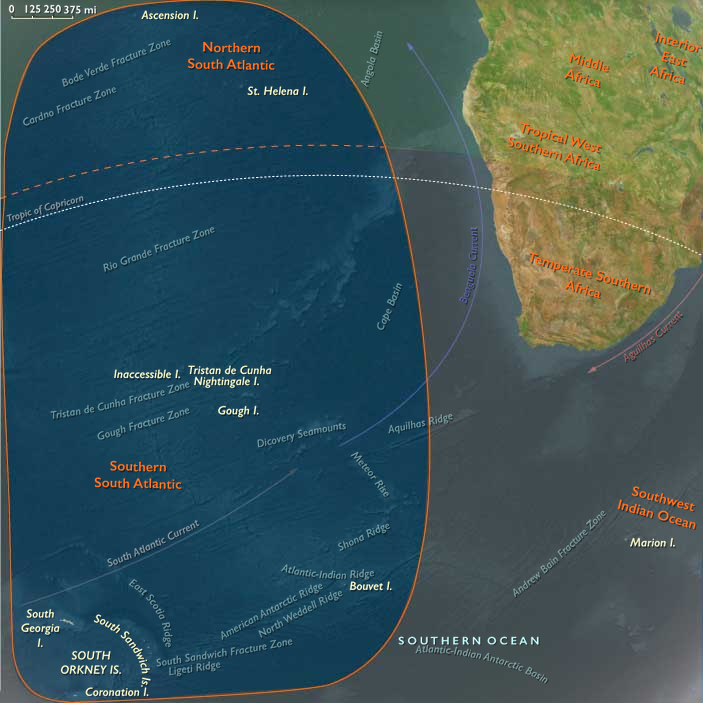
The subregion of Northern South Atlantic includes Saint Helena and Ascension Island. Marine terraces neared present elevations; high ridges intercepted clouds; young cinder cones and lava tongues (Ascension) contrasted with deeply dissected massifs (Saint Helena).
Climate & Environmental Shifts
Near-modern sea level; warm SSTs; stable trades with seasonal ITCZ shifts. On Saint Helena’s heights, persistent cloud belts fostered humid summit habitats; Ascension’s drier cone still gathered fog in lee gullies.
Subsistence & Settlement
No humans. Proto-cloud-forest elements (tree ferns, woody composites on Saint Helena) took hold in wet belts; drought-tolerant shrubs and tuft grasses dominated lee slopes. Seabirds, crabs, land snails, and detritivores expanded with richer soils; turtles continued seasonal nesting.
Technology & Material Culture
None locally; elsewhere, pottery horizons spread. Island “archives” were peat pockets, guano layers, and slope colluvium.
Movement & Interaction Corridors
Gyre fronts and eddies aggregated plankton and forage fish; long-range shearwaters and tropicbirds cycled across the basin.
Cultural & Symbolic Expressions
None.
Environmental Adaptation & Resilience
Vertical zonation diversified refugia: wet summits vs. arid skirts; colonies re-sited after cliff failures; beach-ridge growth buffered nests from surge. Soil formation accelerated beneath colonies, stabilizing vegetation mosaics.
Transition
By 4,366 BCE, Saint Helena supported small humid highland patches amid dry skirts; Ascension remained mostly arid with greener ravines—both ringed by prolific pelagic seas.
Topics
Subjects
Regions
Subregions
Years: 6093BCE - 4366BCE
Topics
Subjects
Regions
Subregions