
Northern South Atlantic (49,293–28,578 BCE): Volcanic Oases …
Years: 49223BCE - 28578BCE
Northern South Atlantic (49,293–28,578 BCE): Volcanic Oases in a Cooler Ocean
Geographic & Environmental Context
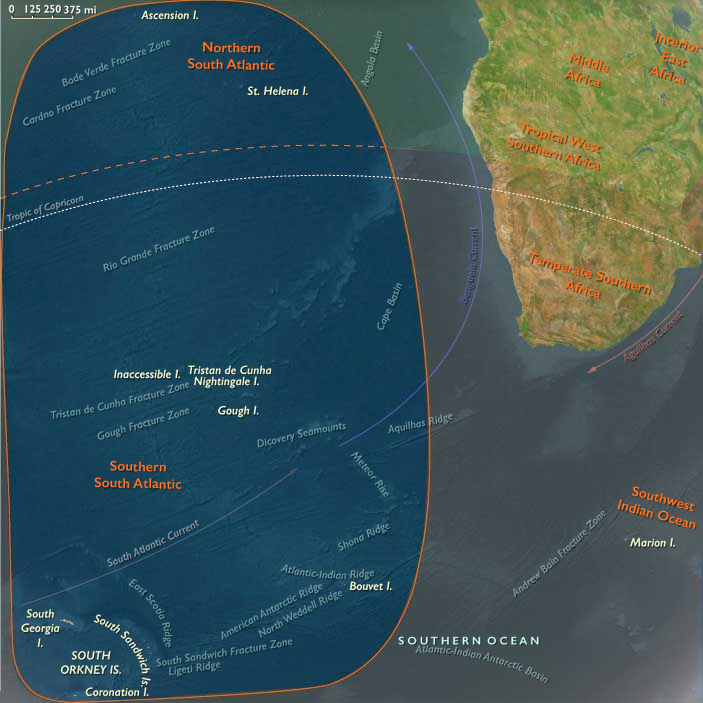
The subregion of Northern South Atlantic includes Saint Helena and Ascension Island. These mid-ocean volcanoes rose steeply from abyssal plains: Ascension, a young shield with cinder cones and lava fields; Saint Helena, an older, deeply eroded massif ringed by cliffs. Narrow boulder/cobble strands, sea caves, and wave-cut benches framed their coasts; inland, stark basalt and trachyte ridges held patchy soils and crater basins.
Climate & Environmental Shifts
This was peak Last Glacial time. Sea level stood ~60–90 m lower, widening shore platforms and exposing additional benches. Cooler sea-surface temperatures and stronger southeast trade winds intensified upwelling along the eastern basin (Benguela limb) and invigorated the South Equatorial Current. Rainfall was limited; fog and orographic cloud banks wetted windward slopes episodically. Dust delivery from Africa waxed, seeding open-ocean productivity.
Subsistence & Settlement
No humans reached these islands. Ecologies were oceanic: immense seabird rookeries on ledges and cinder cones; green and hawksbill turtles foraged offshore and likely nested on low strands during interludes; intertidal zones teemed with grazers and filter feeders. Inland vegetation was sparse—ferns, lichens, and pioneering grasses colonized ash and scoria, with moisture-catching ravines sheltering a few shrub pockets.
Technology & Material Culture
Globally, Upper Paleolithic blade and bone technologies blossomed; none touched this oceanic pair. The only “materials” on island surfaces were volcanic rock, bird bone, shell, guano crusts, and wind-blown sand.
Movement & Interaction Corridors
The South Atlantic subtropical gyre (Brazil → South Equatorial → Guinea → Canary → North Brazil Currents) and trade-wind belts routed pelagic life. Seabirds commuted across basins; turtles navigated gyre margins; tunas, billfish, and sharks hunted frontal zones.
Cultural & Symbolic Expressions
None locally. If the islands “spoke,” it was through biogenic landmarks—white guano veneers on headlands and turtle crawls etched into storm-lowered beaches.
Environmental Adaptation & Resilience
Seabirds nested in dense, shifting colonies; pioneering plants stabilized ash with rhizo-mats; turtle nesting tracked strands that came and went with sea-level oscillation. Nutrient subsidies (guano → soils) catalyzed small green oases on otherwise austere rock.
Transition
By 28,578 BCE, glacial seas and trade winds still ruled. The islands stood as stark, lifeboat habitats in a cool, windier Atlantic, rich offshore, austere on land—entirely unknown to humans.
Topics
Subjects
Regions
Subregions
Years: 49223BCE - 28578BCE
Topics
Subjects
Regions
Subregions