
South Asia (964 – 1107 CE): Ghaznavids …
Years: 964 - 1107
South Asia (964 – 1107 CE): Ghaznavids and Cholas, Palas and Senas, and the Rise of a Maritime Subcontinent
Geographic and Environmental Context
South Asia in the Lower High Medieval Age extended from the Hindu Kush and Himalayas to the southern tip of the Indian Peninsula, embracing the Indo-Gangetic Plain, Deccan Plateau, and the Indian Ocean island chainsfrom Sri Lanka to the Maldives and Chagos.
This world contained diverse ecological zones: fertile deltas (Bengal), monsoon-watered plains (Punjab, Doab, Tamil Nadu), high plateaus (Deccan), and maritime corridors that connected the Bay of Bengal, Arabian Sea, and wider Indian Ocean. Stable monsoons and abundant river systems fostered dense agrarian civilizations, while strategic mountain passes and seaways linked the region to Central Asia, the Middle East, and Southeast Asia.
Climate and Environmental Shifts
The Medieval Warm Period sustained favorable rainfall and robust agricultural production across the subcontinent.
-
Bengal’s delta expanded, increasing rice cultivation.
-
Deccan reservoirs and Tamil tank systems mitigated drought.
-
Sri Lanka’s irrigation canals and Polonnaruwa reservoirs ensured food security.
-
In the north, Himalayan passes remained open for salt-and-wool exchange, while steppe pressures introduced new migratory and military currents into Afghanistan and Punjab.
Ecological stability thus underpinned both imperial consolidation and far-reaching commerce.
Societies and Political Developments
Northern South Asia: From Ghazni to Bengal
-
Afghanistan and Punjab:
The Ghaznavid Empire, under Mahmud of Ghazni (r. 998–1030), extended from Ghazni to the Punjab, conducting celebrated but destructive raids into India. After mid-century, the Seljuks displaced Ghaznavid power in Khurasan, leaving a Punjabi remnant. -
Delhi–Doab:
Fragmented into Rajput strongholds—Tomaras of Delhi, Chauhans of Ajmer—defending regional autonomy through fortified cities and chivalric warfare. -
Bengal:
The Palas revived under Mahipala I (r. 988–1038), patronizing Buddhism, but waned as the Sena dynasty(Ballala Sena, Lakshmana Sena) rose, asserting Hindu orthodoxy and moving the political center to Vikramapura. -
Kashmir prospered under Hindu–Shahi kings with temple patronage and bronze artistry.
-
Nepal saw the Malla dynasty strengthen Kathmandu’s urban and temple culture; Bhutan absorbed Tibetan Buddhist diffusion, embedding monastic authority.
-
Arakan and the Chindwin valley connected Bengal and Upper Burma through Buddhist polities such as Launggyet, mediating rice and elephant trade.
Maritime South Asia: The Chola Zenith and Maritime Integration
-
Tamil Nadu and the Cholas:
Under Rajaraja I (r. 985–1014) and Rajendra I (r. 1014–1044), the Chola Empire unified the peninsula and projected naval power across the Bay of Bengal, conquering northern Sri Lanka, the Maldives, and launching expeditions toward Southeast Asia.
Monumental Shaiva temples—notably the Brihadeshvara at Thanjavur (1010)—symbolized imperial grandeur. -
Deccan:
The Western Chalukyas contested Chola influence; the Rashtrakutas’ legacy persisted through successor states balancing agrarian control with temple patronage. -
Kerala (Chera realm):
Spice exports (pepper, cinnamon) enriched port towns along the Malabar Coast. -
Sri Lanka:
The Cholas annexed the north in 993 CE, ruling from Polonnaruwa until local resurgence under Vijayabahu I (r. 1055–1110) restored Sinhalese sovereignty. -
Islands:
The Maldives entered the Chola orbit as a node in the cowrie and coconut trades; Lakshadweep and Chagos remained lightly settled but linked to wider sea routes.
Economy and Trade
Agriculture and maritime commerce operated in symbiosis.
-
Agriculture:
Wheat and barley dominated the Punjab, rice thrived in Bengal, Nepal, and the Tamil plains, while millet and barley sustained Himalayan terraces. -
Crafts:
Ghazni and Lahore produced ivory and fine textiles; Bengal excelled in bronze sculpture; Tamilakam specialized in cotton weaving. -
Trade Networks:
-
Overland: Horses via Kabul; textiles and indigo from North India; Himalayan salt and wool exchanged for grain.
-
Maritime: Chola fleets controlled shipping from Coromandel to Sri Lanka, the Maldives, and Southeast Asia, exporting rice, textiles, and metals, importing gold, aromatics, and ceramics.
-
Bengal’s ports (Tamralipta, Chandpur) traded rice and sugar with Arakan and Pagan Burma.
-
Malabar Coast ports supplied spices to Arab and Persian merchants; cowries from the Maldives circulated as currency across the Indian Ocean.
-
-
Coinage: Ghaznavid silver dirhams and Chola gold fanams symbolized dual monetary spheres bridging Islamic Asia and the Indic world.
Subsistence and Technology
-
Irrigation:
Ghaznavid canals around Lahore, embankments in Bengal, and vast tank systems in Tamil Nadu and Andhra maximized monsoon use. -
Military:
Turkish cavalry and war-elephants dominated northern battlefields; southern navies wielded catapults and fire arrows at sea. -
Architecture:
Chola Dravidian temples, Sena Hindu shrines, Ghaznavid mosques in Lahore and Ghazni, and Nepalese pagodas expressed regional diversity. -
Artisanal technology: advanced bronze casting, stone carving, shipbuilding, and water-management engineering enriched both sacred and practical life.
Movement and Interaction Corridors
-
Khyber and Bolan Passes: conduits for Central Asian caravans and invasions.
-
Punjab–Doab–Bengal trunk route: horses, textiles, and tribute moved east–west.
-
Bay of Bengal seaways: joined Coromandel, Sri Lanka, and Southeast Asia.
-
Bengal–Arakan–Chindwin corridor: linked rice and elephant trade to Pagan Burma.
-
Himalayan passes: carried salt, wool, and religious ideas between Kathmandu, Bhutan, and Tibet.
Together these routes knit the subcontinent into a single commercial and religious field reaching from Samarkand to Srivijaya.
Belief and Symbolism
South Asia’s religious landscape was plural and dynamic.
-
Islam: Ghaznavid rule introduced Sunni madrasas and mosques in Punjab, with early Sufi lodges fostering intercultural dialogue.
-
Hinduism: Chola and Sena patrons reinforced Shaiva and Vaishnava orthodoxy through monumental architecture and ritual kingship.
-
Buddhism: persisted in Bengal, Nepal, and Kashmir; Vajrayāna centers in Bihar–Nepal transmitted teachings to Tibet, influencing the phyi dar revival.
-
Jainism flourished under Chalukya and local Deccan courts.
-
Sri Lanka: Theravāda continuity anchored by Polonnaruwa monasteries.
-
Bhutan and Himalayan regions: integrated Tibetan Drukpa Kagyu traditions.
Temples, stupas, and mosques alike proclaimed divine kingship and cosmological order across diverse faiths.
Adaptation and Resilience
Hydraulic engineering and ritualized redistribution enabled resilience to climatic fluctuation.
-
Tank irrigation buffered drought; flood embankments protected deltas.
-
Maritime trade diversified revenue beyond agrarian surplus.
-
Caste and monastic networks ensured social continuity and education.
-
Inter-regional diplomacy—tribute, pilgrimage, and intermarriage—helped maintain equilibrium despite warfare.
The coexistence of Hindu, Buddhist, and Islamic polities fostered cultural synthesis rather than collapse.
Long-Term Significance
By 1107 CE, South Asia embodied a dual-centered world:
-
In the north, the Ghaznavids were declining, soon to yield to Ghurid expansion; Rajput houses held the plains; Bengal transitioned from Pala Buddhist to Sena Hindu rule; and Himalayan kingdoms blended Indic and Tibetan traditions.
-
In the south, the Cholas presided over the most extensive maritime empire ever forged by an Indian dynasty, while Sri Lanka regained independence and the Deccan balanced Chalukya and regional powers.
-
Across both spheres, agricultural intensification, urban prosperity, and maritime connectivity positioned South Asia as a pivotal crossroads between Islamic West Asia, Southeast Asia, and East Africa.
By the early twelfth century, the subcontinent stood as a maritime–continental civilization, where temple and mosque, caravan and ship, monsoon and mountain together defined one of the world’s most intricate and enduring cultural ecologies.
People
Groups
- Tajik people
- Kirat people
- Iranian peoples
- Hinduism
- Pashtun people (Pushtuns, Pakhtuns, or Pathans)
- Jainism
- Buddhism, Tibetan
- Buddhism
- Khas peoples
- Rajasthani people
- Buddhism, Mahayana
- Tokharistan (Kushan Bactria)
- Gandhāra
- Bon
- Baloch people
- Rajasthan, Rajput Kingdoms of
- Rajputs
- Islam
- Gurjara-Pratihara
- Nepal, Kingdom of
- Palas of Bengal, Empire of the
- Rashtrakuta Dynasty
- Abbasid Caliphate (Baghdad)
- Paramara dynasty
- Samanid dynasty
- Chandelas (Candellas) of Khajuraho, Kingdom of the
- Tahirid dynasty
- Abbasid Caliphate (Samarra)
- Utpala Dynasty
- Saffarid dynasty
- Shahi Kingdom, or Hindu Shahi
- Abbasid Caliphate (Baghdad)
- Ghilzai (Pashtun tribal confederacy)
- Cauhans (Chamnas) of Ajmer and Delhi, Rajput Kingdom of the
- Gujarat, Solanki Kingdom of
- India, High Medieval
- Lohara dynasty
- Senas of Bengal, Kingdom of the
- Gahadavala dynasty
Topics
Commodoties
- Gem materials
- Colorants
- Domestic animals
- Fibers
- Textiles
- Strategic metals
- Slaves
- Salt
- Sweeteners
- Money
- Spices
Subjects
- Commerce
- Writing
- Architecture
- Sculpture
- Conflict
- Faith
- Government
- Custom and Law
- Medicine
- Mathematics
- Astronomy
- Philosophy and logic
Regions
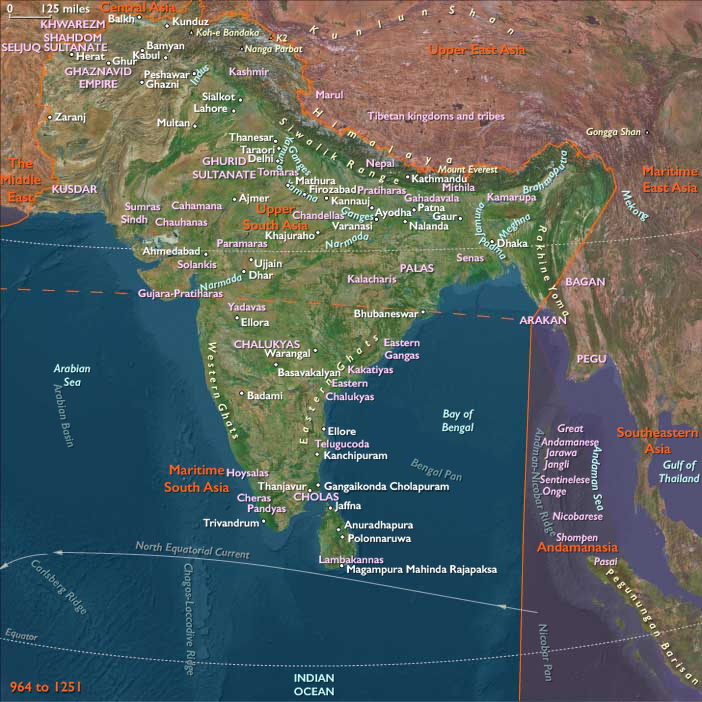
Subregions
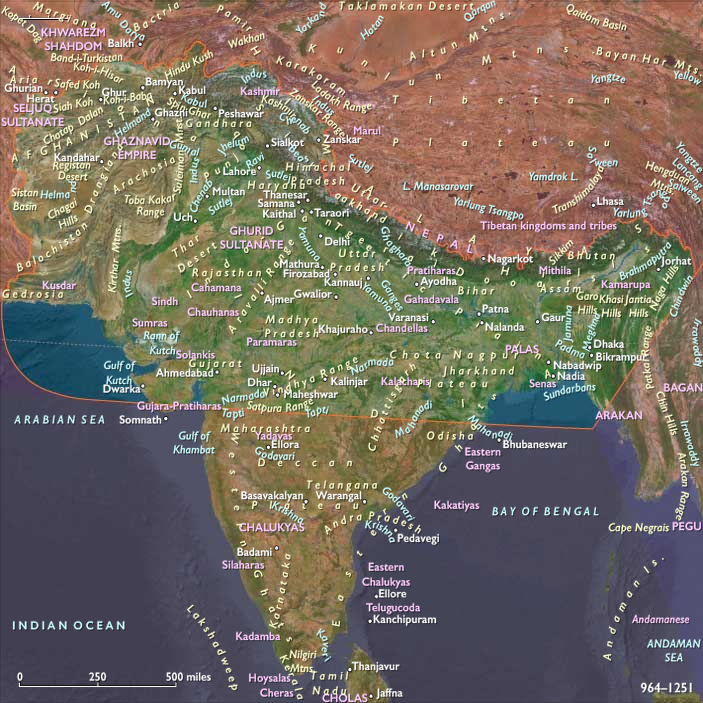

Related Events
Showing 10 events out of 52798 total
Years: 964 - 1107
People
Groups
- Tajik people
- Kirat people
- Iranian peoples
- Hinduism
- Pashtun people (Pushtuns, Pakhtuns, or Pathans)
- Jainism
- Buddhism, Tibetan
- Buddhism
- Khas peoples
- Rajasthani people
- Buddhism, Mahayana
- Tokharistan (Kushan Bactria)
- Gandhāra
- Bon
- Baloch people
- Rajasthan, Rajput Kingdoms of
- Rajputs
- Islam
- Gurjara-Pratihara
- Nepal, Kingdom of
- Palas of Bengal, Empire of the
- Rashtrakuta Dynasty
- Abbasid Caliphate (Baghdad)
- Paramara dynasty
- Samanid dynasty
- Chandelas (Candellas) of Khajuraho, Kingdom of the
- Tahirid dynasty
- Abbasid Caliphate (Samarra)
- Utpala Dynasty
- Saffarid dynasty
- Shahi Kingdom, or Hindu Shahi
- Abbasid Caliphate (Baghdad)
- Ghilzai (Pashtun tribal confederacy)
- Cauhans (Chamnas) of Ajmer and Delhi, Rajput Kingdom of the
- Gujarat, Solanki Kingdom of
- India, High Medieval
- Lohara dynasty
- Senas of Bengal, Kingdom of the
- Gahadavala dynasty
Topics
Commodoties
- Gem materials
- Colorants
- Domestic animals
- Fibers
- Textiles
- Strategic metals
- Slaves
- Salt
- Sweeteners
- Money
- Spices
Subjects
- Commerce
- Writing
- Architecture
- Sculpture
- Conflict
- Faith
- Government
- Custom and Law
- Medicine
- Mathematics
- Astronomy
- Philosophy and logic
Regions
Subregions