
Upper South Asia (100–243 CE): The Kushan …
Years: 100 - 243
Upper South Asia (100–243 CE): The Kushan Golden Age, Cross-Cultural Exchanges, and Regional Diversification
The Apex of Kushan Power
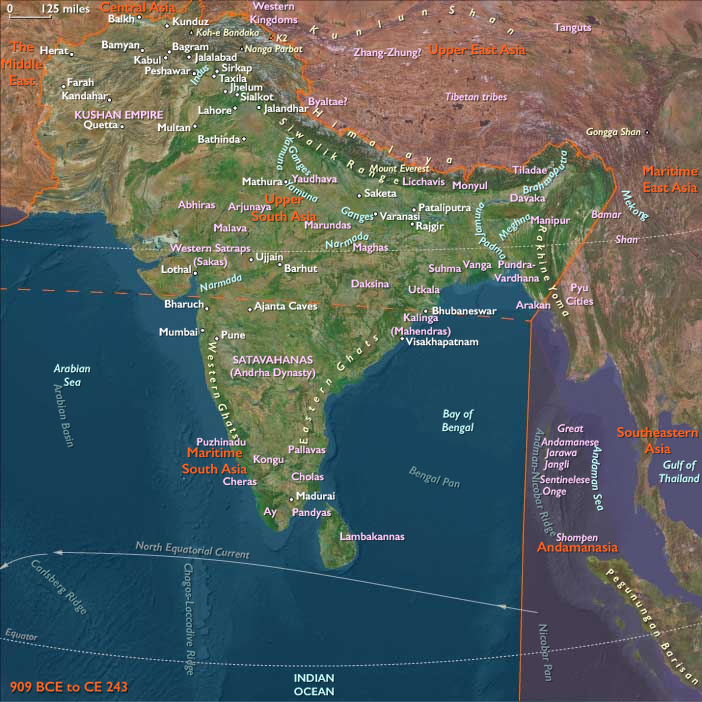
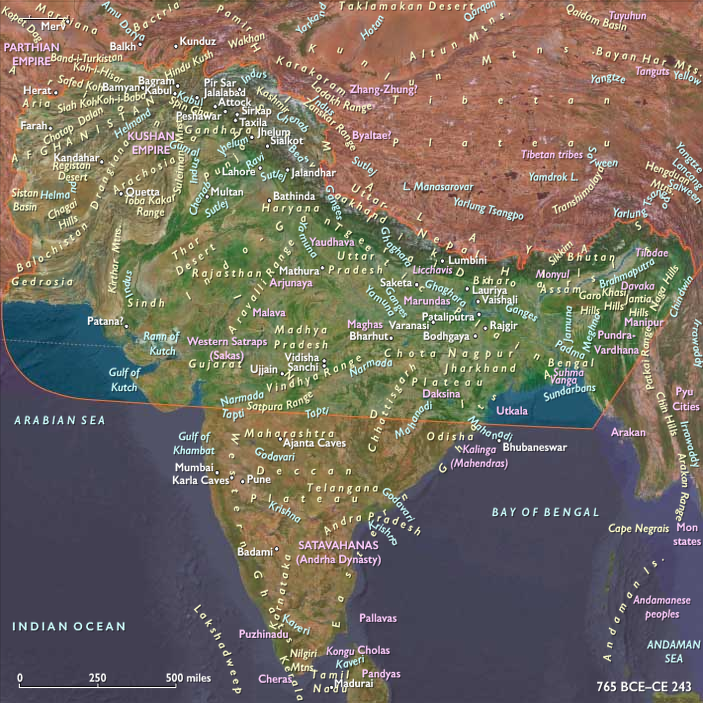
The age from 100 to 243 CE marks the zenith of the Kushan Empire, especially during the reign of its most celebrated ruler, Kanishka I (ca. 127–150 CE). Under Kanishka, the empire expanded further, encompassing extensive territories in present-day Afghanistan, Balochistan, Punjab, Sindh, and much of North India, consolidating its role as a dominant political and economic power.
Flourishing Silk Road Trade
The Kushans controlled crucial segments of the Silk Road, fostering robust trade relations between Rome, Persia, India, and China. Northern South Asian cities such as Taxila, Mathura, Peshawar (Purushapura), and Balkh (Bactra) prospered as cosmopolitan hubs where merchants, scholars, and religious leaders exchanged goods, ideas, and cultural practices.
Gandharan and Mathuran Artistic Synthesis
Artistic traditions flourished dramatically in this era, especially the Gandharan and Mathuran schools of sculpture. Gandhara art, characterized by its Greco-Buddhist style, produced iconic images of the Buddha combining classical Greek realism with Indian symbolism. The Mathuran school, by contrast, developed a distinctly indigenous representation, influencing Hindu, Jain, and Buddhist iconography throughout the subcontinent.
Religious and Philosophical Renaissance
Kanishka I famously convened the Fourth Buddhist Council in Kashmir, leading to the codification and expansion of Mahāyāna Buddhism. This era saw Buddhist teachings spread extensively into Central Asia and East Asia, greatly facilitated by Kushan patronage. Concurrently, Zoroastrianism and emergent forms of Brahmanical Hinduism continued to thrive, reflecting the empire’s commitment to religious diversity and tolerance.
Rise of Regional Kingdoms and Indigenous States
Although centralized Kushan power flourished, regional kingdoms and tribal states maintained autonomy along the empire's periphery. In the Himalayan foothills, including areas like Nepal, Sikkim, and Bhutan, indigenous peoples such as the Kirāta continued distinct cultural traditions, engaging periodically with lowland kingdoms through trade and limited political interactions.
Cultural Influence in Northwestern Burma
The Kushan period saw increased interactions extending as far as northwestern Burma (Myanmar), particularly in regions such as Kachin State, Sagaing Region, and Chin State. This facilitated the exchange of cultural and religious ideas along emerging overland trade networks linking the Indian subcontinent with Southeast Asia, laying foundations for later historical interactions.
Socioeconomic and Administrative Advances
Under Kushan rule, Northern South Asia experienced advancements in governance, adopting Persian administrative frameworks and Hellenistic influences. Coinage minted during this period exhibited Greco-Roman artistic motifs, further indicating international influence and economic integration. Urban planning, trade regulation, and legal codification flourished, significantly enhancing regional stability.
Linguistic and Literary Developments
The Kushan era contributed significantly to linguistic evolution. Prakrit dialects became standardized in regional literary and administrative contexts, while the classical Sanskrit language was increasingly codified and used in religious and philosophical texts. Scholars from Kushan cities contributed notably to the fields of grammar, poetry, and religious philosophy, laying the groundwork for subsequent classical literary traditions.
Legacy of the Age
The era from 100 to 243 CE stands as a pivotal age for Upper South Asia, characterized by political unity under the Kushans, thriving economic exchanges, remarkable artistic synthesis, and profound religious and intellectual developments. This period solidified cultural and economic ties across Asia, significantly influencing subsequent historical trajectories and leaving a lasting imprint on the region’s complex cultural heritage.
People
Groups
- Kirat people
- Iranian peoples
- Gandhāra
- Hinduism
- Pashtun people (Pushtuns, Pakhtuns, or Pathans)
- Kashi, Kingdom of
- Scythians, or Sakas
- Buddhism
- Khas peoples
- Parthian Empire
- India, Classical
- Indo-Scythians
- Indo-Parthians, Kingdom of the
- Kushan Empire
- Western Satraps
- Buddhism, Mahayana
- Tokharistan (Kushan Bactria)
- Gandhāra
- Huns
- Persian Empire, Sassanid, or Sasanid
Commodoties
Subjects
- Writing
- Architecture
- Sculpture
- Painting and Drawing
- Decorative arts
- Conflict
- Mayhem
- Faith
- Government
- Custom and Law
- Medicine
- Mathematics
- Astronomy
- Philosophy and logic
Regions
Subregions
Related Events
Showing 10 events out of 61429 total
Years: 100 - 243
People
Groups
- Kirat people
- Iranian peoples
- Gandhāra
- Hinduism
- Pashtun people (Pushtuns, Pakhtuns, or Pathans)
- Kashi, Kingdom of
- Scythians, or Sakas
- Buddhism
- Khas peoples
- Parthian Empire
- India, Classical
- Indo-Scythians
- Indo-Parthians, Kingdom of the
- Kushan Empire
- Western Satraps
- Buddhism, Mahayana
- Tokharistan (Kushan Bactria)
- Gandhāra
- Huns
- Persian Empire, Sassanid, or Sasanid
Commodoties
Subjects
- Writing
- Architecture
- Sculpture
- Painting and Drawing
- Decorative arts
- Conflict
- Mayhem
- Faith
- Government
- Custom and Law
- Medicine
- Mathematics
- Astronomy
- Philosophy and logic
Regions
Subregions