
Upper South Asia (1888–1899 CE): Frontier Consolidation, …
Years: 1888 - 1899
Upper South Asia (1888–1899 CE): Frontier Consolidation, Rising Nationalism, and Early Modernization
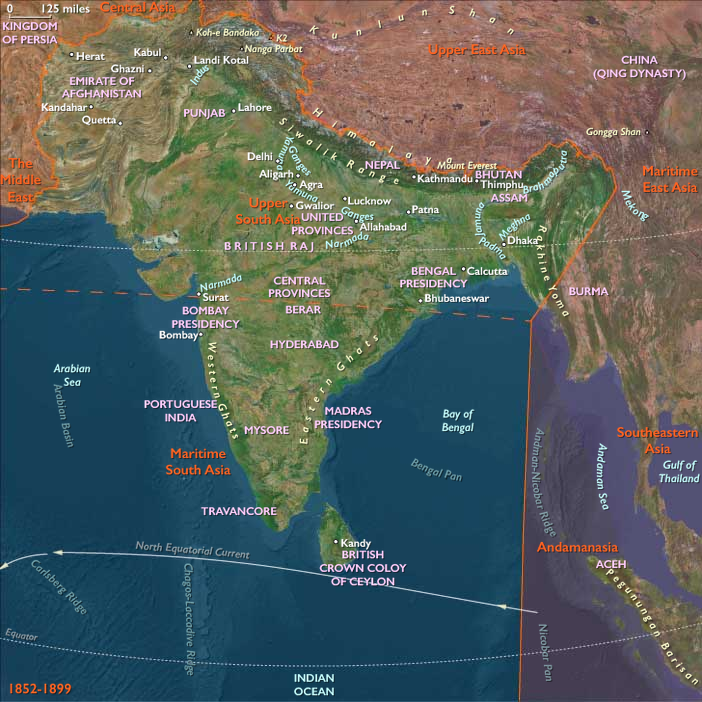
Strategic Consolidation in the Northwest Frontier
Between 1888 and 1899, the British further entrenched their geopolitical position along the northwestern frontier, emphasizing their control over territories bordering Afghanistan. In 1889, Britain formally established the Gilgit Agency as a permanent administrative unit, extending British strategic presence deep into the mountainous regions of present-day Gilgit-Baltistan. The British soon launched military campaigns against the local states of Hunza and Nagar (1891–1892), establishing military garrisons and installing compliant rulers, effectively incorporating these strategically crucial states into their sphere of influence.
In 1893, British diplomat Sir Mortimer Durand negotiated the Durand Line agreement with the Afghan Amir Abdur Rahman Khan, defining spheres of influence between Afghanistan and British India. This line—only partially surveyed—created lasting complexities by dividing Pashtun tribal lands, establishing the future international boundary between Pakistan and Afghanistan. Though initially serving British strategic interests, the Durand Line eventually generated lasting political tensions and border disputes.
Afghanistan under Abdur Rahman Khan
During this era, Amir Abdur Rahman Khan (r. 1880–1901) consolidated Afghanistan's political unity through centralization and military force, brutally suppressing internal opposition. His campaigns notably targeted the Hazara in the region known as Hazarajat, conquering them between 1891–1893 and initiating a harsh period of persecution against the predominantly Shi’a ethnic group. Additionally, in 1896, he subdued the previously autonomous region of Kafiristan, forcibly converting its inhabitants to Islam and renaming it Nuristan ("Land of the Enlightened"). Under his iron-fisted rule, Afghanistan remained isolated but internally cohesive, stabilizing after decades of turmoil.
Economic and Administrative Modernization in British India
British authorities continued ambitious economic reforms, greatly enhancing infrastructure across North India. Railways rapidly expanded to connect strategic centers such as Lahore, Peshawar, Karachi, and Calcutta, promoting economic integration and facilitating British administrative and military movements. The agricultural economy, particularly in the Punjab, flourished under expanded irrigation projects and canal colonies, notably establishing the region as India's primary agricultural producer and “granary.”
British administration implemented modern governance models, dividing provinces into clearly demarcated districts under British district officers, drawn primarily from the elite Indian Civil Service. Local governance was gradually opened to limited participation from Indians after the Indian Councils Act of 1892, allowing cautiously controlled representation.
Early Nationalist Politics and Muslim Responses
Nationalist sentiment continued gaining strength among educated Indians, particularly within the influential Indian National Congress, founded in 1885. Initially functioning as a moderate reformist body, Congress increasingly pressed for expanded representation and political rights. Concurrently, Muslims, wary of Hindu political dominance, looked increasingly to Sir Syed Ahmad Khan, whose cautious approach stressed education and cooperation with the British. Graduates of his Muhammadan Anglo-Oriental College at Aligarh began shaping the political and intellectual elite among North Indian Muslims, laying the groundwork for a separate Muslim political identity.
Cultural and Literary Developments
The period saw a vibrant expansion of cultural expression in regional languages such as Urdu, Hindi, Bengali, and Punjabi. In 1888, Rudyard Kipling, writing in British India, published his influential collection Plain Tales from the Hills, vividly depicting life in British India, including regions such as Punjab and the hill station of Simla. Kipling’s narratives captured the complex social interactions between British colonizers and Indian subjects, influencing popular perceptions of British colonial rule.
Meanwhile, indigenous literary and cultural expressions increasingly voiced nationalist sentiment, contributing to the developing national consciousness and cultural pride. Literature and poetry—especially in Urdu and Bengali—addressed political, social, and cultural concerns, fostering deeper regional and national identities.
Himalayan Region: Sikkim and Bhutan
Britain reinforced its strategic interests in the eastern Himalayas through the Sikkim Expedition (1888–1889). Responding to Tibetan incursions, British forces expelled Tibetan troops from Sikkim, signing the Anglo-Chinese Convention of Calcutta in 1890, formally establishing Sikkim as a British protectorate and clearly demarcating its boundaries with Tibet.
In Bhutan, internal political consolidation continued under the leadership of Ugyen Wangchuck, the influential governor (ponlop) of Tongsa, who strengthened centralized rule. Recognizing British geopolitical dominance, Wangchuck maneuvered diplomatically to secure British goodwill, laying the foundation for Bhutan’s future monarchy and ensuring the kingdom’s long-term independence.
Socioeconomic and Demographic Changes
Population growth, urbanization, and economic integration accelerated significantly due to infrastructural improvements. Yet social inequalities, particularly between Hindus and Muslims, became increasingly pronounced. Muslim communities, especially in Bengal, frequently found themselves marginalized economically and educationally, laying seeds of later political grievances. British administrative policies often intensified divisions by favoring certain "martial races" like Punjabis and Pathans for military recruitment, deliberately excluding groups such as Bengalis, perceived as politically unreliable.
Legacy of the Era
From 1888 to 1899, Upper South Asia experienced profound geopolitical consolidation along its northwest frontier, economic integration, early modernization, and heightened political and cultural nationalism. British strategic decisions during this period—especially the creation of the Durand Line and frontier consolidation in Gilgit and Chitral—set lasting regional dynamics. Simultaneously, emerging nationalist and cultural identities laid foundations for intensified political activism and nationalist mobilization in subsequent decades.
People
Groups
- Bengalis
- Pashtun people (Pushtuns, Pakhtuns, or Pathans)
- Indian people
- Muslims, Sunni
- Muslims, Shi'a
- Hazara people
- Gurkha
- Bhutan, Kingdom of
- Sikkim, Kingdom of
- British Empire
- Bengal Presidency
- Nepal, Shah Kingdom of
- Britain (United Kingdom of Great Britain and Ireland)
- India, Late Modern
- Afghanistan, (Barakzai) Emirate of
- Punjab Province
- British Raj; India (Indian Empire)
- Indian National Congress
Topics
Subjects
Regions
Subregions

Years: 1888 - 1899
People
Groups
- Bengalis
- Pashtun people (Pushtuns, Pakhtuns, or Pathans)
- Indian people
- Muslims, Sunni
- Muslims, Shi'a
- Hazara people
- Gurkha
- Bhutan, Kingdom of
- Sikkim, Kingdom of
- British Empire
- Bengal Presidency
- Nepal, Shah Kingdom of
- Britain (United Kingdom of Great Britain and Ireland)
- India, Late Modern
- Afghanistan, (Barakzai) Emirate of
- Punjab Province
- British Raj; India (Indian Empire)
- Indian National Congress
Topics
Subjects
Regions
Subregions