
Upper South Asia (1876–1887 CE): Frontier Wars, …
Years: 1876 - 1887
Upper South Asia (1876–1887 CE): Frontier Wars, Political Awakening, and Administrative Consolidation
The Second Anglo-Afghan War and Frontier Policy
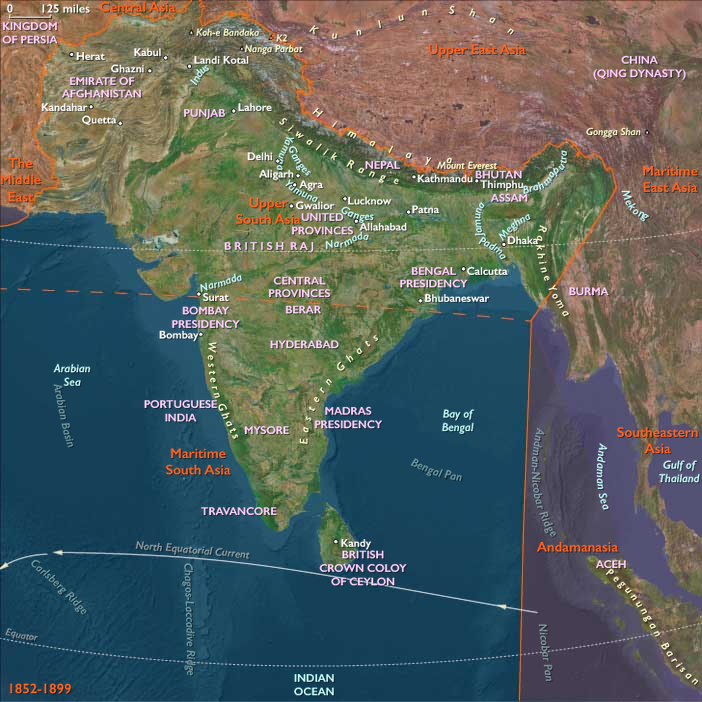
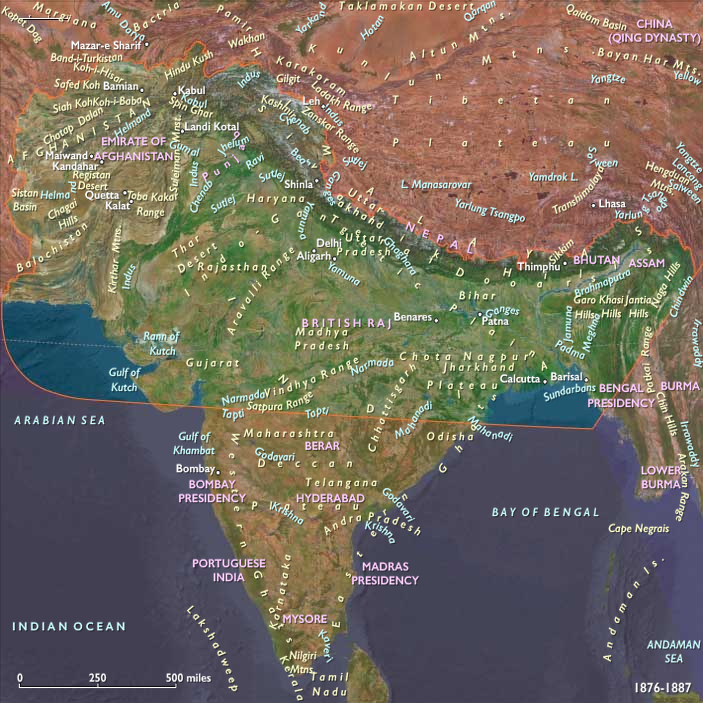
The period from 1876 to 1887 CE was defined largely by geopolitical rivalries between the British and Russian empires—the Great Game—with Afghanistan as the contested buffer state. Britain's aggressive forward policy led to the Second Anglo-Afghan War (1878–1880). Triggered by the Afghan Amir Sher Ali Khan’s rejection of a British diplomatic mission in 1878, the British responded by invading and occupying major cities such as Kabul and Kandahar.
The war concluded with the Treaty of Gandamak (1879), wherein Afghanistan ceded control of its foreign policy to Britain, allowing British supervision over its external relations. Afghanistan also ceded strategic territories, including the districts of Pishin, Sibi, Harnai, and Thai Chotiali, strengthening British control over critical frontier areas.
British Expansion in Balochistan and Gilgit
In parallel, British strategic ambitions solidified their hold over Balochistan. Following earlier diplomacy, Sir Robert Sandeman in 1876 brought regions like Kharan, Makran, and Las Bela under formal British protection. The British also secured critical mountain routes by permanently leasing the Bolan Pass in 1883 and annexing certain regions of Balochistan directly into British India by 1887.
Further north, the Gilgit Agency, initially established informally in 1876, was formally integrated as a permanent political entity by the end of this era, extending British surveillance into Hunza, Nagar, and the strategically significant region of Chitral. These moves were aimed at creating a robust defensive line against perceived Russian threats.
Administrative and Economic Transformations
Internally, British administrative structures became firmly established. The hierarchical colonial administration—led by British-appointed provincial governors—expanded significantly. Railways, irrigation projects, and urban administrative councils continued to evolve. The extensive railway network facilitated integration of local economies, particularly in Punjab and Sindh, fostering agricultural growth and increased trade within the subcontinent.
Bhutan’s Internal Consolidation and External Realignment
In the eastern Himalayas, internal power struggles within Bhutan intensified. After decades of instability, a prominent regional leader, Ugyen Wangchuck, the ponlop of Tongsa, emerged victorious from a civil conflict (1882–1885). With growing British pressure from the south and Tibet's diminished influence, Wangchuck’s rise heralded the beginning of Bhutan’s political stabilization and realignment toward British India.
Emergence of Early Indian Nationalism
The period witnessed the initial crystallization of Indian nationalism. A notable milestone occurred in 1885 with the founding of the Indian National Congress in Bombay. Initiated by intellectuals and professionals like Allan Octavian Hume, a retired British civil servant, and notable Indian leaders like Dadabhai Naoroji, the Congress began as a modest forum advocating for greater representation of educated Indians in colonial governance. While initially loyalist and moderate, it established the first organized all-India platform for nationalist aspirations.
Muslim Political Consciousness and the Aligarh Movement
Simultaneously, Muslim political consciousness advanced significantly under the leadership of Sir Syed Ahmad Khan. Emphasizing education and modernization within an Islamic context, Sir Syed sought to ensure that Muslims could adapt to new realities under British rule without losing their distinct religious identity. His Muhammadan Anglo-Oriental College (established in 1875 in Aligarh) matured during this period, becoming a prominent institution blending modern Western education with traditional Islamic values.
Socio-cultural and Literary Shifts
The socio-cultural landscape saw the emergence of literary and intellectual movements in regional languages—especially Urdu, Bengali, and Punjabi—reflecting growing political and social consciousness. Poets and writers explored themes of colonialism, nationalism, and cultural identity, gradually contributing to a more cohesive Indian national awareness.
Legacy of the Era
Between 1876 and 1887, Upper South Asia saw British dominance solidified along critical frontiers, notably through aggressive policies toward Afghanistan, Balochistan, and Gilgit. Politically, this era witnessed significant groundwork for the future of the nationalist movements—both Hindu and Muslim—that would dominate the subregion’s 20th-century history. These movements laid crucial ideological foundations for subsequent political developments, culminating eventually in independence and partition.
People
- Allan Octavian Hume
- Dadabhai Naoroji
- Robert Groves Sandeman
- Sher Ali Khan
- Syed Ahmad Khan
- Ugyen Wangchuck
Groups
- Indian people
- Bhutan, Kingdom of
- British Empire
- Russian Empire
- Nepal, Shah Kingdom of
- Britain (United Kingdom of Great Britain and Ireland)
- India, Late Modern
- Afghanistan, (Barakzai) Emirate of
- British Raj; India (Indian Empire)
- Indian National Congress
Topics
Subjects
Regions
Subregions
Years: 1876 - 1887
People
- Allan Octavian Hume
- Dadabhai Naoroji
- Robert Groves Sandeman
- Sher Ali Khan
- Syed Ahmad Khan
- Ugyen Wangchuck
Groups
- Indian people
- Bhutan, Kingdom of
- British Empire
- Russian Empire
- Nepal, Shah Kingdom of
- Britain (United Kingdom of Great Britain and Ireland)
- India, Late Modern
- Afghanistan, (Barakzai) Emirate of
- British Raj; India (Indian Empire)
- Indian National Congress
Topics
Subjects
Regions
Subregions