
Upper South Asia (1864–1875 CE): Colonial Consolidation, …
Years: 1864 - 1875
Upper South Asia (1864–1875 CE): Colonial Consolidation, Frontier Policies, and Early Nationalist Sentiments
Expansion of British Frontier Control
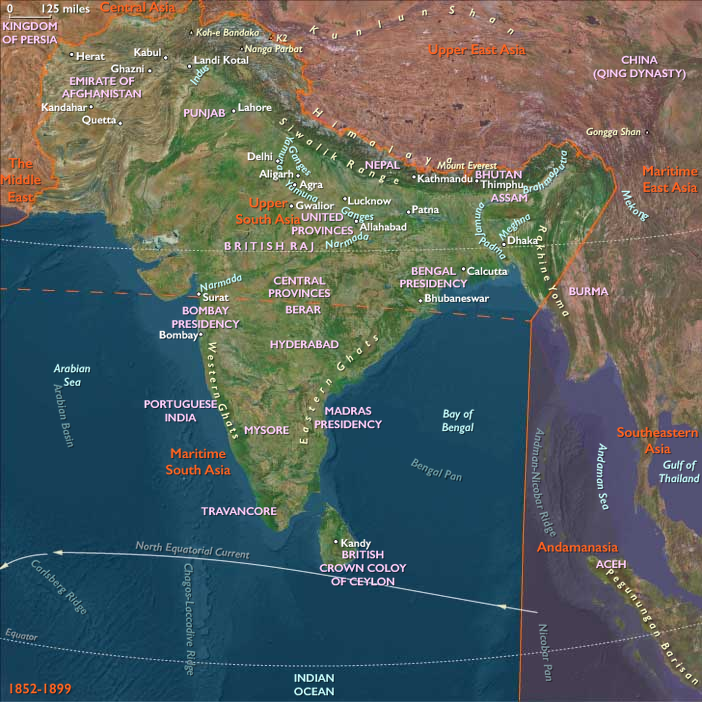
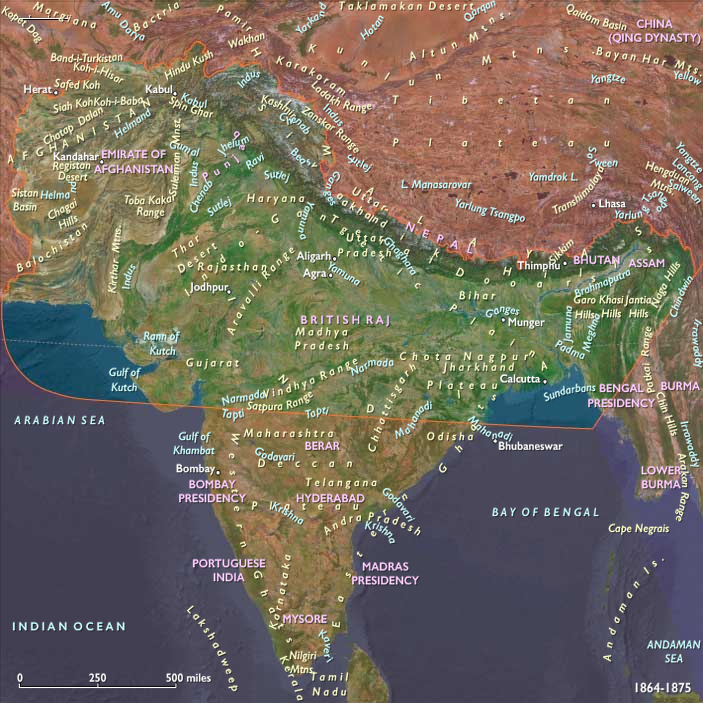
From 1864 to 1875, the British solidified their control over strategic frontier regions, extending the boundaries of British India deep into territories like Balochistan and the Northwest Frontier. The policy, driven largely by British anxieties over Russian influence in Central Asia, led to direct British control in key strategic locations. Notably, in 1874, Sir Robert Sandeman negotiated treaties with local leaders, including the Khan of Kalat, integrating significant portions of Balochistan under British suzerainty.
Reorganization of Administrative Structure
Administratively, the British established permanent district governance systems, particularly in the Punjab, Sindh, and the Northwest Frontier Province (NWFP). British India was divided into provinces led by appointed governors, further subdivided into districts, each overseen by British administrators—often members of the prestigious Indian Civil Service. This hierarchical structure strengthened British political and economic control, laying foundations for modern administrative divisions within today's India and Pakistan.
Economic Transformation: Railways and Irrigation
British economic initiatives, including railway expansions and irrigation projects, profoundly transformed the agricultural and economic landscape. Extensive irrigation projects in Punjab turned the region into a prosperous agricultural zone, significantly increasing food production, particularly of wheat, and facilitating the settlement of large agricultural colonies primarily populated by Sikhs and Muslims. These economic developments integrated regional economies more tightly into global markets dominated by Britain.
Afghanistan and the Great Game
During this period, Afghanistan became increasingly central to geopolitical tensions between Britain and Russia, a rivalry famously dubbed the "Great Game." British policymakers debated extensively between aggressive "forward policies" and cautious restraint. In the late 1860s and early 1870s, Britain maintained limited influence in Afghanistan through diplomacy rather than direct control, preparing the stage for subsequent conflicts.
Nepal under Rana Rule
In Nepal, Prime Minister Jung Bahadur Rana continued consolidating the hereditary Rana autocracy. Through skillful diplomacy and modernization, he sustained Nepal’s independence by maintaining strong alliances with Britain. Rana’s authority ensured internal stability but stifled political reform, creating conditions of socio-economic stagnation that persisted into the twentieth century.
Bhutan’s Political Realignment
In the eastern Himalayas, internal rivalry intensified within Bhutan. The British, seeking stability along their northeastern borders, engaged in diplomatic exchanges and occasionally direct intervention. A period of civil conflict (1864–1865) concluded with the Treaty of Sinchula (1865), under which Bhutan ceded territory—the Bengal and Assam Duars—to Britain in exchange for annual compensation, marking the start of closer ties between Bhutan and British India.
Emergence of Early Nationalist Thought
The late 1860s and early 1870s saw the initial stirring of nationalism within the educated elite in North India, notably in regions such as Bengal and the cities of Lahore and Calcutta. Influenced by Western education and the principles of liberty and representative governance, intellectual figures began questioning colonial authority, though such sentiments remained largely confined to literary and scholarly circles at this early stage.
Cultural and Social Transformations
Educational reforms and the spread of missionary schools increased the diffusion of Western knowledge. Literary and religious movements, including revivalist Islamic thought inspired by scholars such as Sir Syed Ahmad Khan, sought reconciliation between traditional religious views and Western science and education. In 1875, Sir Syed founded the Muhammadan Anglo-Oriental College in Aligarh, laying the foundations of a distinct Muslim political consciousness.
Legacy of the Era
The period from 1864 to 1875 was critical in shaping modern Upper South Asia. British colonial structures became firmly entrenched, frontier regions were incorporated into imperial administration, and early nationalist ideologies emerged among the educated classes. The transformations during this decade set the stage for later nationalist movements and significantly influenced the geopolitical and socio-cultural dynamics of the subregion in subsequent periods.
People
Groups
- Indian people
- Bhutan, Kingdom of
- British Empire
- Russian Empire
- Bengal Presidency
- Nepal, Shah Kingdom of
- India, Late Modern
- Afghanistan, (Barakzai) Emirate of
- Kalat, Khanate of
- British Raj; India (Indian Empire)
Subjects
Regions
Subregions
Related Events
Showing 10 events out of 14241 total
Years: 1864 - 1875
People
Groups
- Indian people
- Bhutan, Kingdom of
- British Empire
- Russian Empire
- Bengal Presidency
- Nepal, Shah Kingdom of
- India, Late Modern
- Afghanistan, (Barakzai) Emirate of
- Kalat, Khanate of
- British Raj; India (Indian Empire)
Subjects
Regions
Subregions