
Upper South Asia (1828–1839 CE): Prelude to …
Years: 1828 - 1839
Upper South Asia (1828–1839 CE): Prelude to Conflict and Regional Shifts
British Colonial Expansion
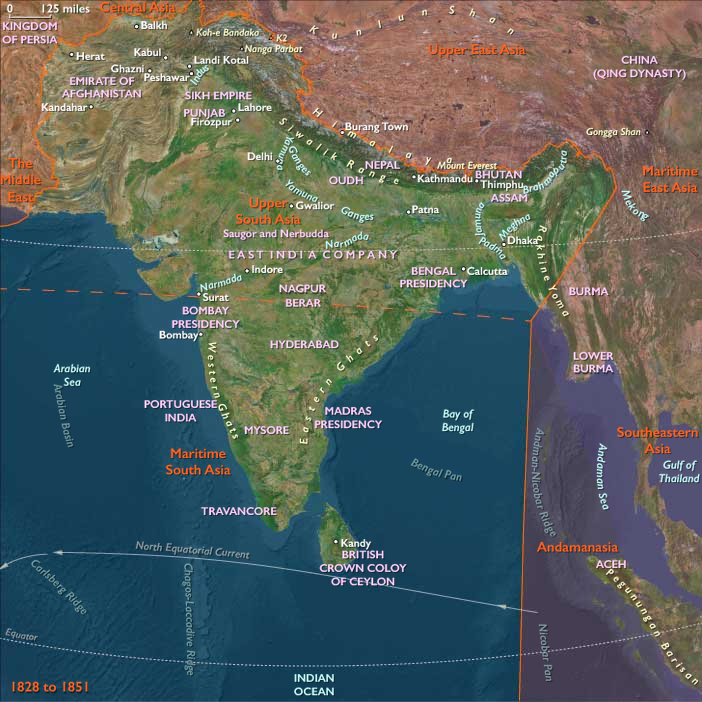
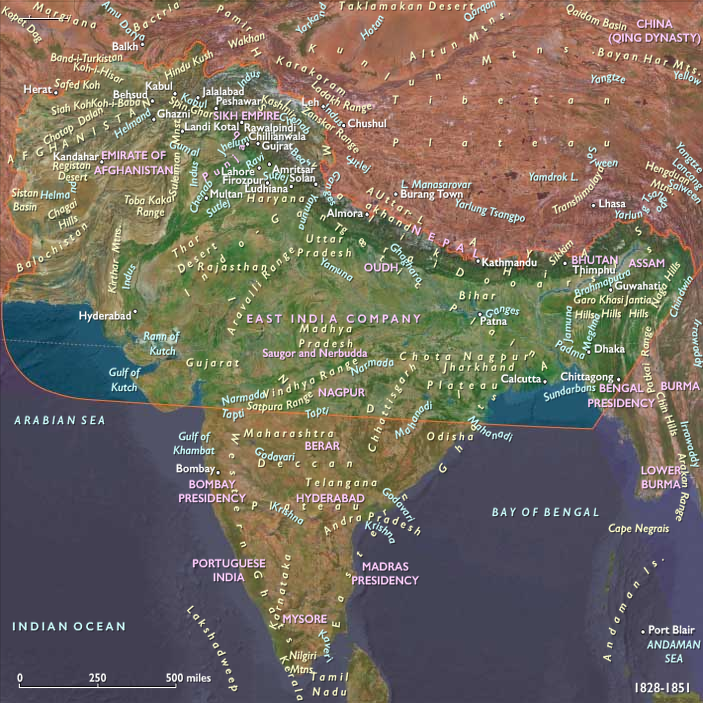
Between 1828 and 1839, Upper South Asia saw increased consolidation under the British East India Company, intensifying its influence through political alliances, military pressure, and territorial acquisitions. Administrative centralization was extended into regions of modern-day Pakistan, notably in Sindh and Punjab, where traditional power structures increasingly yielded to colonial domination.
Punjab and the Sikh Empire
The powerful Sikh Empire, under the rule of Maharaja Ranjit Singh (1799–1839), enjoyed its peak territorial expanse and internal stability during this era. Lahore emerged as a cultural and political center, with Sikh influence stretching from the Khyber Pass in the west to Kashmir in the north and towards regions of modern-day Himachal Pradesh and Jammu. However, Ranjit Singh’s death in 1839 marked a turning point, precipitating internal succession struggles that would soon attract British intervention.
Afghanistan and the "Great Game"
The geopolitical rivalry known as the Great Game, chiefly between the British and Russian empires, profoundly impacted Afghanistan during this period. Seeking to counter perceived Russian influence, Britain attempted diplomatic engagement, followed by military force. In 1838, the British launched the ill-fated First Anglo-Afghan War, intending to install Shah Shuja Durrani as a compliant ruler in place of Dost Mohammad Khan. The British captured Kabul and Kandahar in 1839, beginning a period of occupation marked by instability and fierce resistance from Afghan tribes.
Nepal and the Rana Ascendancy
In Nepal, the period saw the political intrigue that would eventually lead to the rise of the Rana dynasty in the 1840s. Though still nominally under the Shah dynasty, political power increasingly concentrated among a small elite, setting the stage for future dynastic rule. Internal rivalry and political maneuvering among aristocratic factions intensified during this era, contributing to long-term shifts in governance.
Cultural and Social Dynamics
The broader region saw significant cultural continuity, with regional literary traditions flourishing despite political turbulence. Languages such as Punjabi, Pashto, and Dari retained strong literary expressions, further solidifying regional identities amid ongoing political change.
Legacy of the Era
The period from 1828 to 1839 laid crucial groundwork for subsequent historical developments, notably the collapse of the Sikh Empire, the British expansion into Punjab, and the entrenchment of British influence in Afghanistan. These shifts marked the transition from indigenous rule toward increased foreign intervention and control, significantly reshaping the geopolitical and cultural landscape of Upper South Asia.
People
Groups
- Pashtun people (Pushtuns, Pakhtuns, or Pathans)
- Indian people
- Durrani (Pashtun tribal confederacy)
- Sikhs
- Mughal Empire (Agra)
- East India Company, British (The Company of Merchants of London Trading into the East Indies)
- Bhutan, Kingdom of
- Sikkim, Kingdom of
- Russian Empire
- Durrani Empire
- India, East India Company rule in
- Bengal Presidency
- Nepal, Shah Kingdom of
- Durrani Empire
- Sikh Empire
- Britain (United Kingdom of Great Britain and Ireland)
- Afghanistan (fragmented)
- India, Late Modern
- Afghanistan, (Barakzai) Emirate of
Topics
Subjects
Regions
Subregions
Years: 1828 - 1839
People
Groups
- Pashtun people (Pushtuns, Pakhtuns, or Pathans)
- Indian people
- Durrani (Pashtun tribal confederacy)
- Sikhs
- Mughal Empire (Agra)
- East India Company, British (The Company of Merchants of London Trading into the East Indies)
- Bhutan, Kingdom of
- Sikkim, Kingdom of
- Russian Empire
- Durrani Empire
- India, East India Company rule in
- Bengal Presidency
- Nepal, Shah Kingdom of
- Durrani Empire
- Sikh Empire
- Britain (United Kingdom of Great Britain and Ireland)
- Afghanistan (fragmented)
- India, Late Modern
- Afghanistan, (Barakzai) Emirate of
Topics
Subjects
Regions
Subregions