
South Asia (1828–1971 CE) Colonial Rule, …
Years: 1828 - 1971
South Asia (1828–1971 CE)
Colonial Rule, Partition, and the Making of Modern Nations
Geography & Environmental Context
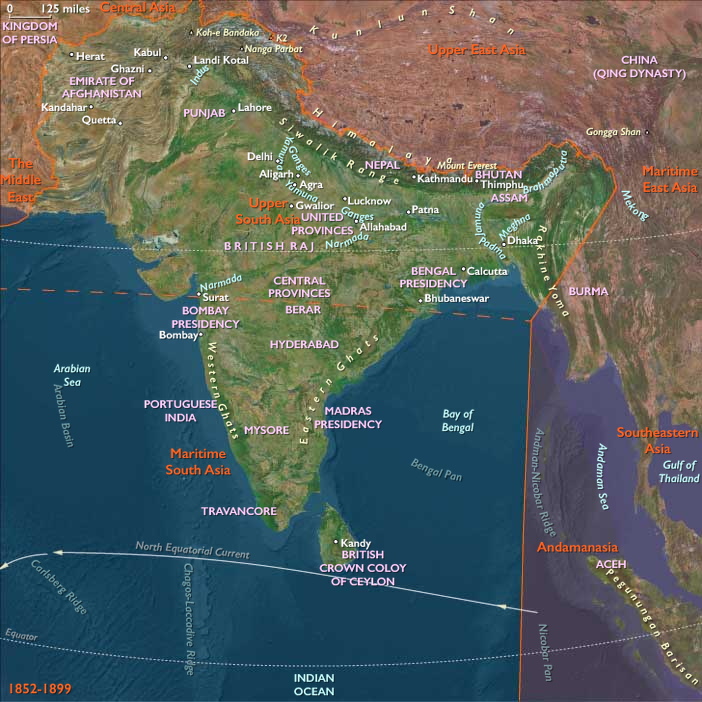
South Asia includes two fixed subregions:
-
Northern South Asia — comprising Afghanistan, Pakistan, Nepal, Bhutan, Bangladesh, and northern India.
-
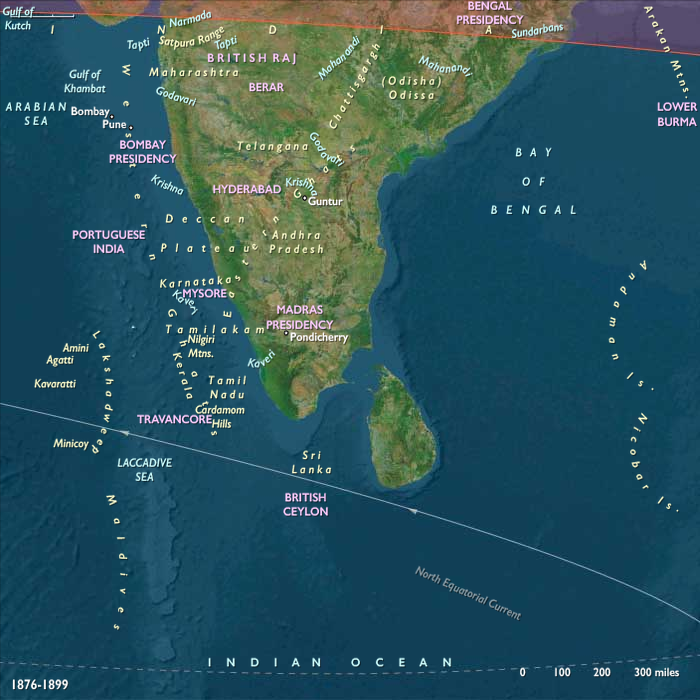
Southern South Asia — comprising southern India, Sri Lanka, and the Maldives.
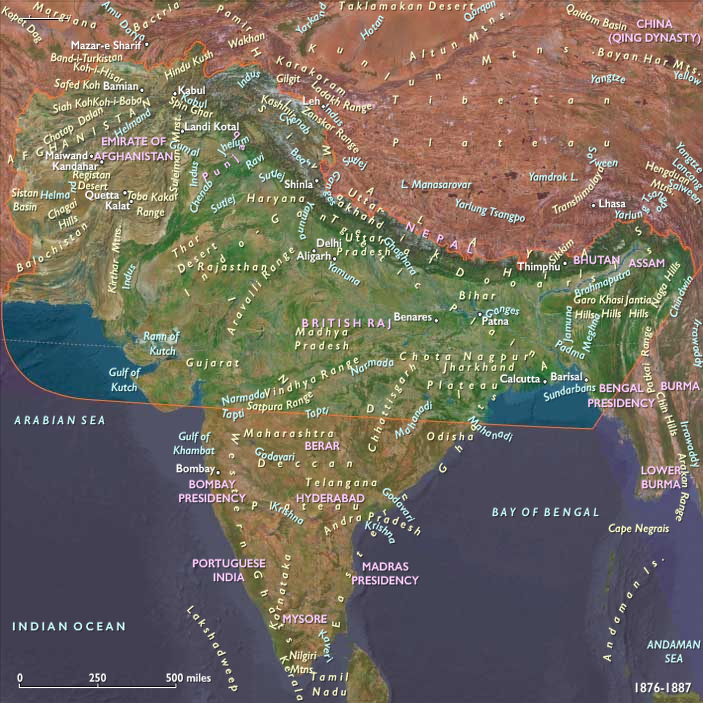
Together these lands form the Indian subcontinent, bounded by the Himalayas, Arabian Sea, Bay of Bengal and the equatorial seas of the Indian Ocean. Anchors include the Indus and Ganges river systems, the Deccan Plateau, the Eastern and Western Ghats, and the island worlds of Sri Lanka and the Maldives.
Climate & Environmental Shifts
The monsoon system continued to govern agriculture, alternating between abundance and drought. The 19th century saw cycles of catastrophic famine (notably in Bengal and Deccan) under colonial revenue systems that prioritized exports. Deforestation and canal irrigation transformed landscapes; massive works like the Ganges Canal (1854) reshaped northern plains. In the 20th century, damming, green-revolution agriculture, and deforestation further altered ecological balance. Cyclones and floods remained recurrent threats along the Bay of Bengal.
Subsistence & Settlement
-
Colonial agriculture reoriented production toward cash crops — cotton, indigo, tea, and jute — for export, while subsistence farmers faced land pressure and debt.
-
Industrial centers arose in Calcutta (Kolkata), Bombay (Mumbai), and Madras (Chennai) under British rule; railways connected ports and interiors.
-
Plantations spread in Sri Lanka (tea, coffee, rubber) and the Maldives (coconut, fish).
-
Urban growth accelerated in the 20th century, with Delhi, Karachi, and Dhaka emerging as political and industrial capitals.
-
Indigenous lifeways persisted in highlands and deserts — pastoral nomadism in Afghanistan and Baluchistan, shifting cultivation in the Northeast Frontier, and temple-centered agriculture in peninsular India and Sri Lanka.
Technology & Material Culture
The British Raj introduced railways, telegraphs, postal networks, and canal irrigation, binding South Asia into an imperial economy. Steamships and later motor transport expanded coastal trade. Architecture blended Victorian Gothic with Mughal and Dravidian revival styles. Textile mills in Bombay and jute mills in Bengal industrialized artisanal crafts. In the 20th century, hydroelectric projects, universities, and film industries (especially in Bombay and Madras) symbolized modernization.
Movement & Interaction Corridors
-
Maritime routes linked Calcutta, Bombay, Colombo, and Karachi to global trade networks.
-
Railways and river systems carried grain, coal, and people across the subcontinent.
-
Labor migrations carried Indian and Sri Lankan workers to Southeast Asia, Africa, and the Caribbean as indentured laborers.
-
Pilgrimage routes to Varanasi, Bodh Gaya, and Kataragama endured, joined by new political and labor networks in the 20th century.
Cultural & Symbolic Expressions
-
Religious reform reshaped identity: Brahmo Samaj, Arya Samaj, Aligarh Movement, and Theosophy blended tradition and modernity.
-
Literary renaissances flourished — Rabindranath Tagore in Bengal, Bankim Chandra Chatterjee, and later Premchand, Iqbal, and Faiz voiced nationalist and humanist visions.
-
Nationalism and art fused in the work of Abanindranath Tagore, Nandalal Bose, and the Indian People’s Theatre Association.
-
Cinema emerged as a modern art form, culminating in postwar classics by Satyajit Ray and Raj Kapoor.
-
Music and dance revival movements (Bharatanatyam, Kathak, Hindustani and Carnatic classical) symbolized continuity and reform.
Environmental Adaptation & Resilience
Village and tribal economies adapted through diversified crops, communal water management, and temple or mosque-based charity. Famines prompted new irrigation and rail systems but also resistance to exploitative taxation. In the 20th century, Green Revolution technologies improved yields but widened regional inequalities. Himalayan and desert ecologies remained fragile under new infrastructure and deforestation.
Political & Military Shocks
-
Colonial consolidation: The East India Company extended control through warfare and treaties until the Rebellion of 1857, after which Britain imposed direct Crown rule.
-
Modernization and dissent: Education, print, and reform spurred nationalism; the Indian National Congress (1885) and Muslim League (1906) emerged as political vehicles.
-
Independence and Partition (1947): British withdrawal created India and Pakistan amid mass migration and communal violence.
-
Regional upheavals: Sri Lanka achieved independence (1948); Nepal ended monarchy autocracy (1950); Bhutan retained isolation until modernization under the Wangchuck dynasty; Maldives became independent (1965).
-
Wars and conflicts: Indo-Pakistani wars (1947–48, 1965, 1971), border war with China (1962), and the struggle of Bangladesh (culminating in independence, 1971) defined postcolonial geopolitics.
-
Cold War alignments: India pursued non-alignment under Jawaharlal Nehru, while Pakistan allied with Western blocs; Afghanistan and Nepal balanced Soviet, Chinese, and Indian influence.
Transition
From 1828 to 1971, South Asia journeyed from colonial subjugation to postcolonial nationhood. Railways, plantations, and English education under British rule created both dependency and modern tools for independence. Partition redrew maps and unleashed trauma, while new nations sought industrial growth and democratic governance amid persistent poverty. India and Pakistan emerged as rival powers; Sri Lanka, Nepal, and Bhutan charted divergent paths; the Maldives embraced autonomy. Despite war and inequality, ancient civilizations redefined themselves as modern states — heirs to both empire and enduring cultural continuity.
People
- Abanindranath Tagore
- Bankim Chandra Chatterjee
- Faiz Ahmad Faiz
- Jawaharlal Nehru
- Muhammad Iqbal
- Nandalal Bose
- Premchand
- Rabindranath Tagore
- Raj Kapoor
- Satyajit Ray
Groups
- Tajik people
- Kirat people
- Sindhi people
- Hinduism
- Bengalis
- Tamil people
- Pashtun people (Pushtuns, Pakhtuns, or Pathans)
- Jainism
- Buddhism
- Buddhism, Tibetan
- Khas peoples
- Indian people
- Maldives (Maldive Islands)
- Buddhism, Mahayana
- Dutch people
- Baloch people
- Jat people
- Durrani (Pashtun tribal confederacy)
- Rajputs
- Islam
- Muslims, Sunni
- Muslims, Shi'a
- Portuguese people
- Ghilzai (Pashtun tribal confederacy)
- French people (Latins)
- Maratha
- Hazara people
- Kaffirs, Sri Lankan
- Sikhs
- India, Portuguese State of
- Gurkha
- East India Company, British (The Company of Merchants of London Trading into the East Indies)
- Bhutan, Kingdom of
- Tranquebar, Danish colony in India
- Sikkim, Kingdom of
- Mughal Empire (Delhi)
- India, Danish
- Sindh, Kingdom of
- India, British
- England, (Stuart) Kingdom of
- Britain, Kingdom of Great
- British people
- Jaipur, Indian princely state of
- Bengal, Nawabs of
- Durrani Empire
- India, East India Company rule in
- India, French
- Bengal Presidency
- Nepal, Shah Kingdom of
- Durrani Empire
- Sikh Empire
- Britain (United Kingdom of Great Britain and Ireland)
- Punjab, Sikh Kingdom of the
- Ceylon, British Crown Colony of
- Afghanistan (fragmented)
- India, Late Modern
- Afghanistan, (Barakzai) Emirate of
- British Raj; India (Indian Empire)
- Indian National Congress
- All-India Muslim League
- British Raj; India (Indian Empire)
- Union of Soviet Socialist Republics (USSR), or Soviet Union
- Afghanistan, Kingdom of
- Britain (United Kingdom of Great Britain and Northern Ireland)
- Jammu and Kashmir, state of
- India, Republic of
- Pakistan, Islamic Republic of
- Ceylon, Republic of
- China, People's Republic of
- Bangladesh
Topics
- India, Modern
- Nader Shah's invasion of India
- Plassey, Battle of
- Panipat, Third Battle of
- Buxar, Battle of
- Anglo-Nepalese War
- Brahmo Samaj
- Renaissance, Bengal
- Afghan-Sikh War
- Anglo-Sikh War, First
- Anglo-Sikh War, Second
- Afghan Civil War
- Indian Rebellion of 1857 (Great Indian Mutiny or Sepoy Rebellion)
- Afghan Civil War
- Theosophy
- Arya Samaj
- Aligarh Movement
- ENSO Famine in India, China, Brazil, Northern Africa (and other countries)
- India: ENSO Famine of 1896-1902
- Afghan Civil War of 1928-29
- World War, Second (World War II)
- Bengal: Famine of 1943
- Green Revolution
- Partition of India
- Indo-Pakistani War of 1947-48
- Indian Annexation of Junagadh
- Cold War
- Indian Civil War of 1947-48
- Indo-Chinese Skirmishing
- Indo-Pakistani War of 1965
- India: Famine of 1965-66
- Indo-Pakistani War of 1971
Commodoties
Subjects
- Commerce
- Writing
- Architecture
- Performing Arts
- Labor and Service
- Conflict
- Mayhem
- Faith
- Government
- Custom and Law
- Dance
- Human Migration
- political movement
Regions
Subregions
Related Events
Showing 10 events out of 19829 total
Years: 1828 - 1971
People
- Abanindranath Tagore
- Bankim Chandra Chatterjee
- Faiz Ahmad Faiz
- Jawaharlal Nehru
- Muhammad Iqbal
- Nandalal Bose
- Premchand
- Rabindranath Tagore
- Raj Kapoor
- Satyajit Ray
Groups
- Tajik people
- Kirat people
- Sindhi people
- Hinduism
- Bengalis
- Tamil people
- Pashtun people (Pushtuns, Pakhtuns, or Pathans)
- Jainism
- Buddhism
- Buddhism, Tibetan
- Khas peoples
- Indian people
- Maldives (Maldive Islands)
- Buddhism, Mahayana
- Dutch people
- Baloch people
- Jat people
- Durrani (Pashtun tribal confederacy)
- Rajputs
- Islam
- Muslims, Sunni
- Muslims, Shi'a
- Portuguese people
- Ghilzai (Pashtun tribal confederacy)
- French people (Latins)
- Maratha
- Hazara people
- Kaffirs, Sri Lankan
- Sikhs
- India, Portuguese State of
- Gurkha
- East India Company, British (The Company of Merchants of London Trading into the East Indies)
- Bhutan, Kingdom of
- Tranquebar, Danish colony in India
- Sikkim, Kingdom of
- Mughal Empire (Delhi)
- India, Danish
- Sindh, Kingdom of
- India, British
- England, (Stuart) Kingdom of
- Britain, Kingdom of Great
- British people
- Jaipur, Indian princely state of
- Bengal, Nawabs of
- Durrani Empire
- India, East India Company rule in
- India, French
- Bengal Presidency
- Nepal, Shah Kingdom of
- Durrani Empire
- Sikh Empire
- Britain (United Kingdom of Great Britain and Ireland)
- Punjab, Sikh Kingdom of the
- Ceylon, British Crown Colony of
- Afghanistan (fragmented)
- India, Late Modern
- Afghanistan, (Barakzai) Emirate of
- British Raj; India (Indian Empire)
- Indian National Congress
- All-India Muslim League
- British Raj; India (Indian Empire)
- Union of Soviet Socialist Republics (USSR), or Soviet Union
- Afghanistan, Kingdom of
- Britain (United Kingdom of Great Britain and Northern Ireland)
- Jammu and Kashmir, state of
- India, Republic of
- Pakistan, Islamic Republic of
- Ceylon, Republic of
- China, People's Republic of
- Bangladesh
Topics
- India, Modern
- Nader Shah's invasion of India
- Plassey, Battle of
- Panipat, Third Battle of
- Buxar, Battle of
- Anglo-Nepalese War
- Brahmo Samaj
- Renaissance, Bengal
- Afghan-Sikh War
- Anglo-Sikh War, First
- Anglo-Sikh War, Second
- Afghan Civil War
- Indian Rebellion of 1857 (Great Indian Mutiny or Sepoy Rebellion)
- Afghan Civil War
- Theosophy
- Arya Samaj
- Aligarh Movement
- ENSO Famine in India, China, Brazil, Northern Africa (and other countries)
- India: ENSO Famine of 1896-1902
- Afghan Civil War of 1928-29
- World War, Second (World War II)
- Bengal: Famine of 1943
- Green Revolution
- Partition of India
- Indo-Pakistani War of 1947-48
- Indian Annexation of Junagadh
- Cold War
- Indian Civil War of 1947-48
- Indo-Chinese Skirmishing
- Indo-Pakistani War of 1965
- India: Famine of 1965-66
- Indo-Pakistani War of 1971
Commodoties
Subjects
- Commerce
- Writing
- Architecture
- Performing Arts
- Labor and Service
- Conflict
- Mayhem
- Faith
- Government
- Custom and Law
- Dance
- Human Migration
- political movement
Regions
Subregions