
South Asia (1684 – 1827 CE) …
Years: 1684 - 1827
South Asia (1684 – 1827 CE)
Imperial Fragmentation, Maritime Rivalry, and the Foundations of Colonial Rule
Geography & Environmental Context
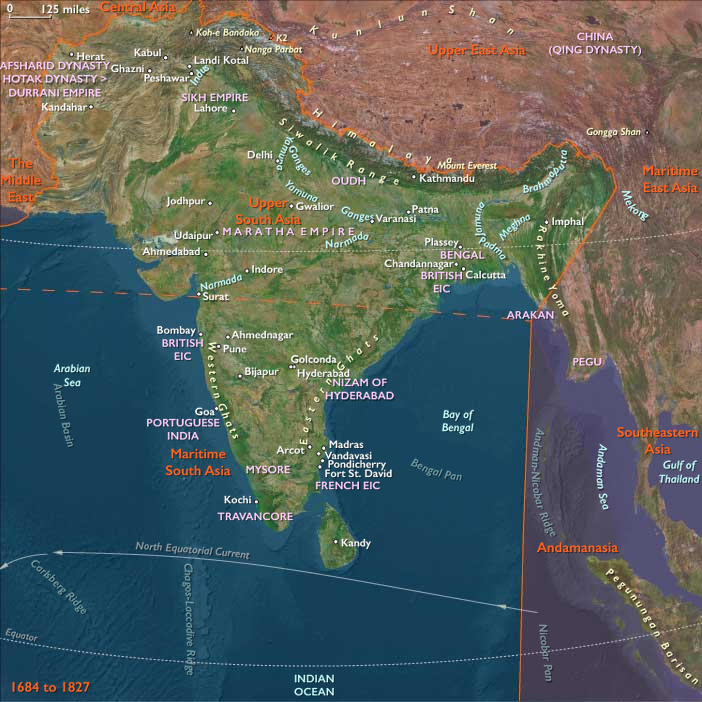
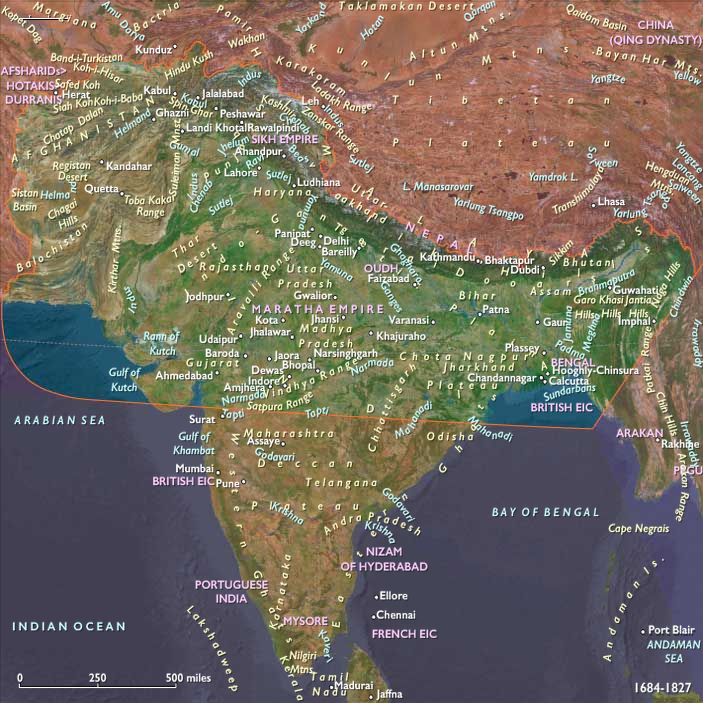
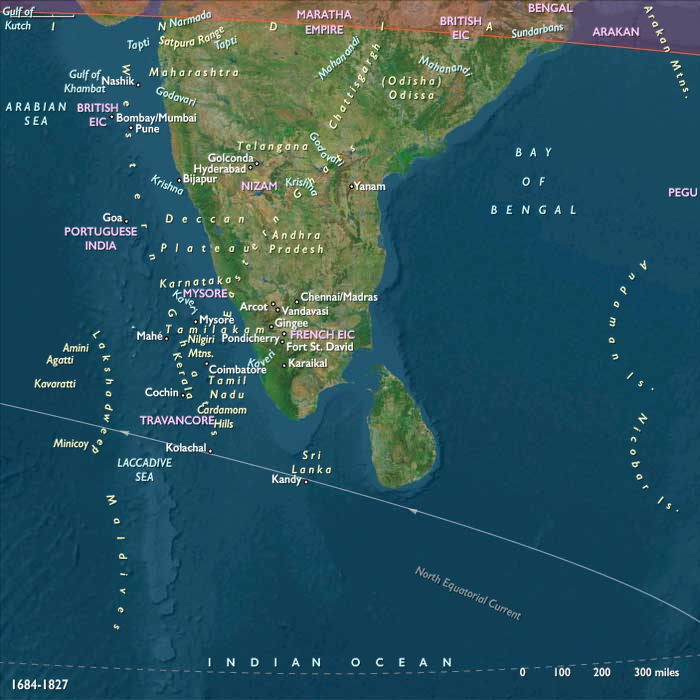
South Asia stretched from the Hindu Kush and Pamirs to the Deccan Plateau, and from the Arabian Sea to the Bay of Bengal. It encompassed the Indus and Ganges river basins, the Himalayan highlands of Nepal and Bhutan, the rice deltas of Bengal and Arakan, the Deccan uplands, and the islands of Sri Lanka, the Maldives, and Chagos. The subcontinent’s position—linking Central Asia, the Indian Ocean, and Southeast Asia—made it both the heart of Asian trade and the prize of rival empires.
Climate & Environmental Shifts
The waning Little Ice Age introduced alternating droughts and floods across the monsoon belt. Bengal endured recurrent famine, culminating in the catastrophic 1770 famine. Himalayan glacial advance modulated river flow; Afghan winters intensified; coastal cyclones and tidal surges devastated the Bengal–Arakan littoral. Yet elaborate canal, tank, and embankment systems buffered many agrarian zones, while island ecologies in the Maldives and Lakshadweep adapted to storm and salt through diversified fishing and coconut economies.
Subsistence & Settlement
Agrarian regimes sustained the densest populations on earth:
-
Indus–Gangetic plains: Wheat, rice, sugarcane, and pulses underpinned Mughal-era prosperity. Irrigation networks, though decaying, still supported Punjab’s fertile canal colonies.
-
Deccan and southern India: Millet, cotton, and pepper dominated; Coromandel weavers supplied global markets.
-
Bengal delta: Rice abundance alternated with disaster under East India Company revenue extraction and coerced indigo and opium cultivation.
-
Afghan highlands: Wheat, fruit orchards, and transhumant herding structured mountain economies.
-
Himalayan kingdoms: Nepal and Bhutan maintained terrace rice and barley cultivation, salt–grain exchange, and yak pastoralism.
-
Sri Lanka and the atolls: Cinnamon, pepper, coconuts, and fisheries supported dense littoral societies, while interior Kandy preserved upland rice autonomy.
Technology & Material Culture
-
Agrarian infrastructure: Persian wheels, tanks, and Mughal canals persisted; Deccan irrigation tanks and Malabar spice terraces displayed local ingenuity.
-
Manufacture: Bengal’s muslins, silk, and indigo; Coromandel chintz and calico; Malabar pepper and Ceylon cinnamon—each integrated local craft into global commerce.
-
Maritime architecture: Dutch and British forts lined Cochin, Galle, and Madras; dhows, baghalas, and European East Indiamen crowded Indian Ocean lanes.
-
Artistic expression: Mughal miniature and marble architecture endured in Lahore and Delhi; temple sculpture, bhakti music, and Sufi calligraphy proliferated; Newar bronzes, Bhutanese dzongs, and Kandy’s temple murals symbolized sacred power.
Movement & Interaction Corridors
-
Overland gates: The Khyber and Bolan passes funneled invasions and caravans between Kabul and Delhi.
-
Riverine and coastal arteries: The Ganges–Brahmaputra delta became a lattice of Company barges and local craft exporting grain, jute, and indigo.
-
Maritime routes: VOC ships monopolized Malabar pepper and Ceylon cinnamon; the EIC expanded from Madras, Bombay, and Calcutta, tying India to Southeast Asia and the Atlantic.
-
Himalayan trade: Nepal and Bhutan moved salt, copper, and wool to Bengal and Tibet.
-
Island networks: The Maldives exported cowries and tuna; Chagos and Diego Garcia linked the Mascarenes and India through plantation provisioning.
Cultural & Symbolic Expressions
South Asia’s pluralism deepened amid political fragmentation:
-
Islamic & Persianate culture: The waning Mughal court still radiated refinement in poetry, miniature painting, and mosque architecture; Sufi shrines knit communities through pilgrimage and music.
-
Bhakti & Sikh movements: Vernacular devotion flourished; Guru Gobind Singh’s Khalsa (1699) forged Sikh martial identity, later embodied in Ranjit Singh’s kingdom at Lahore.
-
Hindu & Buddhist renewals: Temple festivals in the south, Vaishnava bhakti in Bengal, and Buddhist monastic reform in Sri Lanka reaffirmed local sovereignty.
-
Himalayan states: Nepalese and Bhutanese monarchs consolidated power through Buddhist rituals and architecture.
-
Island Islam: The Maldives and Lakshadweep nurtured coral-stone mosques and dynastic chronicles; enslaved Africans and South Indians in Chagos created creole religious and musical traditions.
Environmental Adaptation & Resilience
-
Irrigation and water management moderated drought in Punjab and the Deccan.
-
Crop diversification: American introductions—maize, tobacco, potatoes—joined traditional grains.
-
Island sustainability: Maldivians rotated fishing grounds, protected coconut groves, and stored dried tuna for famine insurance.
-
Famine coping: Temple and mosque endowments, grain stores, and pilgrim networks offered relief, though colonial requisition eroded many safeguards.
Political & Military Shocks
-
Mughal decline: After Aurangzeb’s death (1707), provincial nawabs of Bengal, Awadh, and Hyderabad asserted autonomy.
-
Afghan & Maratha wars: Nadir Shah’s sack of Delhi (1739) and Ahmad Shah Durrani’s raids (1748–1767)devastated the north; the Third Battle of Panipat (1761) broke Maratha expansion and left Punjab contested.
-
Sikh consolidation: By 1799, Ranjit Singh unified Punjab, creating a modernized Sikh kingdom.
-
European ascendancy:
-
British East India Company victories at Plassey (1757) and Buxar (1764) secured Bengal; Delhi fell under Company protection (1803).
-
The Anglo-Mysore and Maratha wars dismantled southern powers.
-
Ceylon (1815) passed from the Dutch to Britain after the fall of Kandy.
-
First Anglo-Nepalese War (1814–1816) and Treaty of Sugauli reduced Nepal’s territory; Bhutan lost its Duars.
-
First Anglo-Burmese War (1824–1826) brought Arakan and Assam under British rule.
-
-
Dutch decline: The VOC collapsed (1799); its possessions, including the Malabar and Ceylon trade posts, shifted to British hands.
Transition
Between 1684 and 1827 CE, South Asia shifted from a constellation of Mughal-successor and regional states to the nucleus of British imperial power. The Mughal world fractured into Afghan, Sikh, Maratha, and nawabi domains even as the East India Company built an oceanic empire linking Bengal to Bombay, and Ceylon to Singapore.
From Kabul’s mountain passes to the coral atolls of the Maldives, local societies adapted through irrigation, trade, and faith, yet the new imperial infrastructure of forts, ports, and plantations began to bind them into a single economic orbit. By 1827, the subcontinent stood transformed: its sovereignty divided, its resources globalized, and its cultural vitality undiminished amid the first full wave of the modern colonial age.
People
- Ahmad Shah Durrani
- Aurangzeb
- Banda Singh Bahadur
- Ghalib
- Guru Gobind Singh
- Ranjit Singh
- Prithvi Narayan Shah
Groups
- Tajik people
- Kirat people
- Iranian peoples
- Hinduism
- Bengalis
- Pashtun people (Pushtuns, Pakhtuns, or Pathans)
- Jainism
- Buddhism
- Buddhism, Tibetan
- Khas peoples
- Indian people
- India, Classical
- Buddhism, Mahayana
- Dutch people
- Jat people
- Durrani (Pashtun tribal confederacy)
- Rajputs
- Islam
- Muslims, Sunni
- Muslims, Shi'a
- Portuguese people
- Ghilzai (Pashtun tribal confederacy)
- French people (Latins)
- Maratha
- Mongols
- Hazara people
- Sikhs
- Gurkha
- East India Company, British (The Company of Merchants of London Trading into the East Indies)
- India, English
- Bhutan, Kingdom of
- Sikkim, Kingdom of
- Mughal Empire (Delhi)
- England, (Stewart, Restored) Kingdom of
- Maratha Empire
- India, English
- England, (Orange and Stewart) Kingdom of
- India, British
- England, (Stuart) Kingdom of
- Britain, Kingdom of Great
- British people
- Bengal, Nawabs of
- Durrani Empire
- Bengal Presidency
- Nepal, Shah Kingdom of
- Durrani Empire
- Sikh Empire
- Britain (United Kingdom of Great Britain and Ireland)
- Punjab, Sikh Kingdom of the
Topics
- India, Modern
- Nader Shah's invasion of India
- Plassey, Battle of
- Panipat, Third Battle of
- Buxar, Battle of
- Anglo-Nepalese War
Commodoties
Subjects
- Commerce
- Writing
- Architecture
- Sculpture
- Conflict
- Faith
- Government
- Custom and Law
- Medicine
- Mathematics
- Astronomy
- Philosophy and logic
Regions
Subregions
Related Events
Showing 2 events out of 2 total
Years: 1684 - 1827
People
- Ahmad Shah Durrani
- Aurangzeb
- Banda Singh Bahadur
- Ghalib
- Guru Gobind Singh
- Ranjit Singh
- Prithvi Narayan Shah
Groups
- Tajik people
- Kirat people
- Iranian peoples
- Hinduism
- Bengalis
- Pashtun people (Pushtuns, Pakhtuns, or Pathans)
- Jainism
- Buddhism
- Buddhism, Tibetan
- Khas peoples
- Indian people
- India, Classical
- Buddhism, Mahayana
- Dutch people
- Jat people
- Durrani (Pashtun tribal confederacy)
- Rajputs
- Islam
- Muslims, Sunni
- Muslims, Shi'a
- Portuguese people
- Ghilzai (Pashtun tribal confederacy)
- French people (Latins)
- Maratha
- Mongols
- Hazara people
- Sikhs
- Gurkha
- East India Company, British (The Company of Merchants of London Trading into the East Indies)
- India, English
- Bhutan, Kingdom of
- Sikkim, Kingdom of
- Mughal Empire (Delhi)
- England, (Stewart, Restored) Kingdom of
- Maratha Empire
- India, English
- England, (Orange and Stewart) Kingdom of
- India, British
- England, (Stuart) Kingdom of
- Britain, Kingdom of Great
- British people
- Bengal, Nawabs of
- Durrani Empire
- Bengal Presidency
- Nepal, Shah Kingdom of
- Durrani Empire
- Sikh Empire
- Britain (United Kingdom of Great Britain and Ireland)
- Punjab, Sikh Kingdom of the
Topics
- India, Modern
- Nader Shah's invasion of India
- Plassey, Battle of
- Panipat, Third Battle of
- Buxar, Battle of
- Anglo-Nepalese War
Commodoties
Subjects
- Commerce
- Writing
- Architecture
- Sculpture
- Conflict
- Faith
- Government
- Custom and Law
- Medicine
- Mathematics
- Astronomy
- Philosophy and logic
Regions
Subregions